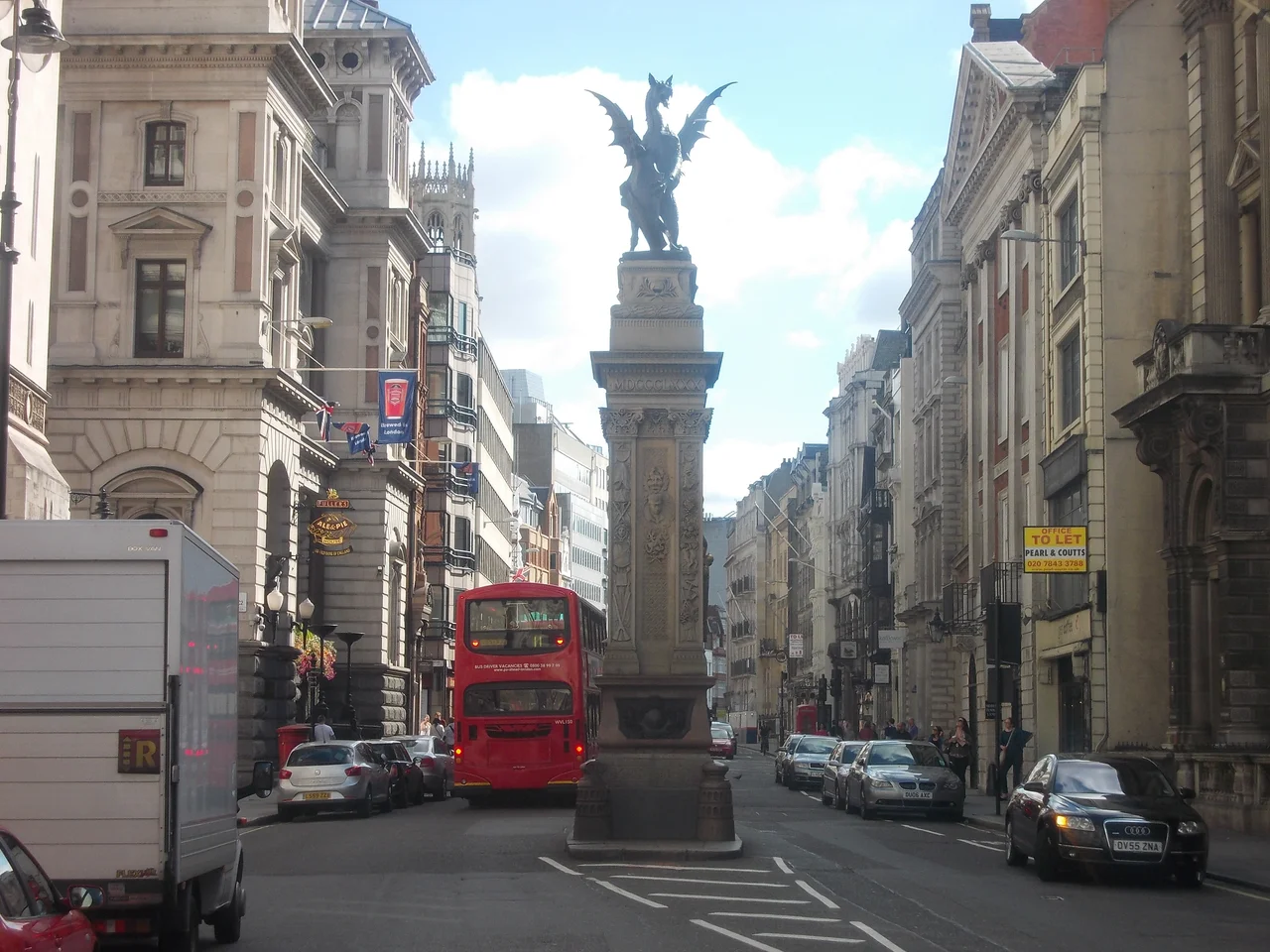

Temple Bar
There used to be a place in London where a monarch had to stop and ask permission to enter. Halfway along Fleet Street, where the City of London met the City of Westminster, a Portland-stone gateway built by Sir Christopher Wren spanned the road. The arched structure had statues of four Stuart monarchs on top and a long history of severed heads on pikes above. When the king or queen approached from Westminster, the procession halted at the gate. The Lord Mayor of London came out to meet them, carrying the City's pearl-encrusted Sword of State, and offered it as a token of loyalty. Only then could the sovereign pass through. The ceremony went out of regular use after the gate was dismantled in 1878, but the gate itself survived. It was carted off in 400 pieces, stored in a Hertfordshire forest for the next 125 years, and finally brought back to London in 2004 to stand by St Paul's Cathedral - the only Wren gateway to the City of London still in existence.
The Bar at the Temple
The first Temple Bar was a chain. By 1293 the City of London Corporation had stretched its jurisdiction beyond the ancient defensive walls, and at the most important crossing - where Fleet Street to the east of the bar met The Strand to the west, near the precinct of the Knights Templar - a barrier needed to be set up to regulate trade. The first one was probably just posts and a rope. By 1351 it had become a timber arch with a small prison cell over the top. The name came from the Temple Church just to the south, the Knights Templar's English headquarters. As the most important entrance from the political capital at Westminster to the commercial capital in the City, the bar became a place of ceremony. In 1422 the funeral cortege of Henry V passed beneath it on its way to Westminster Abbey, with torch-bearers in every doorway from Southwark north. In 1503 Elizabeth of York's hearse halted at the bar for the Abbots of Westminster and Bermondsey to bless the corpse. On 31 May 1534, the day before her coronation, Anne Boleyn passed through; the bar had been freshly painted, choristers sang nearby, and the Fleet Street conduit ran with claret wine.
Wren's Stone Replacement
The medieval timber gate escaped destruction in the Great Fire of London in 1666 - the fire stopped just short, after sweeping across nearly all of the City. But as part of the great rebuilding programme, the City Corporation decided the old gate had to go. Charles II commissioned Sir Christopher Wren to design something fit for the entrance to the rebuilt capital. The new Portland-stone arch, built between 1669 and 1672, was a rusticated English Baroque structure with one wide central arch for carriages and two narrower side arches for pedestrians. Above the arches, on niches in the upper storey, John Bushnell carved four life-sized statues celebrating the 1660 restoration of the Stuart dynasty: Charles II and his executed father Charles I on the west face, looking toward Westminster; James I and his queen Anne of Denmark on the east face, looking into the City. The upper room above the arches was rented to the neighbouring banking house of Child and Co., which used it to store its archives. Charles Dickens later renamed Child and Co. as Tellson's Bank in A Tale of Two Cities. He also wrote, with horror, of the severed heads of executed traitors that were impaled on pikes above the gate during the 18th century - heads exposed on Temple Bar with an insensate brutality and ferocity, in his words.
Exile to a Hertfordshire Wood
By the 1870s the gate had become a serious obstruction to London traffic. The other seven main gates of the City - Ludgate, Newgate, Aldersgate, Cripplegate, Moorgate, Bishopsgate and Aldgate - had all been demolished in the 1760s. Temple Bar held out the longest, but in 1878 the City Corporation finally dismantled it, carefully numbering every stone. The brewer Sir Henry Meux purchased the pieces and re-erected the gate in 1888 at his country estate of Theobalds Park in Hertfordshire, where it stood for the next 115 years in a woodland clearing, gradually crumbling, sometimes vandalised, mostly forgotten. The Temple Bar Trust acquired it from the Meux Estate in 1984 for the symbolic price of one pound. In 2001 the City of London resolved to bring it home. The gate was dismantled stone by stone over the course of October 2003 - the first stone removed on 13 October - and its 2,500 numbered pieces shipped on 500 pallets to London. There it was painstakingly reassembled at the entrance to the redeveloped Paternoster Square, immediately north of St Paul's Cathedral. It reopened to the public on 10 November 2004. The total cost was over 3 million pounds.
The Dragon That Marks the Spot
The original location on Fleet Street did not stay empty. In 1880 the City Corporation commissioned its surveyor Horace Jones to design a memorial to mark where the bar had stood. The result is a neo-Renaissance pedestal in the middle of the road, crowned by a bronze dragon by Charles Bell Birch - a small, fierce creature clutching the shield of the City of London. Most passers-by call it a griffin; it is, properly, a dragon, the heraldic supporter of the City's arms. The pedestal carries bronze statues of Queen Victoria and the future Edward VII, both by Joseph Boehm. They are the last royals to have passed through Wren's gate. Reliefs around the base depict the ceremony of the monarch halting to receive the Sword of State. In Virginia Woolf's novel The Years, a character looks up at the dragon and finds it ridiculous, something between a serpent and a fowl. In Charlie Fletcher's children's book Stoneheart, the dragon comes to life. It is one of London's many small civic mythologies - a stone fence post that the city has spent two and a half centuries dressing up in dragons, traitors' heads, royal blessings, exiles and homecomings.
Behind the Gate Today
Walk through the rebuilt Wren arch today and you step into Paternoster Square, the modern commercial development that replaced a bomb-flattened Blitz site north of St Paul's. The London Stock Exchange occupies one corner. A 23-metre column by Whitfield Partners stands at the centre topped with a flaming copper urn. The cathedral itself dominates the southern view. In September 2022, after years of restoration work, Temple Bar London and the adjacent Paternoster Lodge were officially reopened by the Duke of Gloucester and the Lord Mayor of London Vincent Keaveny as the new home of the Worshipful Company of Chartered Architects. The upper room above the arches - the one where Child and Co. used to store its banking records, where Dickens imagined his fictional clerks at work - is now a dining and meeting space for the livery company. You can occasionally tour it. The statues of Charles I and Charles II still look westward, although Westminster is now half a mile away. The pearl-encrusted Sword of State still exists at the Guildhall. The City still has a Lord Mayor. And on certain ceremonial occasions, when a reigning monarch comes east into the City of London, the meeting still happens - just no longer at the gate that gave the ceremony its name.
From the Air
Temple Bar now stands at approximately 51.5137 degrees north, 0.1119 degrees west, on the north side of Paternoster Square, immediately north of St Paul's Cathedral in the City of London. From altitude the white Portland stone of the arch is hard to spot against the surrounding modern development, but the dome of St Paul's is a clear landmark. The Temple Bar Memorial with its bronze dragon stands at a different location, half a mile to the west, where Fleet Street meets the Strand outside the Royal Courts of Justice. London City Airport (EGLC) is roughly five nautical miles east; London Heathrow (EGLL) about thirteen nautical miles west. Best viewing altitudes are 1,500-3,000 feet.
Nearby Stories
- Stevenage 5.7 km away
- Malling Abbey 5.7 km away
- 1952 Farnborough Airshow Crash 7.7 km away
- Ingatestone Hall 8.2 km away
- Hellfire Caves 9.1 km away
- The Carrington Event: The Solar Storm That Could Happen Again 9.8 km away
- Bletchley Park 16 km away
- Castle Hedingham 23 km away