_(14579114747).jpg)
Temple Church
There is a circle of stone effigies on the floor of the Round Church. Nine medieval knights, carved in Purbeck marble from the 13th and 14th centuries, lie with their legs crossed and their hands folded over the hilts of their swords. They are some of the oldest surviving sculpted figures in England. The most famous among them is William Marshal, 1st Earl of Pembroke - the man who, in this very room in January 1215, brokered a meeting between King John and his rebellious barons. The grievances raised at the Temple that day would be addressed five months later at Runnymede, in the document Magna Carta. Marshal lies here. So do his sons. So do other Crusader knights, and a Lord Chancellor of England, and the playwright John Marston, and the poet Oliver Goldsmith. The round church above them, consecrated on 10 February 1185 by the Patriarch of Jerusalem himself, is older than 99 percent of all surviving English churches.
The Round Church
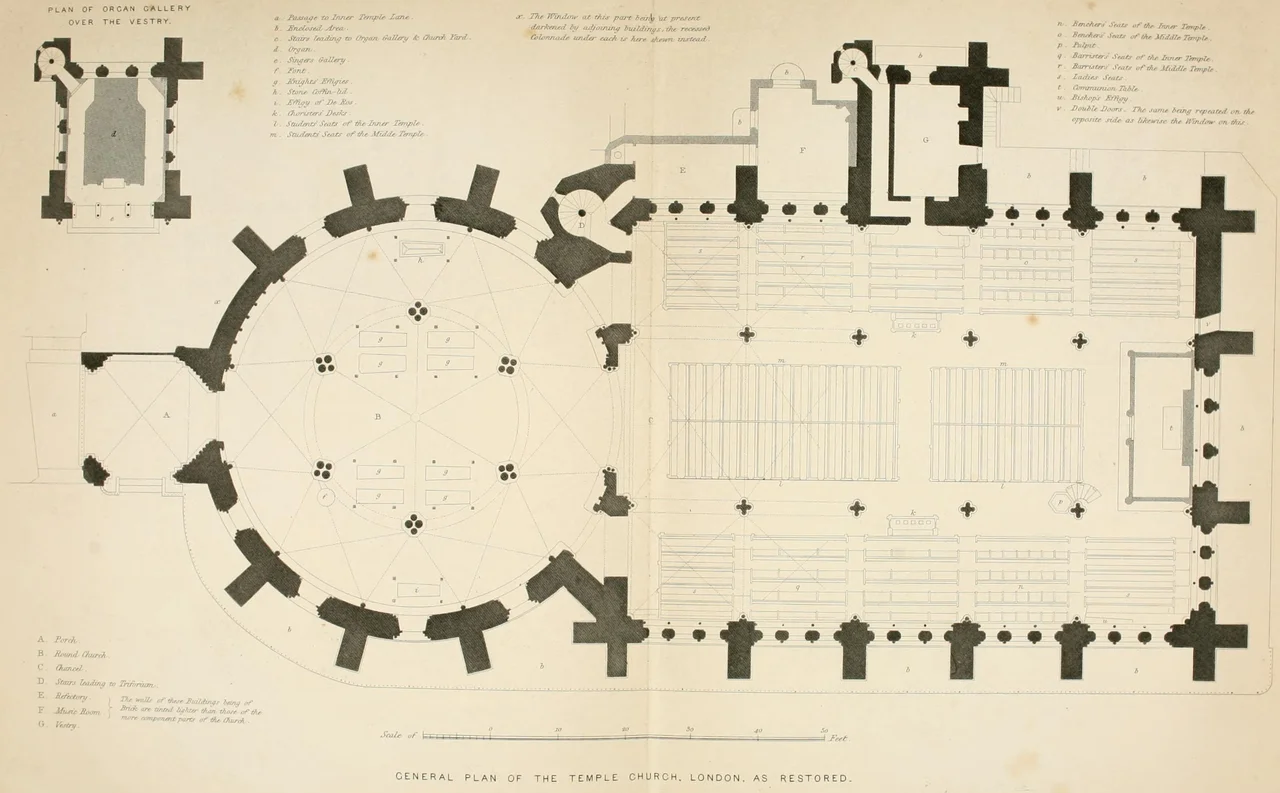
The Knights Templar built it in the shape they considered holy. After the First Crusade captured Jerusalem in 1099, the Templars made their headquarters on the Temple Mount - specifically in the Al-Aqsa Mosque, which the Christians called the Temple of Solomon, and the nearby Dome of the Rock, which they called the Templum Domini. The Templum was a round building, and over the next century round churches multiplied across Europe wherever the order set up house, each one a small architectural echo of the holy city. The London church is one of only four medieval round churches still standing in England. It is 55 feet in diameter, ringed by the earliest known surviving free-standing Purbeck marble columns. Grotesque carved heads scowl from the spandrels - originally painted in bright colours, although the paint is long gone. Patriarch Heraclius of Jerusalem himself crossed Europe to consecrate the church on 10 February 1185, with King Henry II almost certainly present. The chancel attached to the east is taller and rectangular, a fully Gothic space, consecrated on Ascension Day 1240 for the soul of Henry III, who at one point planned to be buried there but later changed his mind and chose Westminster Abbey instead.
Banking and Magna Carta
The Templars in London were enormously rich and enormously powerful. They functioned as Europe's first international bankers, transferring funds across the continent on letters of credit so pilgrims and crusaders did not have to carry gold. The Master of the Temple in London sat in Parliament as the first baron of the realm. Kings and papal legates frequently lodged at the Temple. Nobles deposited their wealth there for safekeeping, sometimes even against the explicit demands of the Crown. The order's quasi-international independence and its mountainous wealth made it dangerous enemies. The most dangerous was Philip IV of France, who in 1307 had every Templar in his kingdom arrested on a single morning - charged with heresy, sodomy, idolatry, and worshipping a severed head named Baphomet - and burned at the stake. The order was abolished in 1312. King Edward II seized the London Temple as Crown property. Eventually the buildings passed to two colleges of lawyers - which became the Inner Temple and Middle Temple, still two of the four London Inns of Court today. The lawyers have kept the Temple Church as their private chapel ever since, paying for its upkeep in exchange for the right to bury their members there.
Wren, Bombs, Rebuilding
The Temple Church survived the Great Fire of London in 1666 because the fire stopped just short of Fleet Street. Christopher Wren still gave it a refurbishment afterward, installing the church's first organ and adding an altar screen. The Victorians stripped much of Wren's work out in their 1841 restoration under Smirke and Burton, redecorating walls and ceiling in high Gothic style. Then on the night of 10 May 1941 - the same horrific raid that destroyed St Nicholas Cole Abbey and damaged Westminster Abbey - German incendiary bombs set the Round Church on fire. The flames spread to the chancel. Every wooden fixture burned. The intense heat cracked the Purbeck marble columns. The Master's House next door burned to the ground the same night. Reconstruction under architect Walter Godfrey took nearly two decades. The cracked columns were replaced with identical ones - including their distinctive slight outward lean. When the restorers opened storage rooms they had not seen for centuries, they found pieces of Wren's 17th-century alterations that had been removed and shelved by the Victorians. These were quietly returned to their original positions. The church was rededicated in November 1958, more Wren than it had been at any point in the previous hundred years.
O for the Wings of a Dove
The Temple Church has a royal peculiar status, meaning it answers directly to the Crown rather than to any bishop, and its choristers have the historic privilege of wearing scarlet cassocks. A choir in the cathedral tradition was established here in 1842 by Edward Hopkins. By the early 20th century, under the directorship of George Thalben-Ball, that choir had become world-famous. In 1927 a 14-year-old boy named Ernest Lough recorded the soaring soprano solo O for the Wings of a Dove in Mendelssohn's Hear My Prayer. The recording sold a million copies by 1962, six million all told - one of the most popular church choir recordings ever released. The acoustics in the Temple kept attracting people. Sir John Barbirolli recorded Vaughan Williams's Fantasia on a Theme by Thomas Tallis here in 1962 at the suggestion of Bernard Herrmann. Paul Tortelier recorded the complete Bach Cello Suites in the church over April 1982. When Hans Zimmer was scoring Christopher Nolan's Interstellar in 2014, he chose the Temple Church for the organ recordings - the haunting double-line organ writing in the score, the music that plays as Cooper passes through the wormhole, was recorded in this room by the church's organist Roger Sayer. Zimmer described setting foot into Temple Church as stepping into profound history.
The Da Vinci Code and the Roses
Dan Brown chose the Temple Church for a key scene in The Da Vinci Code in 2003 because of its Templar history; the film version was shot inside the church in 2005. The novel made the location famous to a new global audience. But the church has always quietly held layered associations with English literature and history. Shakespeare set the fictional scene in Henry VI, Part 1 that supposedly began the Wars of the Roses - the moment Yorkists and Lancastrians pluck white and red roses from a garden in the Temple grounds to mark their factions. In 2002 the modern Temple gardens commemorated the event by planting fresh red and white rose bushes. John Selden the great 17th-century jurist is buried here. So is Oliver Goldsmith, the Anglo-Irish novelist of The Vicar of Wakefield. The Master of the Temple - whose title still echoes the office of the head of the Knights Templar - is appointed by the Crown and gives regular lunchtime talks open to the public. The current Master, Robin Griffith-Jones, has held the post since 1999. The recruitment pack for his successor specifies that the new appointee must be willing to bless same-sex relationships. Even an 840-year-old royal peculiar moves, eventually, with the times.
From the Air
Temple Church sits at approximately 51.5132 degrees north, 0.1104 degrees west, tucked between Fleet Street and Victoria Embankment, in the precinct of the Inner Temple and Middle Temple Inns of Court. From altitude the round-and-rectangular ground plan of the church is just visible in a green courtyard hemmed in by the legal buildings of the Temple, immediately east of Temple Underground station and south-west of the Royal Courts of Justice. London City Airport (EGLC) is roughly six nautical miles east; London Heathrow (EGLL) about thirteen nautical miles west. Best viewing altitudes are 1,500-3,000 feet over the bend of the Thames.
Nearby Stories
- Stevenage 5.7 km away
- Malling Abbey 5.7 km away
- 1952 Farnborough Airshow Crash 7.7 km away
- Ingatestone Hall 8.2 km away
- Hellfire Caves 9.1 km away
- The Carrington Event: The Solar Storm That Could Happen Again 9.8 km away
- Bletchley Park 16 km away
- Castle Hedingham 23 km away