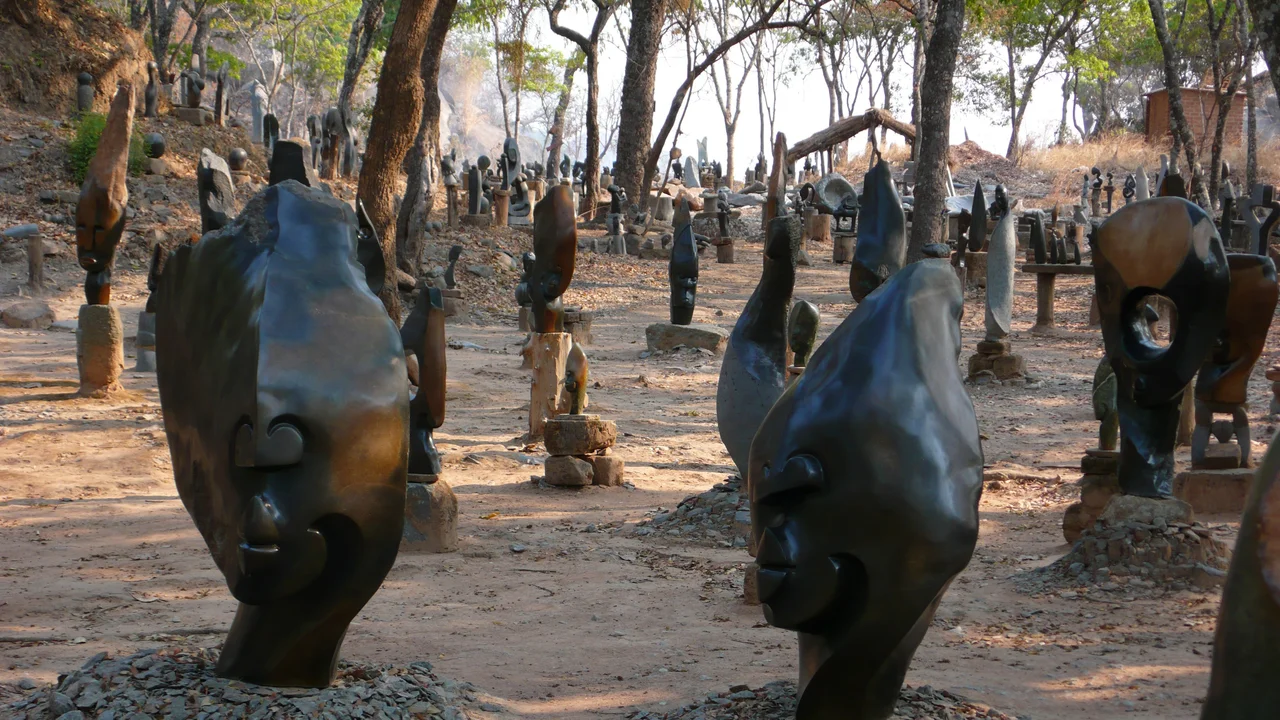

Tengenenge
The word itself means "the beginning of the beginning." In the Korekore dialect of Shona, Tengenenge gestures toward origins, toward the moment before a thing starts. It turned out to be the right name for a place that has given form - literally, chiseled into stone - to one of the most important art movements in modern Africa. Since 1966, hundreds of sculptors have lived and worked on this hillside in Zimbabwe's Guruve District, turning hard green-black serpentine into human faces, spirit figures, animals, and forms that refuse easy categories. Some of the names that emerged here - Bernard Matemera, Henry Munyaradzi, Sylvester Mubayi, Fanizani Akuda, Bernard Takawira - are now in museum collections from London to New York.
A Farm That Became a Studio
Tom Blomefield came to this land to grow tobacco and mine chromium. By the mid-1960s, neither business was paying. International sanctions against Ian Smith's white-minority Rhodesian government, which had unilaterally declared independence in 1965, had squeezed commodity exports to the point where Blomefield needed a new plan for the workers who depended on him. The answer walked up his road in the person of Crispen Chakanyuka, a sculptor who noticed something the farmer had overlooked: the hillside was part of the Great Dyke, a 550-kilometer geological feature rich in hard serpentine stone. Blomefield secured the mining rights, and the people who had been growing tobacco began carving. What started as an economic improvisation became the largest gathering of sculptors the country had ever seen.
The First Generation
The artists who cut their first pieces at Tengenenge in the late 1960s became known as Zimbabwe's first generation of stone sculptors. Their work reached the wider world largely through Frank McEwen, director of the National Gallery of Rhodesia in Salisbury, who organized exhibitions at home and abroad and built the market that made names like Matemera and Munyaradzi internationally recognized. McEwen and Blomefield eventually fell out over how the movement should grow. McEwen wanted to train a select group of sculptors at the gallery; Blomefield wanted to keep Tengenenge open to anyone who turned up with a chisel and a willingness to work, including artists from Angola, Malawi, and Mozambique. Tensions rose between the two men until 1973, when McEwen resigned from the gallery - political tensions with the white-minority government had made his position untenable, as he had dared to empower Black artists. Blomefield sold the farm that same year and moved to Harare.
Through the War and Back
The sculpture community kept working without him for a while, but by 1979 the Rhodesian Bush War had reached the hills of Guruve. Guerrilla fighters moved through the area, most of the artists scattered, and Tengenenge emptied out. December 1979 brought the Lancaster House Agreement; 1980 brought the independent Zimbabwe. The community rebuilt itself slowly. In 1985, Blomefield returned, and his presence drew others back. A tar road reached Tengenenge in 1989, opening it to visitors for the first time in decades. That same year the Netherlands hosted Beelden op de Berg, an international exhibition in Wageningen that reintroduced Tengenenge's work to European audiences. At the peak of its success, more than 1,200 people depended on the community's sales - sculptors, their families, the craftspeople and cooks who supported the whole operation. Some visitors were critical of the living conditions; others noted that few places anywhere had given African artists this much freedom to work.
The Stone and the People Who Shape It
Serpentine from the Great Dyke is a difficult medium - hard enough to hold fine detail, soft enough to be carved by hand with chisels and rasps, and prone to surprising the sculptor with hidden seams of color. The artists who settled at Tengenenge developed techniques that are still taught: reading the stone before cutting, working with the natural grain rather than against it, polishing selected surfaces while leaving others rough to play living texture against smooth form. By 2011 the community had restructured itself under a management team of five artists, trying to sustain the place through Zimbabwe's years of economic crisis. Tom Blomefield died in the Netherlands on 8 April 2020, aged 95. His ashes were buried at Tengenenge on 6 December of that year. Zimbabwe's tourism industry had by then nearly collapsed, and art sales alongside it, but the sculptors have kept working - cutting stone on the hillside where the work began, in a place whose name promises the beginning of something else.
From the Air
Tengenenge, Zimbabwe. Coordinates 16.72°S, 30.93°E. Nearest airport: Robert Gabriel Mugabe International, Harare (FVRG), ~150 km south-southeast. Recommended altitude 5,000-10,000 ft. Look for the Great Dyke's ridgeline running roughly northeast-southwest, a distinctive serpentine geology that shows as darker rock in otherwise bushveld country.
Nearby Stories
- Great Dyke 41 km away
- Karoi 57 km away
- National Gallery of Zimbabwe 91 km away
- Cahora Bassa 112 km away
- Lower Zambezi National Park 129 km away
- Tete Province 193 km away
- Bulawayo Railway Museum 388 km away
- Gorongosa National Park 390 km away