_05.jpg)
Terjit
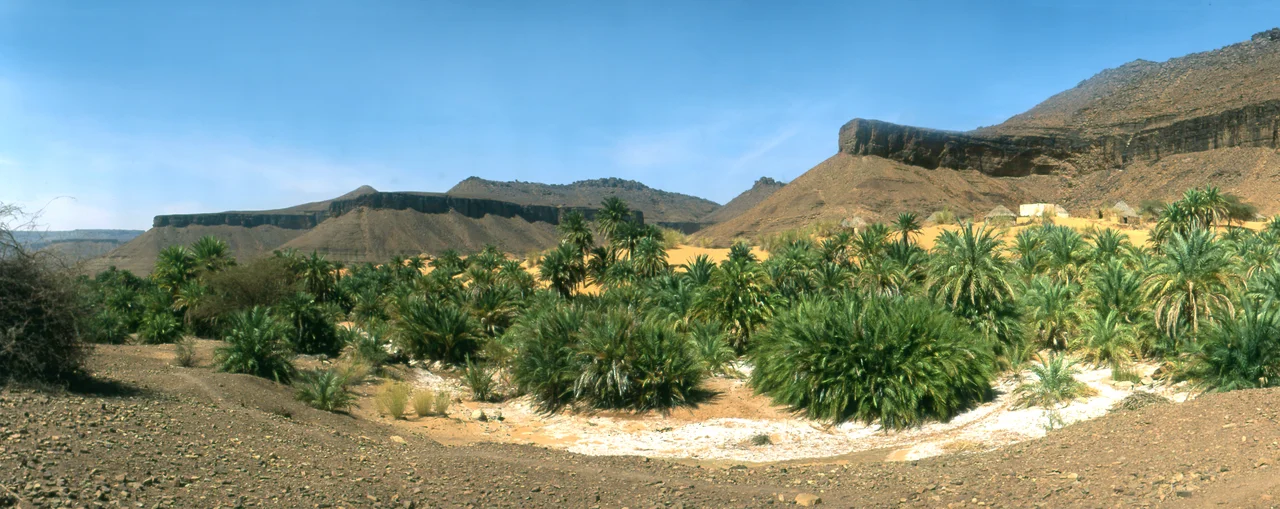
The instruction for what to do at Terjit is refreshingly short: nothing. You come to this gorge on the western edge of the Adrar plateau to sit in the shade of date palms, dip your feet where springwater surfaces from the rock, and let the desert heat stay outside the canyon walls. Eleven kilometers off National Highway 1 and about forty-five from Atar, the oasis rewards travelers who slow down, and punishes those who try to rush it. Bring patience, bring supplies, and plan to stay the night.
Getting There
Terjit sits 45 km south of Atar and roughly 11 km off the N1 Atar-Nouakchott highway. The simplest approach is a bush taxi from Atar, which runs about 200 MRU per person. Buses bound for Aoujeft from Nouakchott or Akjoujt pass nearby, with the Nouakchott fare around 500 MRU. If you find yourself stranded, get dropped at the Ras Darf police checkpoint where the road to Terjit and Aoujeft branches off, and wait there for a lift heading in. This is overland travel at its most improvised: schedules are loose, vehicles fill when they fill, and a friendly wave often does more than a timetable. Build slack into your plans and treat the journey as part of the experience rather than an obstacle to it.
Inside the Gorge
The oasis is the attraction, full stop. A palm grove stretches a few hundred meters along a stream that emerges from a spring, hemmed in by the steep rock walls of the deep valley. Step under the canopy and the temperature drops; the green feels almost unreasonable against the ochre desert just beyond the rim. There are picnic areas and a small natural pool, though it is too shallow for real swimming. A modest entrance fee covers the rear, eastern part of the oasis, around 200 ouguiya as of 2023, and you pay only once even if you wander in and out across your stay. The right way to experience Terjit is to find a patch of shade, listen to the water, and stay put for a while.
Hiking the Escarpments
For those who want more than stillness, several hikes climb the cliffs around the oasis, but they demand respect. Two paths run west from the southeast end of the grove along the northeast and southwest escarpments. The northern route drops back into the oasis near the Auberge Chez Jemal; the southern one runs farther, meeting the road toward Aoujeft, where you walk a final kilometer back to the entrance. Go only if you are sure-footed, sun-protected, and confident with desert navigation. Getting lost out here is genuinely dangerous, so do not wander far, carry water, and turn back early if the terrain or your bearings feel uncertain.
Eating and Sleeping
Provisioning is minimal. A few shops sell water, biscuits, and tinned sardines, and sometimes you have to track down the owner to open up, so carry your own supplies. Dates, harvested locally, are the one luxury, sold cheaply straight from the producer. For meals, the auberges serve food in the 200 to 500 ouguiya range. To sleep, you can rent a tent pitched in the palm groves or stay at one of the guesthouses: Auberge des Caravanes offers small huts with mosquito nets, good showers, and toilets for around 700 ouguiya, while Chez Jemal is a tented camp with facilities. Those mosquito nets matter, because the mosquitoes here can carry malaria, so cover up, use protection, and mind the sun while you are at it.
From the Air
Terjit lies at 20.26°N, 13.09°W, tucked into a gorge on the western edge of the Adrar plateau, roughly 45 km south of Atar. The nearest airfield is Atar International (GQPA); Nouakchott (GQNN) lies well to the southwest. From the air, look for a thin ribbon of green threading a canyon in otherwise bare desert. Recommended viewing altitude is 2,000-4,000 ft AGL for the grove to read against the plateau. Visibility is typically excellent in the dry season, though blowing dust can reduce it sharply during harmattan winds.
Nearby Stories
- Maaden El-Irvane 27 km away
- Chinguetti Mosque 35 km away
- Geography of Mauritania 69 km away
- Akjoujt 78 km away
- Choum 83 km away
- Inchiri region 94 km away
- Jbilet Winselwan Meteorite 103 km away
- Zug, Western Sahara 119 km away