.jpg)
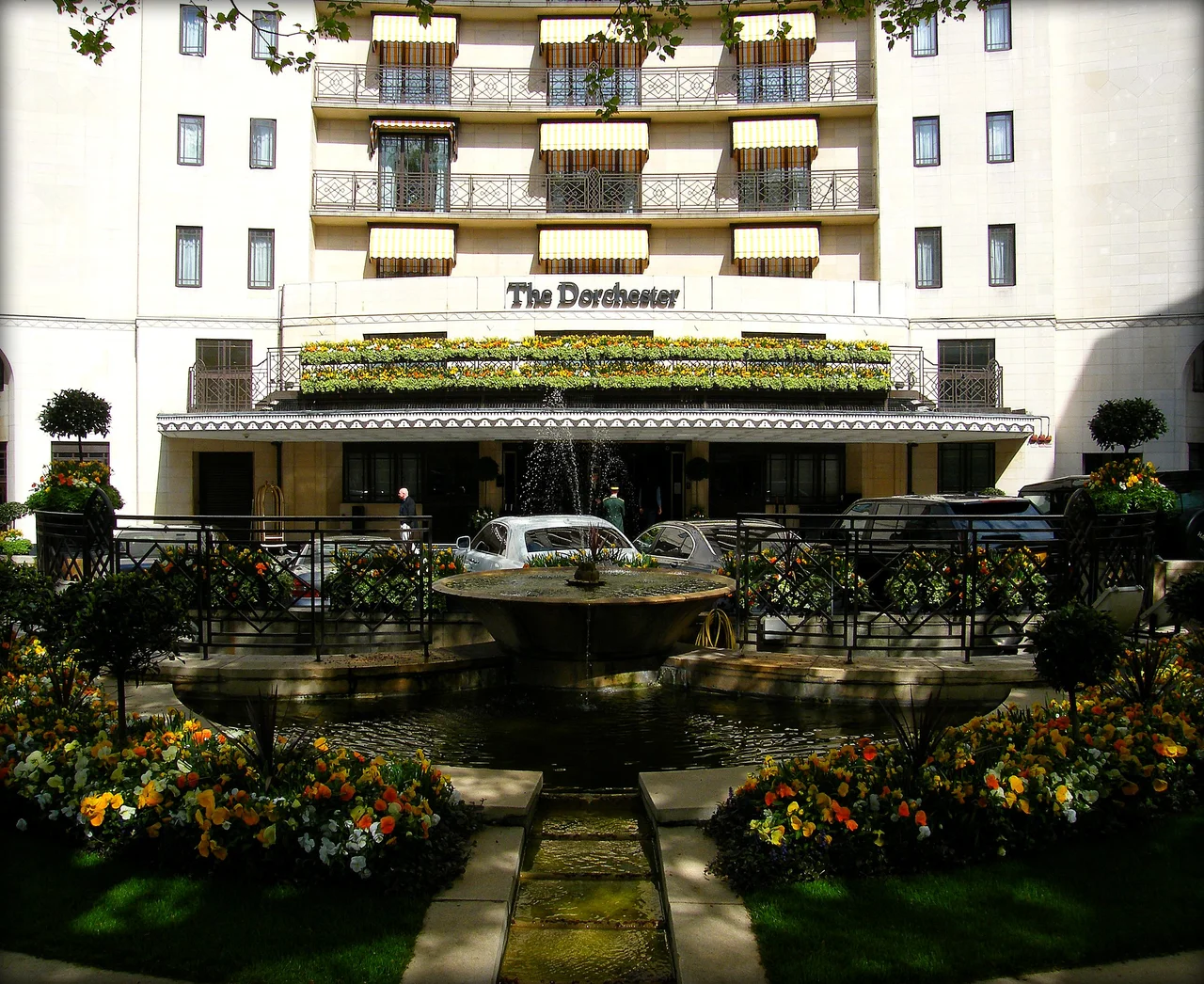
The Dorchester
On Saturday 18 April 1931, Lady Astor launched a hotel at a grand luncheon on Park Lane. The Dorchester opened for business two days later. On the Tuesday, it celebrated with a 'Lace Ball' in the ballroom. The hotel had arrived. Within a decade, Cecil Day-Lewis was writing poetry nearby, Somerset Maugham was working on novels in a suite, and T. S. Eliot was dining in the restaurant. The Dorchester did not simply attract the famous—it attracted the famous who needed somewhere to think, to meet, and, increasingly, to stay safe when bombs were falling.
The Site and Its Predecessors
The land beneath the Dorchester has a longer history than the hotel. William the Conqueror granted the Manor of Hyde to Geoffrey de Mandeville after the Norman Conquest. Joseph Damer acquired it in the eighteenth century, and a large house called Dorchester House was built here in 1751—named in 1792 when Damer became the Earl of Dorchester. The Marquess of Hertford owned it for a time. Then Captain Robert Stayner Holford rebuilt it as a new Dorchester House. It was Sir Francis Towle, managing director of Gordon Hotels, who saw the potential for a luxury hotel on this site overlooking Hyde Park. He negotiated financing from Prudential Insurance and McAlpine's construction company. Dorchester House was quickly demolished. The BBC had nearly bought the property first, but settled for another building elsewhere. Work began in 1929 and the hotel opened two years later.
Concrete, Cork, and Compressed Seaweed
The Dorchester was built from reinforced concrete—an unusual choice for a luxury hotel—which allowed large internal spaces without the support pillars that earlier construction methods required. This was Sir Owen Williams' contribution before he abandoned the project in February 1930 and was replaced by William Curtis Green. The concrete structure turned out to be unexpectedly useful. When German bombing began in 1940, politicians and military leaders concluded that the Dorchester's construction made it one of London's safest buildings and chose to live there during the war. Princess Elizabeth was at the Dorchester on 10 July 1947, the day before her engagement to Philip Mountbatten was announced. In the rooms, the walls were faced with cork to reduce sound and the floors lined with compressed seaweed for insulation—details that speak to the 1930s obsession with building something better than had existed before.
A Star-Studded Guest Book
Elizabeth Taylor and Richard Burton were regulars in the 1960s and 1970s. Alfred Hitchcock dined here. Barbra Streisand. Charlton Heston, who became so fond of the place that he remarked: 'The cooks and bakers, the clerks and porters, the maids and the flower ladies, the bell men are the hotel.' In 1961, Leicester City players stayed here before an FA Cup Final against Tottenham Hotspur—Taylor and Burton were in residence simultaneously. In 1972, Raquel Welch visited Chelsea Football Club and brought their players back for a cocktail party at the Dorchester that was also attended by the Rolling Stones. In 2003, Ken Bates agreed to sell Chelsea FC to Roman Abramovich after a 20-minute meeting in a hotel suite. The Dorchester Bar, run in the 1930s by Harry Craddock—one of the era's most famous barmen—was where Craddock invented the 'Dorchester of London' cocktail.
Ownership, Controversy, and Continuity
In 1985 the Sultan of Brunei purchased the Dorchester. The hotel is now part of the Dorchester Collection, owned by the Brunei Investment Agency. The ownership has generated sustained controversy: in 2014, and again in 2019, celebrity boycotts drew attention to Brunei's human rights record, particularly regarding laws imposing the death penalty for homosexuality. George Clooney, Ellen DeGeneres, and Elton John were among those who called for the hotel to be shunned. Protests took place outside. Several organisations cancelled planned events. The hotel has continued to operate through these campaigns. It holds 250 rooms and 49 suites, employs 90 full-time chefs, and maintains a floral team. A plane tree in the front garden was named one of the Great Trees of London in 1997. The hotel became a Grade II listed building in January 1981.
From the Air
The Dorchester stands at 51.507°N, 0.153°W on Park Lane in Mayfair, Westminster, on the eastern edge of Hyde Park. From altitude, Hyde Park is unmistakable—a large green rectangle in the heart of the West End. Park Lane runs along its eastern edge, and the Dorchester's eight-storey facade faces the park directly. Nearest airport is Heathrow (EGLL, about 14 miles west). The nearest tube stations are Hyde Park Corner and Marble Arch. The area sits at approximately 15 metres elevation. London City Airport (EGLC) lies about 12 miles to the east.
Nearby Stories
- Stevenage 5.7 km away
- Malling Abbey 5.7 km away
- 1952 Farnborough Airshow Crash 7.7 km away
- Ingatestone Hall 8.2 km away
- Hellfire Caves 9.1 km away
- The Carrington Event: The Solar Storm That Could Happen Again 9.8 km away
- Bletchley Park 16 km away
- Castle Hedingham 23 km away