
The Guardian
On 5 May 1821 — the same day, by chance, that Napoleon died on St Helena — a Manchester cotton merchant named John Edward Taylor published the first issue of a paper he called the Manchester Guardian. The Peterloo massacre had taken place barely two years earlier, when British cavalry charged a crowd of pro-democracy protestors in St Peter's Field and killed at least eighteen of them. The radical Manchester Observer, which had championed the survivors, had just been closed by the police. Taylor, who was no radical, founded a paper instead. He had backers — a group of non-conformist businessmen known as the Little Circle, two of whom would later be revealed by a 2023 Scott Trust review to have had links to the Atlantic slave trade. The paper Taylor founded would, over two centuries, move from Manchester to London, change its name, and arrive in 2026 as one of the few major newspapers in the world owned not by a person or a corporation but by a trust whose only job is to keep it independent.
Cotton, Reform, and the Scott Trust
For its first century the paper was a Manchester institution, edited from 1872 to 1929 by C. P. Scott, whose name now anchors the trust that owns it. Scott was a Liberal MP, a friend of Chaim Weizmann, and the author of the 1921 editorial whose phrase "comment is free, but facts are sacred" became the paper's unofficial motto. When Scott's son John Russell Scott inherited the title in 1936, he gave it away. He transferred ownership to a new charitable foundation, the Scott Trust, charged with one purpose: "to secure the financial and editorial independence of The Guardian in perpetuity." The trust still owns the paper. There is no proprietor to please, no family to inherit, no shareholders to placate with dividends. The model is rare enough in journalism that the Guardian remains, for better and for worse, an experiment in what a newspaper can be when nobody is making money from it.
From Manchester to London
It dropped "Manchester" from the masthead on 24 August 1959 and began printing in London in 1961. The move severed something. For more than a century the paper had been a regional voice with a national reach — supportive of Republican Spain (George Orwell wrote in Homage to Catalonia that it was the only large English paper "that leaves me with an increased respect for its honesty"), opposed to the Suez intervention in 1956, suspicious of Soviet trials and American McCarthyism in equal measure. London changed the readership and the politics. By the 1980s the Guardian was the paper of the British centre-left, broadly Labour-aligned but with a stubborn independent streak. It was the only major British paper not to back the Iraq invasion in 2003. Its sister Sunday paper The Observer, acquired in 1993, sometimes took a different line.
Phone Hacking and Snowden
Two stories defined the modern Guardian. In 2011, reporter Nick Davies broke the news that the News of the World had hacked the phone of murdered teenager Milly Dowler. The story brought down the country's biggest-selling Sunday paper and triggered the Leveson Inquiry into press standards. In June 2013, the paper began publishing material leaked by Edward Snowden, a former National Security Agency contractor — including the existence of the surveillance program PRISM and the bulk collection of Verizon telephone records by the Obama administration. In July 2013, agents from Britain's GCHQ visited the Guardian's offices in King's Cross and supervised the physical destruction of hard drives containing Snowden material. The paper had already copied the files to The New York Times. The Guardian US edition won the 2014 Pulitzer Prize for Public Service for its coverage.
A Newspaper That Does Not Make Money
Through most of the 2000s and 2010s the Guardian lost roughly a hundred thousand pounds a day. The Scott Trust's endowment, built up from the sale of regional papers and online classifieds, was supposed to be perpetual — and yet by 2014 the paper was visibly burning through it. The 2014 launch of a membership scheme, which asks readers to pay voluntarily for content that remains free to read, has been the experiment that worked. By 2018 the paper had more than a million subscriptions or donations. By 2019 the news and media operations had broken even. The print edition, switched to tabloid format in 2018 and printed since then on Trinity Mirror presses, continues to decline; the website does not. The Guardian is now read in print by perhaps a hundred thousand people a day and online by more than twenty-three million UK adults a month.
Kings Place
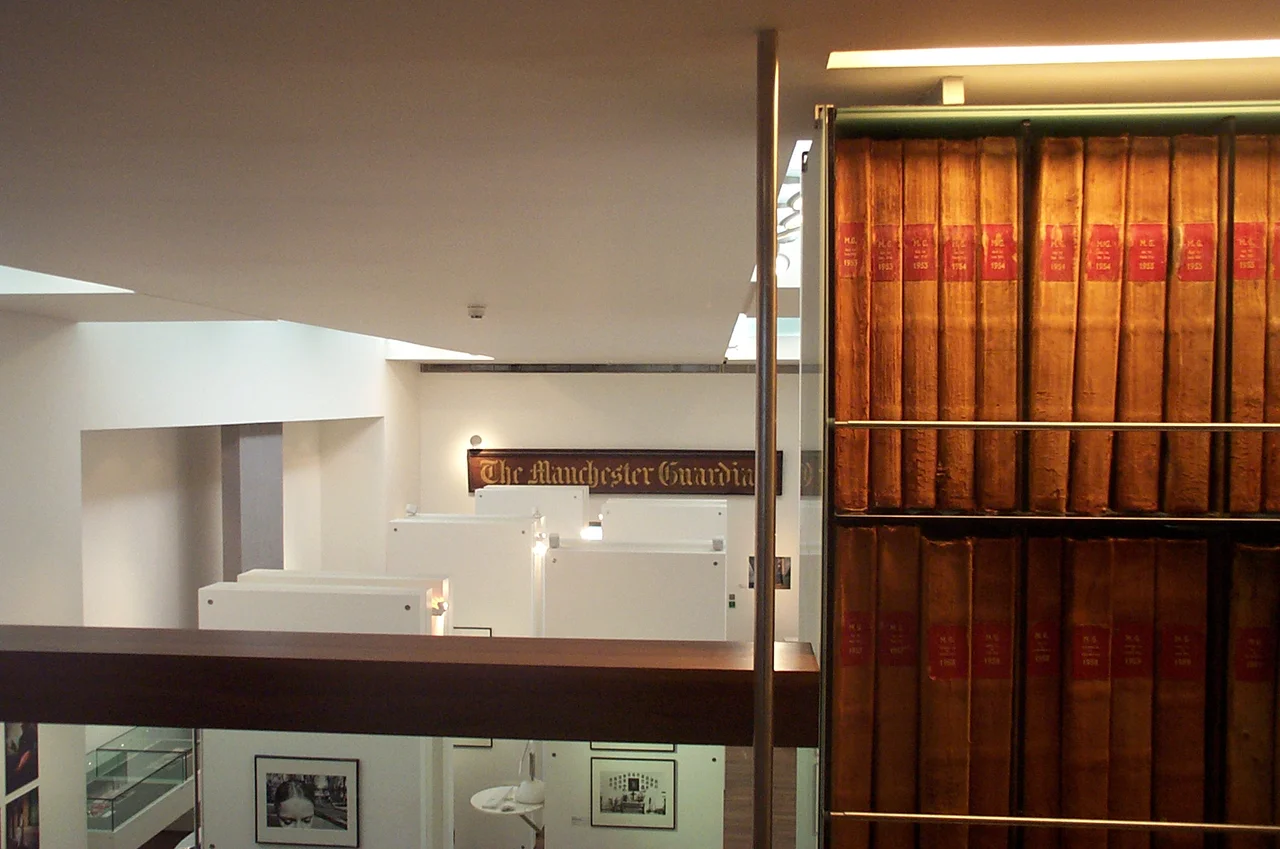
Walk down York Way behind King's Cross station and you reach Kings Place, the canal-side office building the Guardian moved into in 2008. The building also houses a concert hall, two galleries, and the headquarters of several smaller arts organisations. The newsroom looks out over the Regent's Canal and the rail tracks of the East Coast Main Line. The Observer, after thirty-two years as the Guardian's Sunday sister, was sold to Tortoise Media in December 2024. The paper that began two centuries ago in a Manchester cotton merchant's office now produces editions for the UK, the United States, Australia, and Europe, and continues to publish from one of the most unusual ownership structures in global journalism — a trust whose only legal obligation is to keep the paper going.
From the Air
Guardian headquarters at Kings Place sits at 51.5351 N, 0.1217 W on the south side of the Regent's Canal, immediately north-east of King's Cross and St Pancras stations. From the air the dual railway sheds of St Pancras and King's Cross are the unmistakable landmark, with the Regent's Canal threading east-west just behind. Nearest airports: London City (EGLC) nine miles south-east, Heathrow (EGLL) sixteen miles west, Luton (EGGW) twenty-two miles north. The Guardian was based in Manchester for its first 138 years; the John Rylands Library at the University of Manchester still holds the paper's archive.
Nearby Stories
- Stevenage 5.7 km away
- Malling Abbey 5.7 km away
- 1952 Farnborough Airshow Crash 7.7 km away
- Ingatestone Hall 8.2 km away
- Hellfire Caves 9.1 km away
- The Carrington Event: The Solar Storm That Could Happen Again 9.8 km away
- Bletchley Park 16 km away
- Castle Hedingham 23 km away