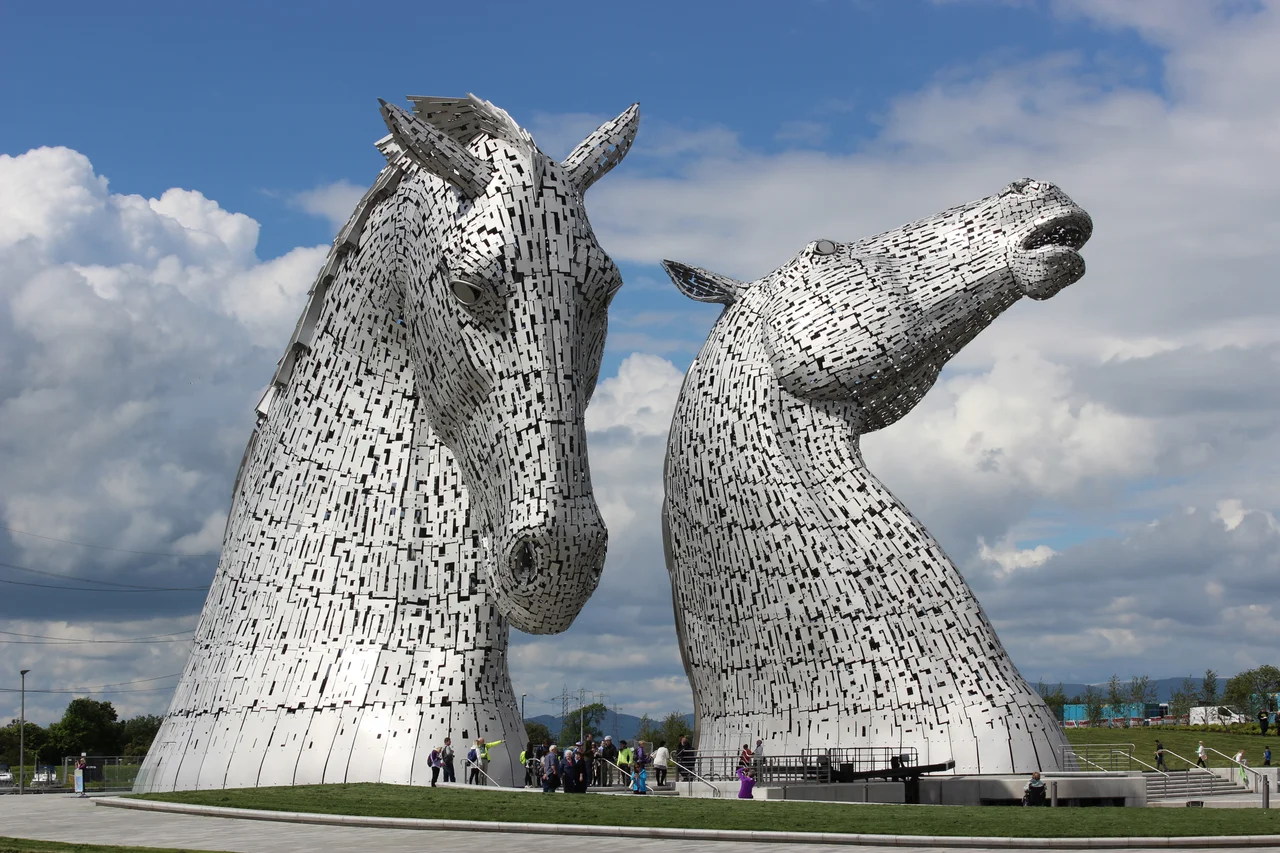

The Kelpies
They are the size of small cathedrals, and they are watching you. Andy Scott's two horse heads stand thirty metres high at the gateway of the Forth and Clyde Canal in central Scotland, 300 tonnes of structural steel sheathed in stainless steel skin, lit at night so they glow against the dark like nothing else in Britain. Drive the M9 between Falkirk and Grangemouth and there is no missing them. They were inspired by Clydesdale draught horses, named after a Scottish water-spirit, and built to last a hundred years.
What a Kelpie Is
In Scottish folklore a kelpie is a shape-shifting water spirit, traditionally said to inhabit lochs and rivers and to drown unwary travellers who tried to ride them. The name was chosen by Scottish Canals at the inception of the Helix project in 2005 to reflect the mythological transforming beasts with the strength and endurance of ten horses. But sculptor Andy Scott did not want to build mythological monsters. He took the concept and moved with it - as he put it - 'towards a more equine and contemporary response, shifting from any mythological references towards a socio-historical monument intended to celebrate the horse's role in industry and agriculture as well as the obvious association with the canals as tow horses.' The Kelpies are gateways, in Scott's words, 'translating the legacy of the area into proud equine guardians.'
Construction
Construction began in June 2013 and the structures were complete by October that year, with a topping-out ceremony on 27 November 2013. The official unveiling took place in April 2014. Each head consists of a structural steel frame clad in stainless steel panels - 928 panels per Kelpie, individually shaped and welded. The forms are positioned on either side of a specially constructed lock and basin where the Forth and Clyde Canal meets the River Carron. The basin allows narrowboats to pass directly under the Kelpies' gaze. The British Constructional Steelwork Association said the structures required 'considerable engineering finesse.' New Civil Engineer called them 'one of Scotland's most complex sculptures.' Nearly a million people visited in the first year.
The Heavy Horse
Scott's Kelpies are tributes to the heavy horse of Scottish industry - the draught animals that pulled wagons, ploughs, barges, and coal-ships through the Forth Valley for centuries before steam and diesel made them obsolete. The Clydesdale is the Scottish heavy horse, bred originally in the Clyde valley to haul agricultural and industrial loads. Two specific horses modelled for the project: Duke and Baron, owned by a local heavy-horse haulier, who stood patiently while Scott took the measurements that would scale up to thirty-metre giants. The 1:10 maquettes from the design process now tour internationally - they have been displayed at Edinburgh Airport, the Field Museum in Chicago's Grant Park, the Falkirk Wheel, Bryant Park in New York, BBC Scotland, and the University of Glasgow.
Reception, Contested
Critical reception split. The Guardian called the site 'one of the most dramatic gateways through which to enter Britain.' Ordnance Survey called them 'amazing and dramatic.' Tiffany Jenkins in The Scotsman said 'they are impressive, stunning even, and I think people will become attached to them and proud of them.' Then Jonathan Jones - also in The Guardian - dismissed the work as 'the latest misbegotten masterpiece of public art... a kitsch exercise in art for the people, carefully stripped of difficulty, controversy, and meaning.' Public response settled the matter quickly. The Kelpies became one of Scotland's most-photographed sculptures, the centrepiece of Helix Park, a free-to-visit attraction that drew nearly a million visitors in their first year and continues to draw tourists from around the world. They sit five miles from the Falkirk Wheel - the rotating boat lift that connects the same canal to the Union Canal - completing one of Britain's strangest engineering corridors.
From the Air
56.019°N, 3.755°W, alongside the M9 motorway just east of Falkirk between Helix Park and the River Carron. Best viewed at 1,000-2,000 feet AGL - the sculptures are clearly visible from the air, particularly when lit at night. Edinburgh Airport (EGPH) is 16 nautical miles east; Glasgow Airport (EGPF) about 17 nautical miles west-southwest. The Falkirk Wheel, the world's only rotating boat lift, sits approximately 5 miles southwest of the Kelpies and is also visible from cruising altitude. The Forth and Clyde Canal corridor links the two structures.
Nearby Stories
- Union Canal (Scotland) 2.9 km away
- Ochil Hills 5.3 km away
- Mugdock Castle 7 km away
- New Lanark 8.7 km away
- Darvel 13 km away
- Innerleithen 13 km away
- Lochearnhead 16 km away
- Inner Tay Estuary 16 km away