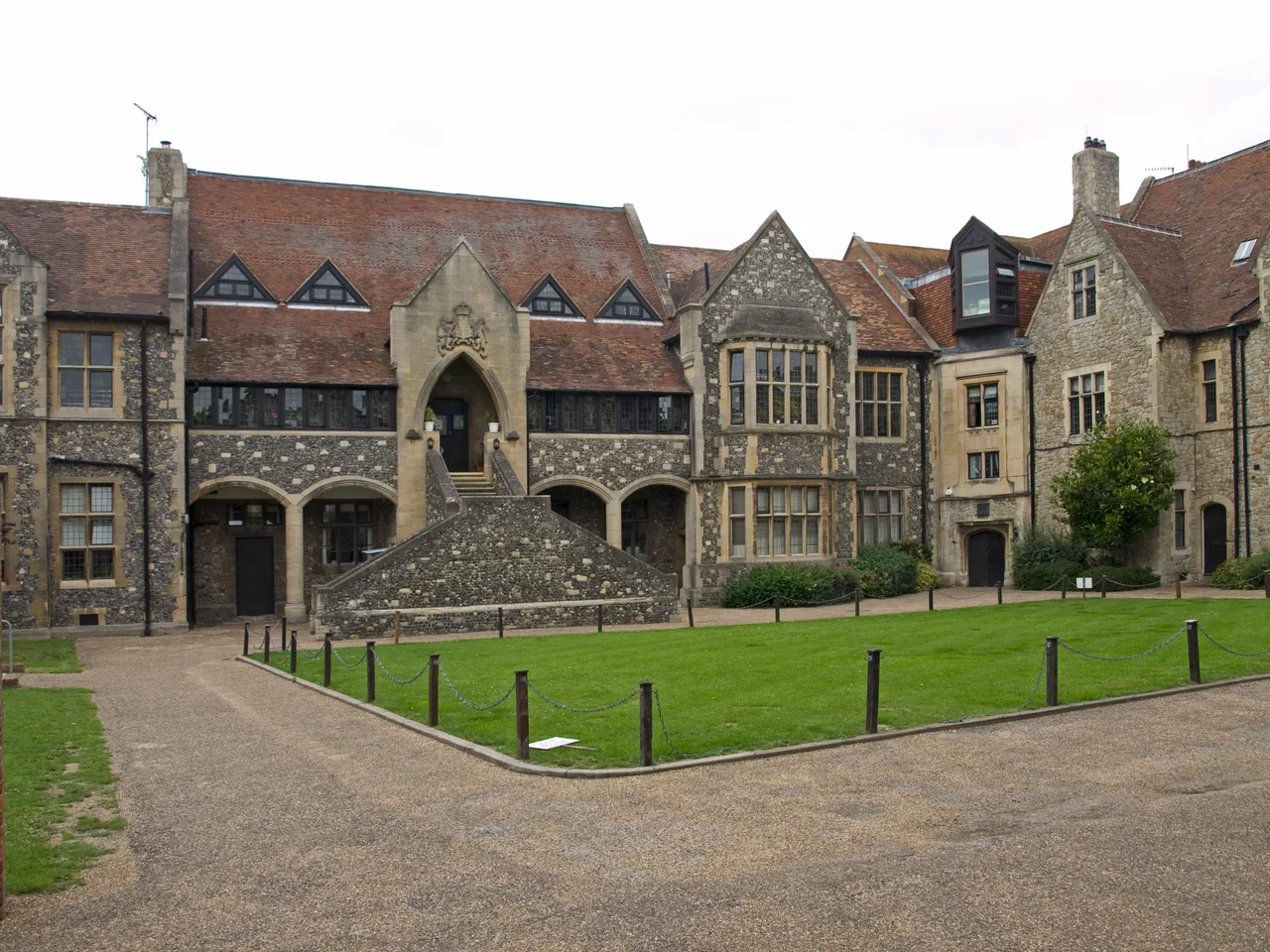

The King's School, Canterbury
When Augustine of Canterbury arrived in Kent in 597 to convert the Anglo-Saxons, he established a teaching community in the abbey he founded - and that teaching has, by the school's own claim, never quite stopped. The King's School, Canterbury argues it is the oldest continuously operating school in the world. Whether you accept that claim entirely depends on what you mean by continuous, but there is no doubt that boys (and now girls) have been studying within sight of Canterbury Cathedral for a span that makes most institutions seem provisional.
From Augustine to Henry VIII
The medieval cathedral school grew up in the abbey grounds where teaching had taken place since late antiquity, a century after the Western Roman Empire collapsed. When Henry VIII dissolved the monasteries, the school could have ended there. Instead, it was re-founded by royal charter in 1541, with a headmaster, a lower master, and fifty King's Scholars - and the name King's School, for King Henry VIII, has stuck ever since. Cardinal Pole moved the school to the Mint Yard not long after, where the Almonry building served the school for over three centuries. The first headmaster, John Twyne, ran the school from 1525 to 1560, bridging the dissolution itself. Over the next hundred years, the pupil list began to read like a history of English ideas: Christopher Marlowe (1579-81), the poet and playwright who rivalled Shakespeare; William Harvey (1588-92), who would discover the circulation of the blood; and John Tradescant the Younger (1619-23), the gardener and collector whose specimens seeded the Ashmolean Museum.
The Norman Staircase and Royal Visits
The school's most painted, photographed, and admired spot is a 12th-century Norman staircase that has stood since the days when Henry II quarrelled with Thomas Becket in the cathedral next door. For formal occasions the school traditionally gathered here. Archbishops of Canterbury addressed the boys from these steps during Visitations. On 11 July 1946, King George VI - accompanied by Queen Elizabeth and the future Queen Elizabeth II, then still Princess Elizabeth - presented the School's Royal Charter to the Dean on the staircase. It is a building where 900 years of English history have used the same set of stone treads.
Pinstripes by Vote
The uniform, called Full Canterbury Dress, is what most outsiders find striking: white shirt with wing collar, black waistcoat, pinstripe trousers, black jacket, black socks, black tie, black shoes. Girls wear pinstripe skirt or trousers with a brooch. When Headmaster Fred Shirley arrived in 1935 he replaced it with sports jackets - and within a year, the boys themselves had asked to revert to their traditional garb. After the war Shirley tried again, and this time put it to a vote. Even with clothes rationing making outmoded clothing nearly impossible to find, the boys voted again to keep tradition. Senior prefects, called Purples, wear distinctive purple gowns; King's Scholars, the academically selected pupils, used to wear black gowns and now wear black jumpers with white trimmings during cathedral services. On Commem Day, the last day of the school year, leavers process in white tie and tails, with breeches and black stockings, while Organ Scholars wear black academic gowns and carry silver-handled canes. The whole production is half school assembly and half medieval ritual.
King's Week and Houses Named for Heroes
In 1952, Fred Shirley introduced King's Week, an arts festival during the last week of summer term. Over a hundred events - classical concerts, theatre, dance - take place at locations around the city, free to attend, no booking required, some broadcast live. There are sixteen houses at the school, most named after past headmasters or pupils of consequence. Marlowe is named for the playwright. Harvey for the physician who traced the systemic circulation. Tradescant for the gardener. Linacre for Thomas Linacre, who founded the Royal College of Physicians. Broughton honours William Broughton (1797-1804), the first Bishop of Australia. Carlyon takes its name from Carlyon Bay in Cornwall, where the school was evacuated during the Second World War.
Continuity and Change
In September 2023, Jude Lowson became the first female Head in the school's nearly 1,500-year history. The Maugham Library is named for the dramatist W. Somerset Maugham, whose ashes were scattered on the lawn nearby. The Old Synagogue at Canterbury, built in 1847-48 as one of the finest examples of Egyptian Revival style in England, now serves as a music recital hall. Boys still climb a Norman staircase. Pupils still walk past the abbey ruins where Augustine taught. They study in a Priory block originally built around 1100. Few schools can claim that the bricks beneath their feet were laid before the Norman Conquest. The King's School can, and does.
From the Air
Located at 51.282°N, 1.083°E in the centre of Canterbury, Kent, immediately adjacent to Canterbury Cathedral within the cathedral precincts. The closest airport is Manston (EGMH) about 13nm northeast; London City (EGLC) lies 47nm west-northwest and Lydd (EGMD) sits 24nm southwest. Recommended viewing altitude is 1,500 to 2,500 feet AGL. The school occupies historic buildings within and around the cathedral precincts, including the Mint Yard and the old St Augustine's Abbey site to the east. Look for Canterbury Cathedral's Bell Harry tower as your primary navigation reference - the school buildings cluster immediately around it on the north side.
Nearby Stories
- Ringlestone Inn 3.4 km away
- Cliffs Pavilion 3.5 km away
- Citadel of Calais 6.5 km away
- 2021 English Channel Disaster 11 km away
- Stag Inn, Hastings 15 km away
- Dungeness Lighthouse 19 km away
- Clacton Pier 32 km away
- Four Days' Battle 54 km away