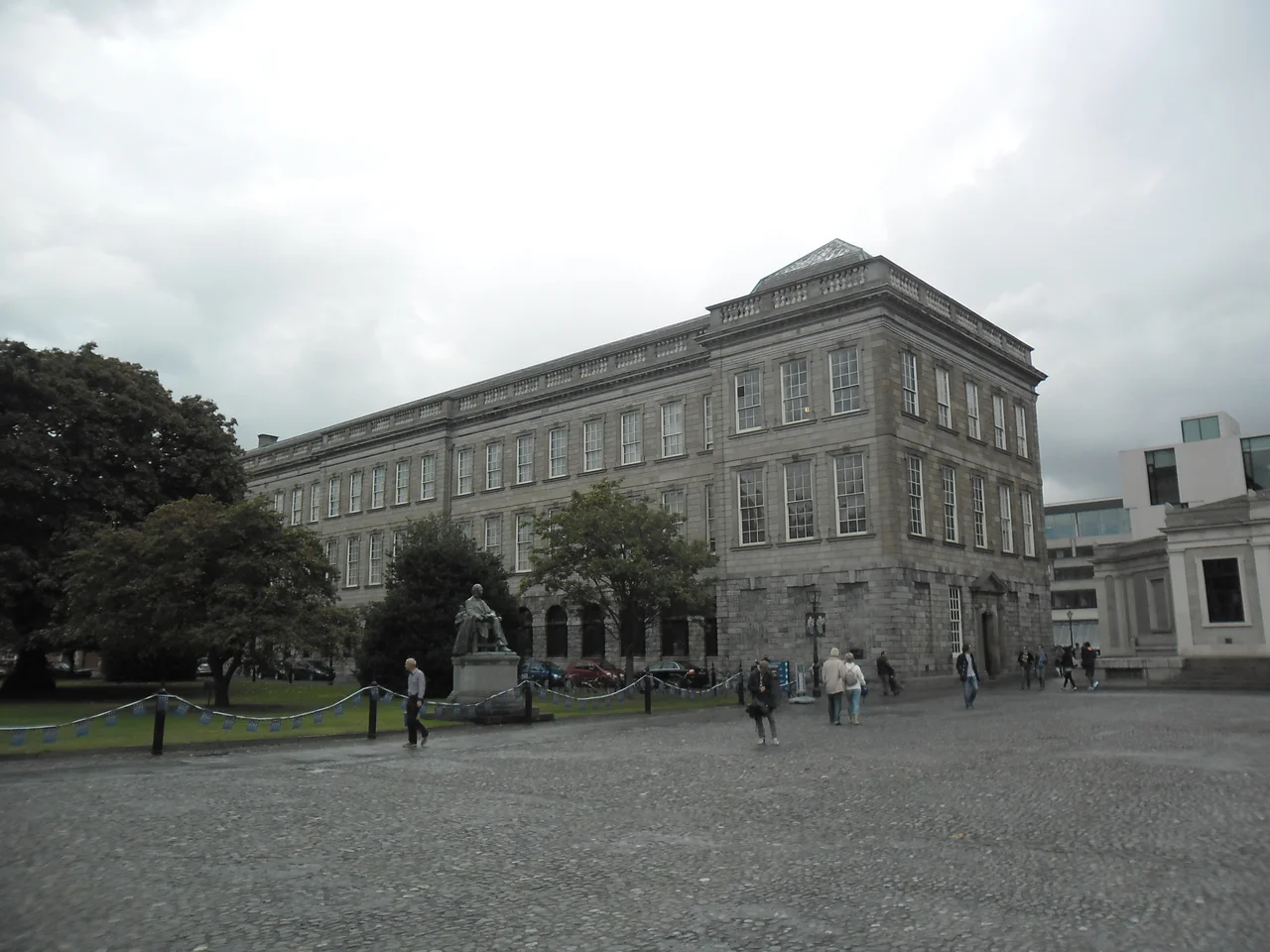

The Old Library, Trinity College Dublin
Step through the door of the Long Room and the smell hits first - centuries of leather binding, old paper, and the faint mineral tang of stone walls that have not been warm since 1732. The eye climbs sixty-five meters of oak bookcases up to the barrel vault arching overhead. Marble heads on stone plinths watch the visitors pass: Swift, Newton, Shakespeare, Boyle, all rendered in cool stone by Peter Scheemakers and Louis-François Roubiliac in the 1740s. And tucked into a glass case at the far end, opened to two illuminated pages, lies the Book of Kells - an eighth-century gospel manuscript whose interlace patterns once kept Irish monks bent over vellum by candlelight.
Burgh's Long Vision
When Thomas Burgh began the library in 1709, Trinity College had been collecting books since the time of Archbishop James Ussher - the same Ussher who calculated, by reading the Old Testament, that Creation had happened on the night before 23 October 4004 BC. Burgh's building was completed in 1732 after the original budget had to be extended in 1717. The structure was so ambitious that the college's books did not fill it. For more than a century the Long Room held empty shelves waiting for volumes. The stonecutters Henry and Moses Darley worked the calp limestone and Scrabo sandstone from family quarries in County Down. Francis Quin laid the brick. William Halfpenny painted the ceiling in 1733-34. Richard Castle, the great Palladian architect, returned around 1750 to oversee the staircase. The building took a generation, and several generations of master craftsmen, to finish.
The Vault That Made the Room
Visitors who think the barrel vault has always been there are mistaken. The original ceiling was flat, exactly as the painter James Malton recorded it in his 1792 illustration. By the mid-19th century the library had finally outgrown Burgh's shell. Between 1859 and 1861 the architects Thomas Newenham Deane and Benjamin Woodward stripped away Halfpenny's painted ceiling and lifted a soaring wooden barrel vault into its place, then added another tier of bookcases supported on granite columns. The sandstone facade outside had begun to decay, so it was replaced with darker granite from the Ballyknockan quarry in the Wicklow Mountains. Thomas Drew filled in the arcaded ground floor between 1889 and 1892. What looks ancient and inevitable is, like most of the past, a layered renovation.
Heads on Plinths
Claudius Gilbert, vice-provost of Trinity, died in the 1740s and left money for marble busts to line the Long Room. Fourteen original busts arrived in the mid-1740s, eight signed by Peter Scheemakers and the rest believed to be the work of Louis-François Roubiliac - sculptors who also carved tombs in Westminster Abbey. The collection grew across two centuries. John Henry Foley and Thomas Kirk added Victorian-era heads. Every face was a man. In February 2023, after 280 years, the library finally unveiled four marble busts of women - among them Lady Augusta Gregory, the folklorist and co-founder of the Abbey Theatre, and Mary Wollstonecraft, who had argued for the rights of women in 1792 while the painter Malton was sketching this very room.
The Manuscript at the End of the Room
The Book of Kells came to Trinity for safekeeping in the 1660s and never left. Bound in four volumes, two of which are usually on display, it contains the four Gospels in Latin, written and painted somewhere between 800 and 825 in a monastic scriptorium on Iona or at Kells. The interlace patterns spiral down through capital letters, animal forms twist into knots that take minutes to unravel by eye, and on the great Chi-Rho page the monogram of Christ explodes across an entire sheet of calf-skin in pigments made from ground stone and crushed insect. Roughly a million people queue through the Long Room every year to see it. In 2022 the college began a major redevelopment of the building, with restoration and rebuilding planned for 2027 to 2030, including the temporary removal of about 700,000 books into climate-controlled storage.
From the Air
53.3438 N, 6.2569 W, in the heart of central Dublin between College Green and Pearse Street. Best viewed from low altitude - the Trinity College campus forms a green rectangle bisected by College Park amid the dense city grid. Dublin Airport (EIDW) lies 9 km to the north; arrivals from the south often pass directly over the city center. The Old Library sits at the southeast corner of Front Square. Watch for typical Atlantic maritime weather - low cloud and drizzle are common; clear winter mornings give the best visibility over the Liffey.
Nearby Stories
- Wicklow Mountains 12 km away
- Mornington 14 km away
- German submarine U-1051 16 km away
- Abbey of Kells 18 km away
- Irish Military Intelligence Service 20 km away
- HMS Manners (K568) 37 km away
- Templemore 42 km away
- Irish Sea Bridge 43 km away