.jpg)
The Shard
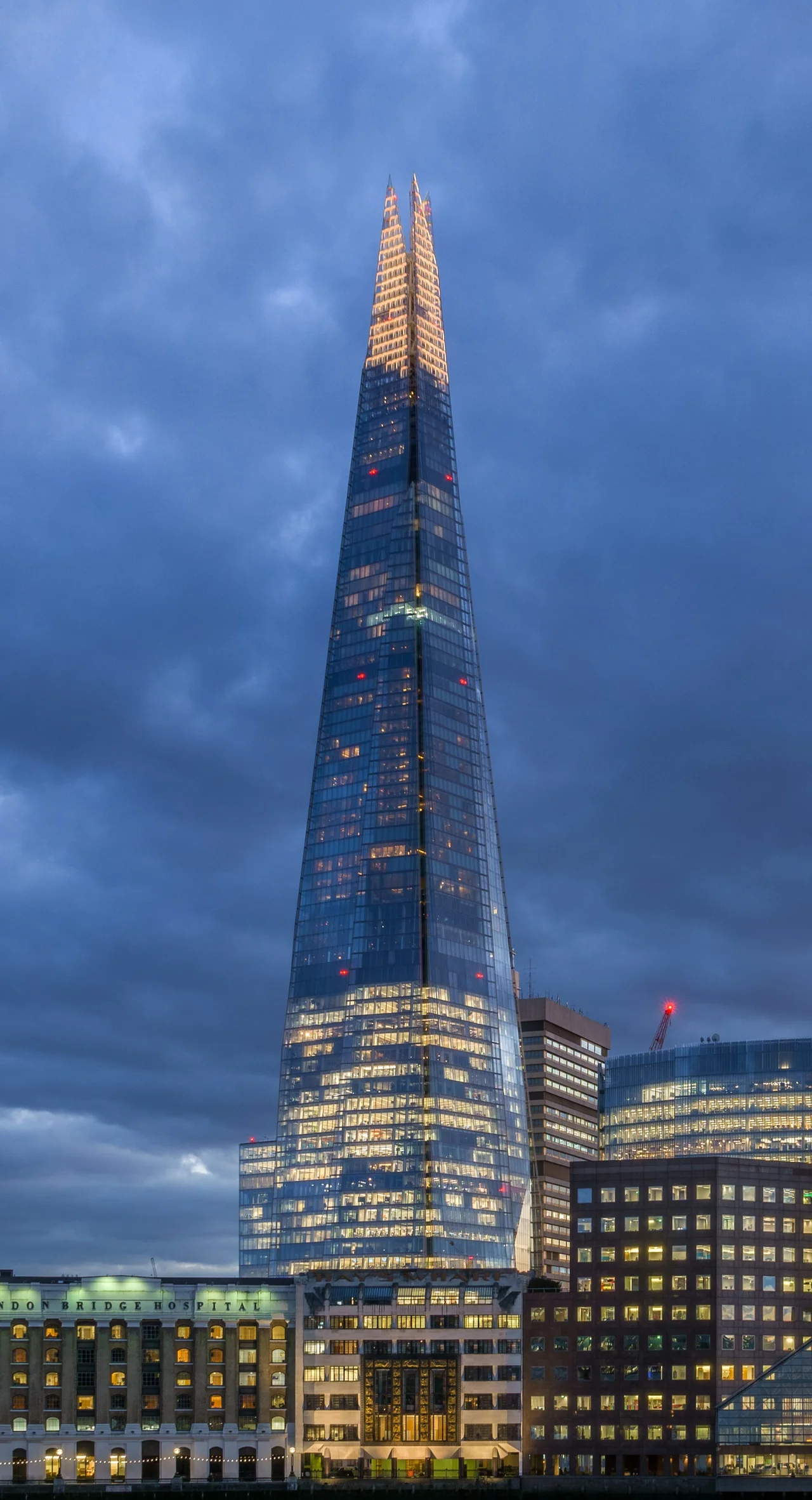
Renzo Piano sketched it on the back of a restaurant menu over lunch in Berlin in the spring of 2000. The Italian architect had been telling London entrepreneur Irvine Sellar what he thought of conventional skyscrapers, which was not much. Then he flipped the menu over, took out a pen, and drew a slender pointed sculpture rising out of the River Thames - tapered to a needle at the top, faceted like a piece of broken glass catching the sky. The finished building stands 309.6 metres above London Bridge station, the tallest in the United Kingdom and Western Europe. It has 11,000 panes of angled glass that change colour with the weather - sometimes silver, sometimes lavender, sometimes nearly the same shade as a London raincloud. It is one of those rare buildings that looks more or less the same in the architect's first sketch as it does today.
A Shard of Glass Through the Heart of London
Not everyone wanted the building. English Heritage opposed planning permission, warning that the tower would cast a shadow over views of St Paul's Cathedral and Tower Bridge. They called the design a shard of glass through the heart of historic London, intended as an insult, and that phrase gave the building its name. Piano disagreed. He saw the slender, spire-like form as a positive addition to a skyline that historically had been defined by church steeples, and proposed that the tapering glass facades would actually become more delicate than opponents claimed. The Deputy Prime Minister John Prescott called a planning inquiry. After hearings in April and May 2003, the Office of the Deputy Prime Minister announced on 19 November 2003 that consent had been approved. The building Piano had sketched on a menu would happen. The 24-storey 1970s office block called Southwark Towers that had stood on the site since 1975 was demolished. PricewaterhouseCoopers, its main tenant, moved out. Construction began in March 2009 in the middle of the worst financial crisis since 1929.
The Qatari Rescue
The project nearly died in the autumn of 2007. Sellar and his original partners had secured 196 million pounds in interim funding from Nationwide Building Society and the Icelandic bank Kaupthing Singer and Friedlander. Then the credit markets seized up. The whole development looked in danger of becoming what economists call the Skyscraper Index - the unhappy historical pattern in which the world's tallest buildings tend to be conceived during booms and finished during recessions. In January 2008 Sellar announced he had found a buyer. A consortium of Qatari investors led by Qatar National Bank paid 150 million pounds to take an 80 percent stake in the project. The original partners were bought out. Construction could proceed. By 2009 the State of Qatar had consolidated full ownership through additional purchases; the Shard is now 95 percent owned by Qatar and five percent by the Sellar Property Group. The Shangri-La hotel that occupies floors 34 to 52 is also Qatari-owned. The building that was named after an insult by English Heritage has become, in some ways, the most prominent piece of foreign investment in central London - an emblem at once of Italian design, British engineering, and Gulf capital.
Top-Down Construction and a Fox Named Romeo
The Shard introduced building methods that had never been tried in the United Kingdom. Top-down construction allowed the foundations to be excavated downward while the core was being built upward, a process more usual in Asia than in Britain. By March 2010 the concrete core was rising at three metres a day. In November 2010 the tower surpassed the height of Canary Wharf's One Canada Square, ending its 18-year reign as Britain's tallest building. The 66-metre, 500-tonne spire arrived on the construction site already test-assembled on a Yorkshire airfield by the steelwork contractor Severfield; it was broken down for transport and lifted into place by what was, at the time, the tallest crane ever built in Britain. The structure topped out on 30 March 2012. Along the way the building accumulated an unofficial mascot. During the cladding phase a red fox was discovered living near the top of the unfinished building. The construction crew called him Romeo. He had apparently entered through the central stairwell and survived on scraps of food left by builders working high above London. Eventually he was captured and taken to the Riverside Animal Centre in Wallington, an unwilling celebrity, his story repeated in newspapers around the world. The Shard was inaugurated on 5 July 2012 by the Prime Minister of Qatar Hamad bin Jassim bin Jaber Al Thani, in time for the London Olympics.
What Is Inside
The Shard contains 72 habitable floors arranged as a vertical city. Floors 2 to 28 hold offices - 26 floors of them, occupied by some 32 companies including Al Jazeera English's main London hub for the network's English-language broadcasting, Warwick Business School's London campus, the European headquarters of Kraft Heinz, and the recruitment giant Robert Half. Floors 31 to 33 hold three high-altitude restaurants: Hutong for Sichuan and northern Chinese, Oblix for modern grill, and Aqua Shard for British seasonal. Floors 34 to 52 are the Shangri-La Hotel, with 202 rooms including some at altitudes that put them above the cloud level on misty London mornings. Floors 53 to 65 contain ten residential apartments, never publicly priced but rumoured to have sold for sums approaching 50 million pounds each. Above them, between the 68th and 72nd floors, is The View from The Shard - the public observation deck. The pyramidal taper means that the building gets narrower toward the top, and the topmost levels are open to weather at the very pinnacle, where the spire continues upward unclad. Lifts climb the building at seven metres per second.
Climbers, Jumpers, and a Doctor in a Motorbike
The Shard's profile has made it a magnet for the kind of people who like to climb things they should not climb. In December 2011, before the building was even finished, a group of recreational explorers called the Place Hackers evaded security and climbed one of the construction cranes; their photos of London from the top went viral. Researcher Bradley Garrett later revealed that more than 20 urban explorers had reached the top of the Shard during its construction. BASE jumpers reportedly jumped from the building at least ten times between 2009 and 2012, four of those jumps by parachutist Dan Witchalls. On 11 July 2013, six Greenpeace volunteers climbed the building to unfurl a banner protesting Arctic oil drilling by Royal Dutch Shell - they had announced themselves as experienced climbers but paramedics were summoned to the base of the tower in case. Prince Andrew, then Duke of York, abseiled down 87 floors on 3 September 2012 to raise money for the Outward Bound Trust. The French urban climber Alain Robert tried to enter the building in November 2012 but was prevented by security and then by court injunction. The Shard has been the headquarters of an alien villain in Doctor Who - in The Bells of Saint John (2013) the Doctor rode an anti-gravity motorbike vertically up the building's south face to reach the antagonist's office. Spider-Man fought Mysterio on Tower Bridge in Spider-Man: Far From Home while Nick Fury watched from a Shard penthouse. In Pokemon Sword and Shield, the Pokemon Duraludon and its giant Gigantamax form are based directly on the building. It has become, in a way Renzo Piano probably did not anticipate over that 2000 lunch, an icon.
From the Air
The Shard sits at approximately 51.5044 degrees north, 0.0867 degrees west, immediately south of London Bridge and beside London Bridge railway station in the borough of Southwark. From altitude it is unmissable - the tallest building anywhere in Western Europe, a glass pyramid rising 309.6 metres above the south bank of the Thames, with 11,000 angled glass panels that reflect the surrounding sky. The Tower of London and Tower Bridge are immediately to the north across the river. London City Airport (EGLC) is roughly four nautical miles east; London Heathrow (EGLL) about fifteen nautical miles west. Best viewing altitudes are 2,000-3,500 feet to take in the full height of the building against the lower London skyline.
Nearby Stories
- Stevenage 5.7 km away
- Malling Abbey 5.7 km away
- 1952 Farnborough Airshow Crash 7.7 km away
- Ingatestone Hall 8.2 km away
- Hellfire Caves 9.1 km away
- The Carrington Event: The Solar Storm That Could Happen Again 9.8 km away
- Bletchley Park 16 km away
- Castle Hedingham 23 km away