
The Tribunal, Glastonbury
The building looks like a courthouse. It is called the Tribunal. People have assumed, since at least 1791, that this was where Glastonbury Abbey held its assizes - where secular justice was dispensed for the Twelve Hides of Glaston, where Judge Jeffreys may have presided over the Bloody Assizes after the Monmouth Rebellion. The trouble is, there is no evidence for any of it. A stone house on Glastonbury High Street has gone for over two centuries by a name that was probably someone's guess.
What the Stone Knows
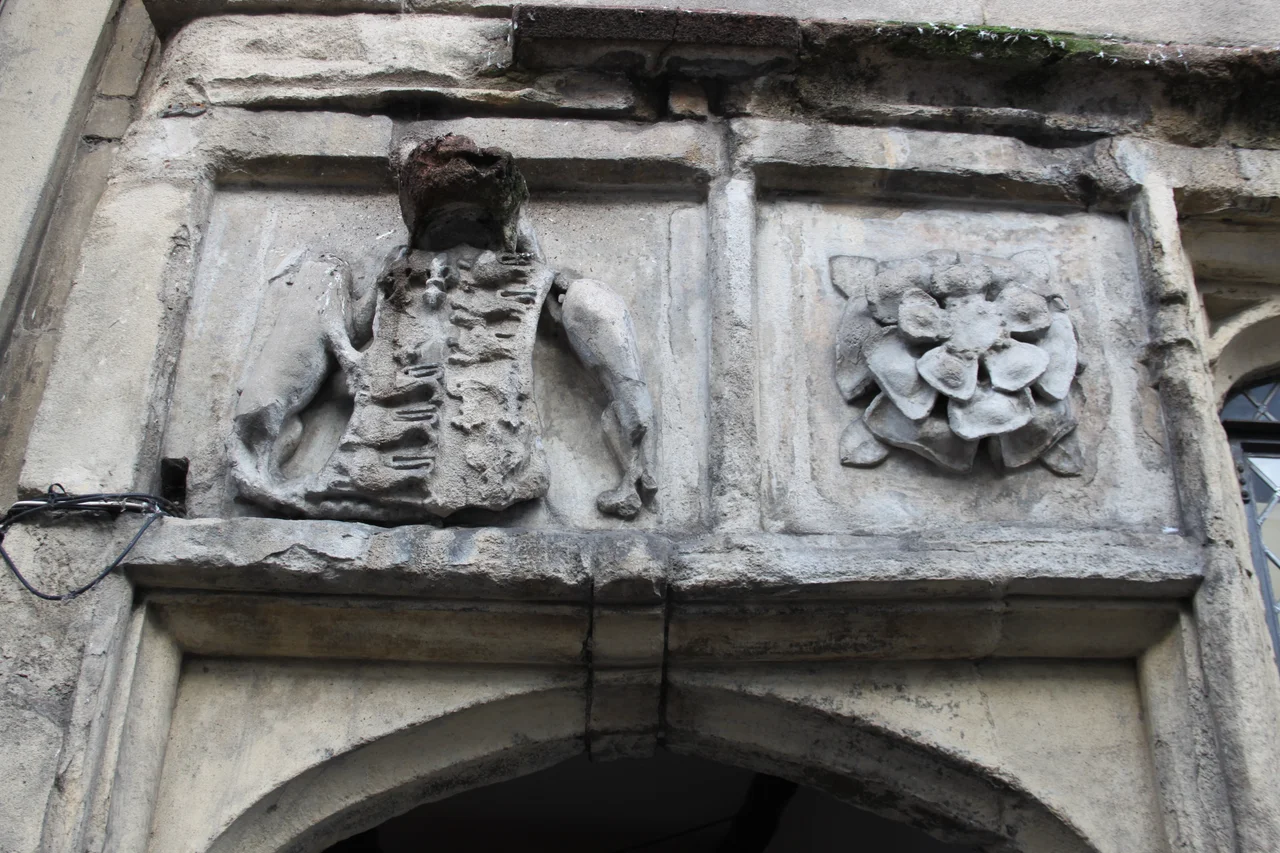
The building's actual past is more modest and more interesting. A timber structure stood on this spot in the 12th century. The current stone house was built in the 15th, almost certainly as a merchant's house, with a fashionable new facade added in the 16th century when the kitchen block went up at the rear. The front room upstairs still has its original arched braced wooden truss roof. The hall on the ground floor preserves a four-light window and Elizabethan ceiling panels with their original plasterwork. One door bears the royal arms above it, carved when this was someone's substantial private home, not a court. Over five centuries it has been a merchant's house, a shop, a school, and a convent. In 1791 the antiquary John Collinson, writing his History and Antiquities of the County of Somerset, called it the Tribunal - and the name stuck. When Richard Warner went looking for the source of the claim in 1826, he could not find one.
The Lake Village Inside
What lives inside the building now has nothing to do with merchants or courts. The Tribunal houses the Glastonbury Lake Village Museum, run by the Glastonbury Antiquarian Society - one of the oldest archaeological societies in England - and curated from objects pulled out of the Somerset peat in the 1890s. Three miles northwest of town, on the boggy ground near Godney, the medical student Arthur Bulleid found something in 1892 that he had been looking for since reading about Swiss lake villages: an Iron Age settlement built on an artificial timber platform in a marsh. He and Harold St George Gray spent fifteen years digging it out. The peat had preserved everything - wood, basketry, cloth fragments, hearths, the bones of beavers and otters. They left most of the timbers buried as the best way to protect them. The portable finds came to the Tribunal.
The Glastonbury Bowl
The most famous object in the collection is the Glastonbury Bowl, a small bronze vessel pieced together from two separately cast halves. The lower half is Iron Age. The upper half was added in the first century AD, probably cut from a sheet of metal that had been something else first. Over its working life it was riveted, repaired, riveted again. It is the kind of object that complicates the picture of prehistoric Britain as primitive - this is sophisticated metalwork that someone valued enough to keep mending. Alongside it are iron currency bars (Iron Age tokens used like coins), whetstones, weaving combs, clay tuyeres from bellows, original storage jars reassembled by Bulleid, and in the Tudor kitchen at the back of the building, an eighth- or ninth-century log canoe found near the lake village site. The canoe is older than the building that holds it by six hundred years.
A Court That Never Was
English Heritage owns the building now and Glastonbury Town Council runs the museum, with proceeds flowing back into the town. The Bloody Assizes connection - Judge Jeffreys, the brutal aftermath of the failed 1685 Monmouth Rebellion, hundreds of men sentenced to death and transportation in summary proceedings - turns out to be wishful Gothic. The trials were held in Wells, not Glastonbury. The Tribunal was probably just a house, owned by a prosperous medieval merchant who could afford stone and stained glass, and later passed through hands that adapted it for whatever the times required. That a building named for justice it never administered ended up holding the artefacts of a vanished marsh village no one remembered for two thousand years is the kind of small joke that Glastonbury seems to specialise in. The wrong name, the right contents.
Visiting
The Tribunal stands on the High Street, a few minutes' walk from the abbey ruins, and serves as Glastonbury's tourist information centre as well as its museum. The Glastonbury Antiquarian Society, founded in 1886 by Arthur Bulleid's father, still curates the exhibits. Walk through the medieval doorway, past the royal arms, into rooms where Elizabethan plasterwork looks down on glass cases of Iron Age weaving combs and a bronze bowl mended in the first century. The merchant who built the house could not have known any of this would happen. The artefacts in the cases predate his building by more than a thousand years, and they survived because someone buried them in peat and someone else, much later, decided to dig them up.
From the Air
The Tribunal stands on Glastonbury High Street at 51.148 degrees north, 2.717 degrees west, in the heart of the medieval town. Glastonbury Tor is half a mile east. The Iron Age lake village site whose artefacts fill the building lies three miles northwest near Godney, in the low-lying Somerset Levels. Nearest airports: Bristol (EGGD), 22 nm north; Exeter (EGTE), 50 nm southwest. Best identified from the air by Glastonbury Tor; the Tribunal itself is one stone building among many on the medieval grid.
Nearby Stories
- New Wardour Castle 2.6 km away
- Cosmeston Medieval Village 9.6 km away
- Ottery St Mary 9.7 km away
- Royal Naval Cordite Factory, Holton Heath 9.8 km away
- Quantock Hills 11 km away
- M Shed 14 km away
- Maiden Castle, Dorset 17 km away
- Silbury Hill 20 km away