.jpg)
The View from The Shard
The lifts climb at seven metres per second. From the ground-floor lobby, a 16-mile-per-hour ride - including a transfer at the 33rd floor - delivers visitors to the 68th level in about 60 seconds. The doors open and the view falls away in every direction. On a clear day visibility reaches 40 miles, which is enough to see the green smudge of the South Downs to the south, the Chiltern Hills to the north-west, and the curve of the Thames Estuary heading east toward the North Sea. The View from The Shard, which opened on 1 February 2013, is the highest publicly accessible vantage point in London. In its first year nearly 900,000 visitors paid to ride those lifts. The viewing platform made over five million pounds in profit before its first birthday.
The 69th Floor: The Indoor Gallery
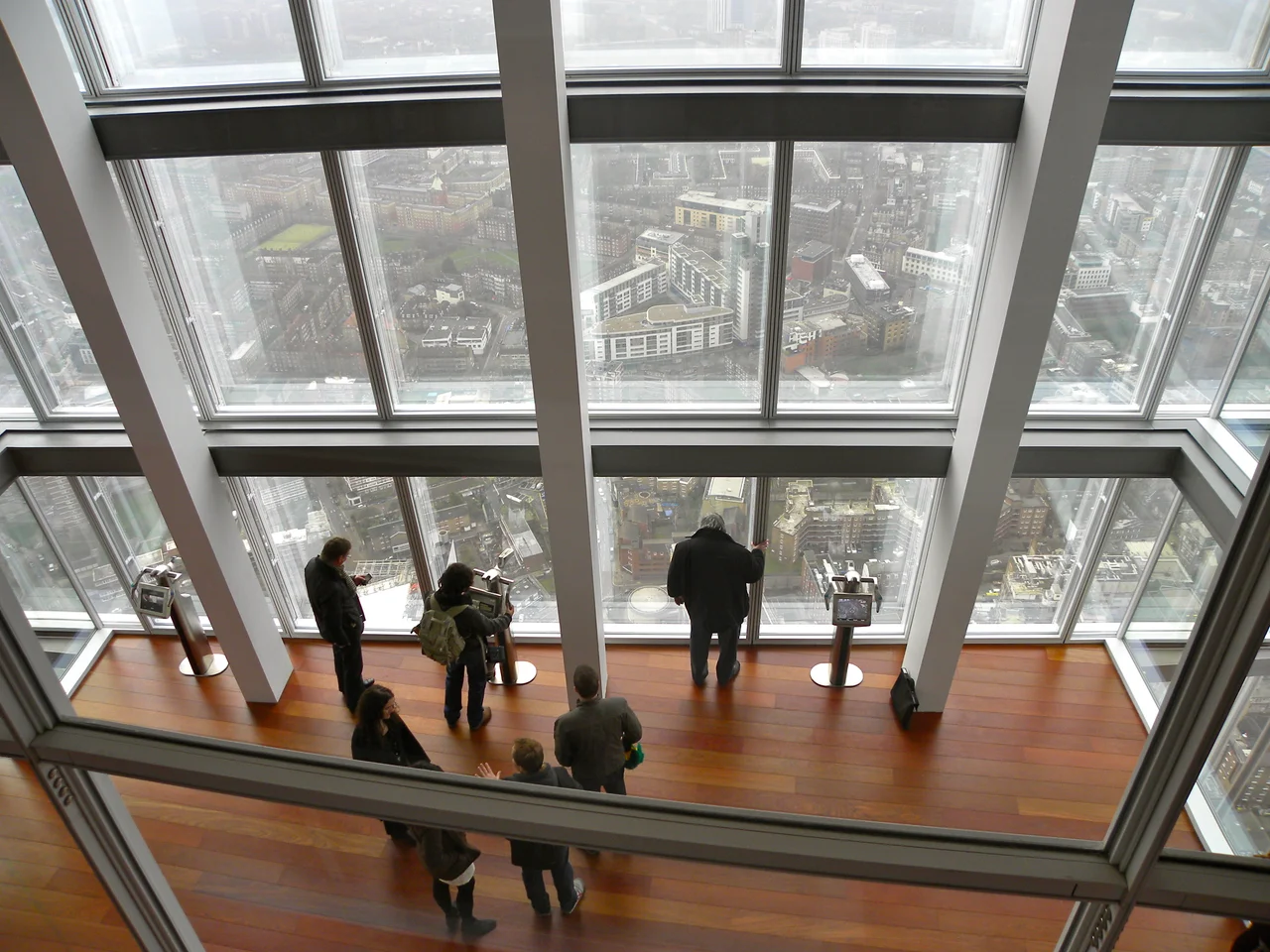
The main viewing gallery occupies the 69th floor of the Shard. It is a triple-height space with floor-to-ceiling windows on all four sides of the building's tapered pyramid - a 360-degree panorama of London from 244 metres up. The team of London Experts who work on the platform are trained to walk visitors through what they are seeing, identifying landmarks across the cityscape. To the north and west the view picks out St Paul's Cathedral, the Houses of Parliament, the London Eye, and the BT Tower; to the east, Canary Wharf, the Olympic Stadium, and the docks; to the south, Crystal Palace, the radio masts of Croydon, and on the clearest days the ridge of the South Downs running through Sussex. Telescopes mounted around the perimeter let visitors zoom in. Interactive screens identify what you are looking at when you point them. The Experts will, if asked, narrate the history of any building visible from the windows - which is most of central London.
The 72nd Floor: Above the Pyramid
Three storeys higher, accessed by another short lift ride, is the 72nd floor - the highest public level in the building at exactly 800 feet, 244 metres above the ground. This gallery is partly open to the sky. The pinnacle of the Shard continues upward overhead - the unclad spire that gives the building its sharp profile - and the wind blows freely between the steel armatures, occasionally with enough force on the upper deck that visitors instinctively grab the rails. The view here is more dramatic than from the indoor gallery below because the surrounding glass is gone. On a clear winter day with the sun low in the south you can watch your own shadow stretch across half of central London. Snow occasionally settles inside the open platform. In summer, swifts and the occasional peregrine falcon fly past at eye level. The peregrines have colonised the Shard's upper structure, nesting in the gaps between the spire's beams. Pause long enough at the rail and you may see one fold its wings and stoop toward a pigeon hundreds of feet below.
What 40 Miles Looks Like
London is famous for not being a city that gives you a view. The traditional skyline has very few tall buildings, and most of the great central squares - Trafalgar, Parliament, Soho - sit at street level surrounded by Georgian and Victorian terraces. To get an aerial sense of London before the Shard opened, you needed the London Eye, which sat at 135 metres, or the dome of St Paul's Cathedral at 111 metres, or the corner balcony of Tower 42 at 183 metres, or the gallery of the Monument at 60 metres. The View from The Shard nearly doubled what was previously possible. From up here the texture of the city becomes visible. The medieval street pattern of the City of London, snaking around what used to be Roman walls, contrasts sharply with the grid-like Georgian estates of Mayfair and Bloomsbury. The Royal Parks - Hyde Park, Regent's Park, Green Park, St James's Park - form a chain of dark green pools across the western half of the view. The Thames meanders past the building like a silver ribbon. You can trace its serpentine bends from Battersea past the Houses of Parliament around the Isle of Dogs and onward toward the Thames Estuary.
The Highest Public Toilet in Britain
One small architectural detail at the top of the building has earned its own modest fame. The visitor toilets on the upper viewing levels feature floor-to-ceiling windows positioned to look directly out over the Thames and the City of London. The windows have optional electric blinds, in case privacy is preferred over view. The result is, by some accounts, the loftiest place in Britain you can urinate while looking down on the dome of St Paul's. As of 2023 the venue also includes a champagne and cocktail bar, a gelato counter, and a coffee shop on Level 69, plus a second champagne bar on Level 72 where visitors can sip drinks while the wind whistles past the open deck. A few couples have proposed marriage here, and at least one wedding has been performed at altitude. Special after-dark sessions called Silent Disco at the Shard have, occasionally, put visitors in wireless headphones and let them dance 244 metres above the city at midnight.
A View Earned by Money and a Long Lift
Tickets are not cheap. The View charges between 25 and 35 pounds depending on time of day and visibility booking - which means an entire family outing can cost over 100 pounds, a fact that has drawn criticism from those who would prefer that the highest public view of the city be free. The view from the dome of St Paul's, by comparison, costs a fraction; the view from the parks costs nothing. But the Shard provides something the other vantage points cannot. London's skyline grows visibly more crowded every year - new towers continue to rise in the City of London cluster (the Walkie-Talkie, the Cheesegrater, 22 Bishopsgate) and across the river at Canary Wharf and Battersea. From most ground-level perspectives, the city's relentless verticalisation feels overwhelming. From the Shard, that same crowd of towers turns into a small, almost intimate huddle in a vast horizontal landscape - the rest of London stretching out for forty miles in every direction, low and flat and surprisingly green.
From the Air
The View from The Shard occupies the upper floors of the Shard skyscraper at approximately 51.5045 degrees north, 0.0865 degrees west, immediately south of London Bridge in Southwark. The viewing platforms sit between 244 and 250 metres above ground level - actually above the cruising altitude of many slow general aviation flights over the city. From altitude the open partially-uncovered observation gallery at the top of the Shard is just barely visible as a small slot of darkness near the pinnacle, with the spire's lattice steelwork rising above. London City Airport (EGLC) is approximately four nautical miles east; London Heathrow (EGLL) about fifteen nautical miles west. Best viewing altitudes for spotting the platform itself are 2,500-3,500 feet.
Nearby Stories
- Stevenage 5.7 km away
- Malling Abbey 5.7 km away
- 1952 Farnborough Airshow Crash 7.7 km away
- Ingatestone Hall 8.2 km away
- Hellfire Caves 9.1 km away
- The Carrington Event: The Solar Storm That Could Happen Again 9.8 km away
- Bletchley Park 16 km away
- Castle Hedingham 23 km away