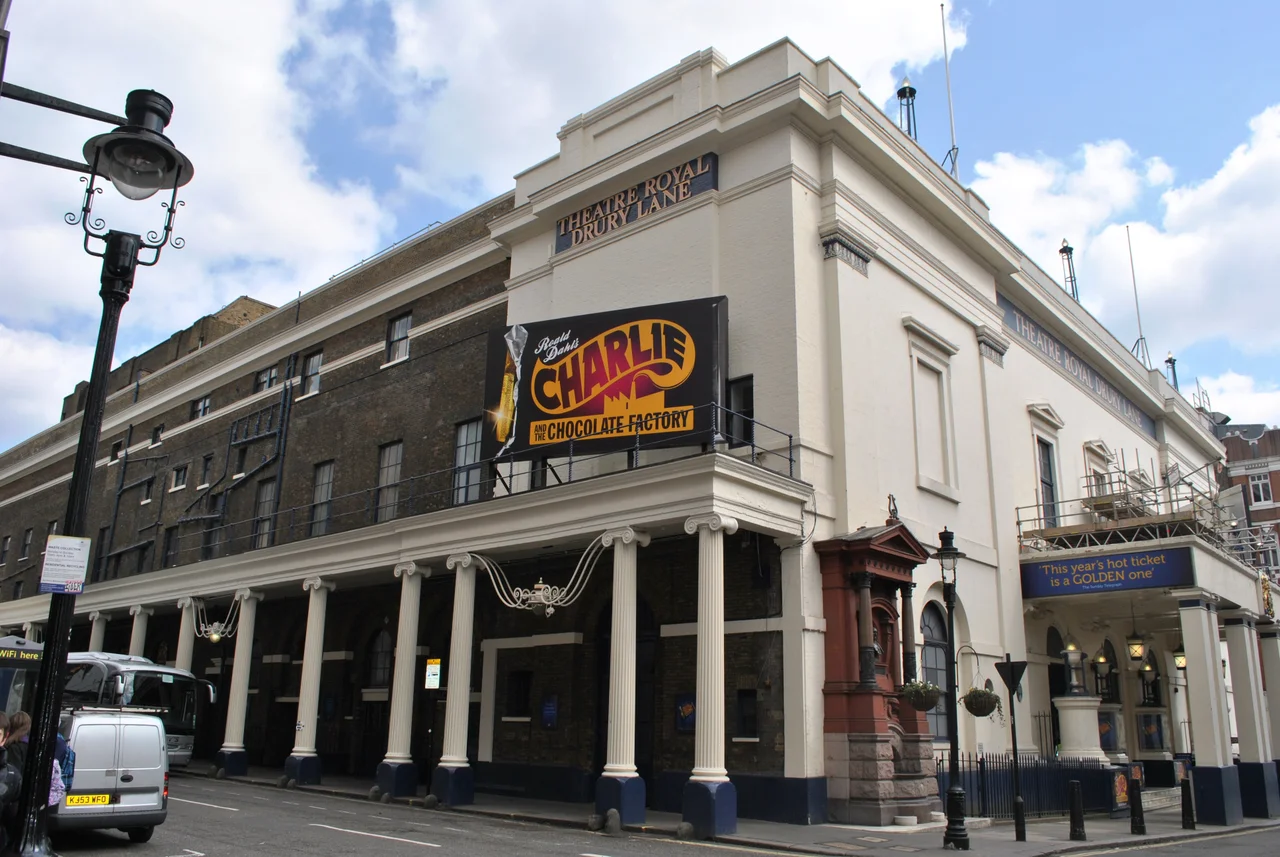

Theatre Royal, Drury Lane
An assassin took two shots at King George III in a London theatre on the night of 15 May 1800. James Hadfield, a soldier deranged by head wounds received fighting in Flanders, stood up from his seat in the pit of Drury Lane and raised a horse pistol toward the royal box, where the king sat with his family. A spectator named David Moses Dyte saw the gun rise and jostled Hadfield's arm. The first shot missed by inches. The second shot also missed. Hadfield was subdued. The king, apparently unruffled, ordered the performance to continue. He then took a calm nap during the interval. The play that night was a comic afterpiece called The Humourist. The theatre where this happened still exists, on the same site it has occupied since 1663 - the longest continuously used theatre site in the English-speaking world.
Four Buildings, One Site
The Theatre Royal Drury Lane has burned down, twice, and been demolished, once, since Charles II granted Letters Patent in 1660 to Thomas Killigrew permitting him to establish a new theatre company. The first building opened on 7 May 1663. It burned in January 1672. The second building, designed by Christopher Wren in the aftermath, opened in 1674 and served for over a century before being declared structurally unsafe and demolished in 1791. The third building, designed by Henry Holland for the actor-manager-playwright Richard Brinsley Sheridan, opened in 1794 with a capacity of more than 3,600 - the largest theatre London had ever seen. Sarah Siddons called it a wilderness of a place and left the company. The third building was equipped with what were then state-of-the-art fire precautions: an iron safety curtain, water reservoirs, water sprinklers. It burned down anyway on 24 February 1809. Sheridan watched the conflagration from a coffee house across the street; offered the loan of an overcoat against the cold, he replied that a man may surely be allowed to take a glass of wine by his own fireside. The fourth and current building, designed by Benjamin Dean Wyatt, opened on 10 October 1812 with a production of Hamlet. It has been in continuous operation for over 213 years.
The Theatres Act and the Patent System
For most of its history the Theatre Royal occupied a strange legal niche. King Charles II's 1660 patent had created a monopoly. Together with the Theatre Royal Covent Garden and, briefly, the Lincoln's Inn Fields theatre, Drury Lane was one of only a small number of London venues legally permitted to stage spoken drama. Other theatres around the city offered music, dance, pantomime, sideshows, anything except the legitimate play. The patent monopoly survived for 183 years. When the Theatres Act of 1843 finally abolished it, the patent had been largely toothless for decades. Variety theatres in places like the Lyceum had been quietly pushing the boundaries for years, sometimes literally smuggling plays into evenings of music and dance. Drury Lane responded to the increased competition the way it had responded to its own unmanageable size in the late 18th century - with spectacle. The 1823 production of Cataract of the Ganges climaxed with an actor on horseback escaping up a cascading waterfall while fire raged across the stage. A production in 1829 used hydraulic apparatus that could pour 39 tons of water across the stage in minutes. By the 1880s under Augustus Harris the Christmas pantomimes had become some of the most lavish productions of the Victorian era, with dance master John D'Auban choreographing armies of children across stages full of fairy palaces and exploding fireworks.
The American Decade
Drury Lane's 20th century was nearly bankrupt until Broadway saved it. Rodgers and Hammerstein's American musicals arrived after the Second World War and held the stage for almost a decade. Oklahoma! opened in April 1947 and ran for over three years. Carousel followed for 1950-51. South Pacific from 1951 to 1953. The King and I from 1953 to 1956. Then Lerner and Loewe's My Fair Lady arrived in 1958 and stayed for five years. For most of the postwar decade and a half, Drury Lane was effectively a colony of the New York musical theatre, where Londoners came to see the American shows that were redefining the form. Later long runs continued the pattern. A Chorus Line from 1976 to 1979. 42nd Street from 1984 to 1989. Then Miss Saigon arrived in 1989 and stayed for ten years - the theatre's longest-running show. Andrew Lloyd Webber purchased the building in 2000. Charlie and the Chocolate Factory played from 2013 to 2017. Frozen from 2021 to 2024. In May 2013 Lloyd Webber unveiled a 4-million-pound restoration to mark the theatre's 350th anniversary, returning the Regency-era Rotunda, Royal Staircases, and Grand Saloon to something approaching their original 1810 condition.
The Man in Grey and Other Ghosts
Tom Ogden's book Haunted Theatres of the World calls Drury Lane one of the most haunted theatres on Earth. The most famous ghost is the Man in Grey, who appears in the upper circle dressed as a late 18th-century nobleman - powdered hair under a tricorne hat, a long cloak, riding boots, and a sword. According to legend the Man in Grey is the ghost of a man whose skeletal remains were discovered in 1848 walled up inside a side passage of the theatre with a knife between his ribs. Witnesses report seeing the figure walk a specific path from the end of the fourth row in the upper circle along the rear gangway to the wall near the royal box, where the remains were found. Unlike most ghosts, an appearance of the Man in Grey is considered lucky - actors who have seen him before performances often have hits. The ghost of the actor Charles Macklin haunts a backstage corridor at the spot where, in 1735, he killed a fellow actor named Thomas Hallam in an argument over a wig - Macklin shouted Goddamn you for a blackguard, scrub, rascal and thrust a cane into Hallam's face, piercing his eye and killing him hours later. The ghost of the clown Joseph Grimaldi, who died in 1837, is said to be a helpful presence backstage, occasionally guiding nervous actors safely across the stage in the dark. The comedian Stanley Lupino claimed to have seen the ghost of Dan Leno, the great Victorian pantomime comedian, in a dressing room.
The First Theatre Lit by Gas
Drury Lane has been responsible for several firsts in British theatre history. On 6 September 1817 it became the first British theatre to be entirely gaslit - the gas lights had already been extended to the audience areas, and that evening they were extended onto the stage itself for the first time. Audiences could suddenly see actors clearly in any part of the stage at any moment of the play, which slowly transformed acting styles away from the broad gestures necessary in candlelight toward more naturalistic performance. The portico that still stands at the Catherine Street entrance was added in 1820. The colonnade running the length of the Russell Street side was added in 1831. The theatre served as the headquarters of the Entertainments National Service Association during the Second World War, organising shows for British and Allied troops, and sustained some minor bomb damage. It reopened in 1946 with Noel Coward's Pacific 1860. The seating is currently around 2,000 - still one of the largest auditoria in the West End, although smaller than the wilderness of a place built in 1794. If you sit in the upper circle on a quiet matinee day, in the same seat at the end of the fourth row where W.J. MacQueen-Pope claimed to have seen the Man in Grey, the theatre creaks around you like a ship - all 213 years of it - and you understand why the ghosts have stayed.
From the Air
Theatre Royal Drury Lane sits at approximately 51.5131 degrees north, 0.1203 degrees west, on Catherine Street just east of the Royal Opera House in Covent Garden. From altitude the theatre's distinctive 1820 portico and the colonnade along Russell Street are not easy to spot among the surrounding Georgian terraces; navigate instead by the Royal Opera House's larger glass-and-iron Floral Hall extension immediately to the west, and the curved bend of the River Thames a short way south. London City Airport (EGLC) is roughly six nautical miles east; London Heathrow (EGLL) about thirteen nautical miles west. Best viewing altitudes are 1,500-3,000 feet.
Nearby Stories
- Stevenage 5.7 km away
- Malling Abbey 5.7 km away
- 1952 Farnborough Airshow Crash 7.7 km away
- Ingatestone Hall 8.2 km away
- Hellfire Caves 9.1 km away
- The Carrington Event: The Solar Storm That Could Happen Again 9.8 km away
- Bletchley Park 16 km away
- Castle Hedingham 23 km away