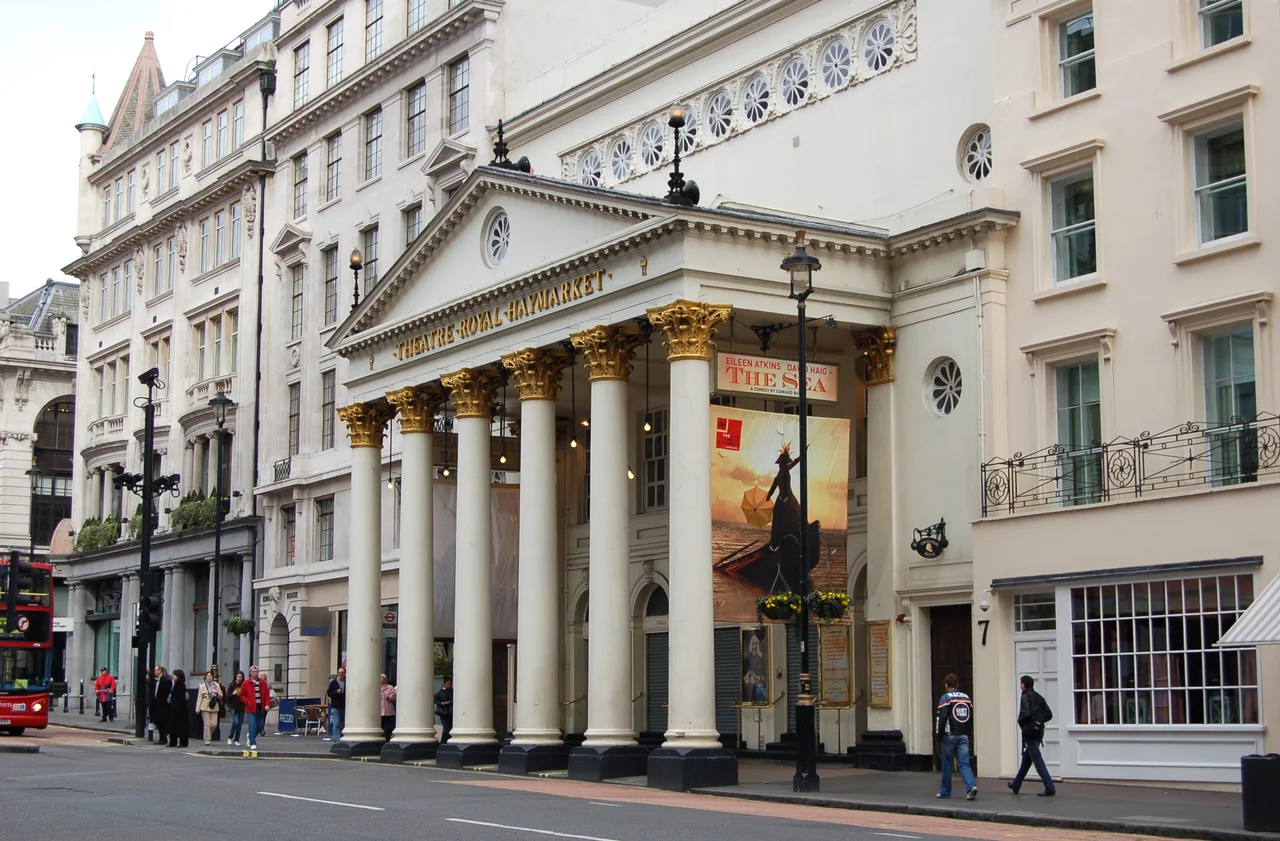

Theatre Royal Haymarket
The actor-managers used to joke that the Haymarket had two leading men: whoever was billed, and John Baldwin Buckstone. Buckstone died in 1879, but theatergoers and cast members still report seeing him in the wings on comedy nights - most famously, Patrick Stewart, who told The Daily Telegraph in 2009 that he saw the Victorian manager standing in the shadows during a 2009 performance of Waiting for Godot. Whether or not you believe in ghosts, the building itself certainly remembers. A playhouse has stood on this slice of Haymarket since 1720, making the Theatre Royal the third-oldest London theatre still in use. Inside its John Nash colonnade, every brick has heard somebody die well and somebody else be born to it.
The Carpenter's Gamble
The whole enterprise began as a side hustle. In 1720 a carpenter named John Potter put up £1,500 - £1,000 for construction, £500 for scenery and costumes - on the site of the King's Head Inn and a gunsmith's shop trading under the sign of the Cannon and Musket. He called his speculation the New French Theatre, and it opened on 29 December that year with a French company performing La Fille a la Morte. Henry Fielding's anti-government satires made the Little Theatre in the Hay famous and dangerous; the government responded with the 1737 Licensing Act, which effectively shut the place down. For decades afterwards, productions snuck in under transparent dodges. One advertisement promised "a Concert, after which, will be exhibited (gratis) a Rehearsal, in the form of a Play, called Romeo and Juliet." The audience knew the wink. So did the censors. Some nights it worked.
Foote's Royal Patent
Samuel Foote was a comic actor who lost a leg in a riding accident as the guest of the Duke of York. The duke felt guilty enough to help Foote secure something extraordinary in 1766: a royal patent to perform legitimate spoken drama during the summer months. London had previously had only two patent theatres, Drury Lane and Covent Garden, both monopolizing winter. With this patent the Haymarket became London's third patent theatre, finally legal, and it opened its rebuilt house on 14 May 1767 as the Theatre Royal. Foote made the place pay by impersonating well-known Londoners on its stage, until the well-known Londoners pushed back hard enough that he sold the theatre to George Colman Sr. in 1777. The Colman family ran it for the next half-century, sometimes from a debtors' prison, sometimes from a small room behind the stage.
Nash's Portico
The original building sat slightly to the north. The current one - the white stone portico that still faces Haymarket today - was raised in 1821 to designs by John Nash, the Prince Regent's favorite architect, the man who shaped Regent Street and Regent's Park. Nash gave the Haymarket a colonnade you can still walk under, and an interior that has been remodelled but not replaced. The auditorium currently seats 888. The freehold belongs to the Crown Estate, as it has for centuries, and the building carries Grade I listed status - the highest level of architectural protection English law affords. In 1873 the Haymarket invented something that every theatregoer now takes for granted: it staged the world's first scheduled matinee performance, a daytime show in addition to the evening one. Within a few years every theatre in London was doing it.
Wilde Premieres and a Dark Connection
Under the actor-manager Herbert Beerbohm Tree in the 1890s, the Haymarket became the house where Oscar Wilde tested his comedies on the world. A Woman of No Importance had its premiere here in April 1893; An Ideal Husband followed in January 1895. Tree's 1895 production of George du Maurier's Trilby made him so much money that he used the profits to build Her Majesty's Theatre across the road and found the Royal Academy of Dramatic Art - RADA. There is a darker line in the building's roster too: John Sleeper Clarke, an American comic actor who managed the Haymarket later in the nineteenth century, was the brother-in-law of John Wilkes Booth. After Booth assassinated Abraham Lincoln in 1865, Clarke chose London over Washington and never went home. The Haymarket gave him a stage where the surname carried no weight.
The Ghost Light
Buckstone managed the theatre from 1853 to 1878, and audiences adored him. He died in 1879, and the sightings began almost immediately. The pattern is consistent: he prefers comedies, appears in the dress circle or the wings, watches contentedly, and vanishes. Margaret Rutherford reported him. Donald Sinden reported him. Patrick Stewart's 2009 sighting was the most widely circulated. Whether you take the stories seriously or not, they say something true about the building - that nearly three hundred years of actors have stood in those wings, and the place holds them somehow. In 2025 the theatre's billings include Brian Cox playing Bach in The Score and Tamsin Greig in Rattigan's The Deep Blue Sea, with David Harewood announced as Othello to Toby Jones's Iago. The carpenter's gamble of 1720 is, by any measure, still paying out.
From the Air
Theatre Royal Haymarket sits at 51.5086°N, 0.1314°W on Haymarket in the City of Westminster, between Pall Mall and Piccadilly Circus. Best viewed at low altitude on approach to or from London City Airport (EGLC) or London Heathrow (EGLL). Surrounding landmarks: Trafalgar Square to the southeast, St James's Palace to the southwest, Piccadilly Circus immediately to the north.
Nearby Stories
- Stevenage 5.7 km away
- Malling Abbey 5.7 km away
- 1952 Farnborough Airshow Crash 7.7 km away
- Ingatestone Hall 8.2 km away
- Hellfire Caves 9.1 km away
- The Carrington Event: The Solar Storm That Could Happen Again 9.8 km away
- Bletchley Park 16 km away
- Castle Hedingham 23 km away