
Third Siege of Missolonghi
The church of Ayios Spiridhon in Missolonghi is small and ordinary-looking. In the spring of 1826, the leaders of a besieged city gathered there to make an impossible decision. The food was gone. The cats, dogs, donkeys, and horses had been eaten. The people still alive were described by witnesses as skeletal, their skin pale and livid, barely able to walk. After nearly a year of blockade, there was no relief coming. The choice before them was not whether to resist, but how to die — and whether the women and children might somehow be spared.
A City That Would Not Fall
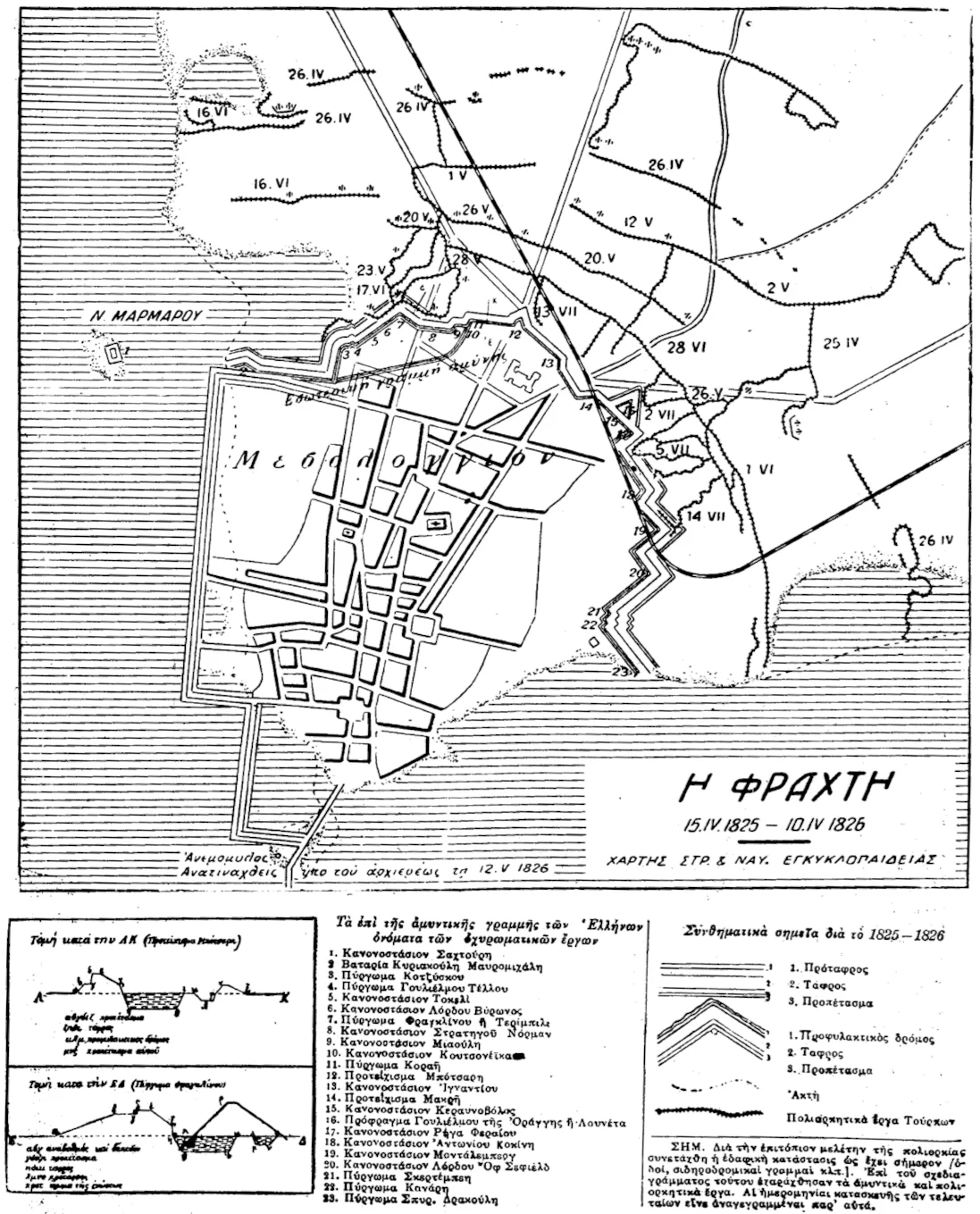
Missolonghi sat on a promontory jutting into a lagoon on the Gulf of Corinth, and its geography was the source of both its strategic importance and its stubborn survivability. The Ottoman Empire had already tried twice to take the city — in 1822 and 1823 — and failed both times. When the commander Reşid Mehmed Pasha arrived for the third attempt in spring 1825, the Sultan had made the stakes clear: either Missolonghi falls, or your head. The Ottoman force numbered 20,000, of which 8,000 were professional soldiers; the defenders inside the walls were roughly 3,000, most of them Greek, along with a small number of Italian, Swiss, and German volunteers who had come to support the Greek cause.
The city's defenses had been reinforced by a military engineer from Chios named Michael Kokkinis, who built 17 bastions with 48 guns and 4 mortars arranged in triangular projections to create overlapping fields of fire. Kokkinis named each bastion after a hero of liberty — Benjamin Franklin, Lord Byron, Tadeusz Kościuszko, Markos Botsaris, Skanderbeg. Byron himself had died in Missolonghi the previous April, lending the city a particular gravity in the eyes of the European public. The defenders held. Whenever the Ottomans breached a wall, the townspeople — men and women together — filled the gap in the night.
The Tightening Noose
Through the summer and autumn of 1825, the siege became a war of mines and mounds. The Ottomans built earthen mounds to gain elevated firing positions; the defenders destroyed them with gunpowder mines dug beneath the Ottoman camps. One Greek eyewitness described the aftermath of a successful counter-mine: "We too were terrified and fell to the ground…legs, feet, heads, half bodies, thighs, hands and entrails fell on us and on the enemy." Between assaults, the two sides sometimes talked across the walls during truces, trading words almost like old acquaintances.
The city might have held indefinitely if not for a change in the strategic balance. In the fall of 1825, Mohammed Ali of Egypt sent 135 ships and 10,000 troops under his son Ibrahim Pasha, who crossed the Gulf of Corinth and joined the siege in January 1826. Ibrahim brought artillery. Over three days in February 1826, his forces fired 5,256 cannon balls and 3,314 mortar shells into the city, destroying much of it. Then he moved to seal the lagoon. One by one, the small islands controlling the entrance fell — Vasiladhi, Dolmas, Poros, finally Anatolikon. Greek Admiral Andreas Miaoulis, who had kept the city supplied through repeated runs through the blockade, could no longer break through. The lagoon became a closed trap, and the people inside began to starve.
The Night of the Exodus
The plan they made at the church of Ayios Spiridhon was desperate by necessity. On the night of 10 April 1826, the able-bodied survivors would attempt a mass breakout. Three columns would go simultaneously: Dimitrios Makris leading the right column with the women and children, Kitsos Tzavelas on the left with fighters, Notis Botsaris in the center. A promised diversionary attack from Georgios Karaiskakis, waiting in the hills to the east, would give them cover. Those too sick or dying to move were placed in houses packed with gunpowder, to be detonated when the Ottomans entered. Of the 9,000 inhabitants of Missolonghi, only 7,000 had the strength to participate at all.
The night began with cloud cover obscuring the moon. In silence, wooden bridges were carried over the walls; blankets and pillows were thrown into the ditches. A thousand soldiers crossed first, then the women and children began to follow. But Karaiskakis — held back by personal and political rivalries from providing his promised support — never came. The clouds parted. Moonlight fell across the sortie. Then someone shouted a command to fall back, and the crowd panicked. Ottoman and Egyptian forces, forewarned by deserters, were in position and opened fire. Thousands were trampled or fell into the ditches and drowned. Others were cut down as they ran. The city behind them was in flames. A Greek secretary named Nikolaos Kasomoulis, watching from across the water, wrote: "The torch that was Missolonghi shed its light as far as Vasiladhi and Klisova and over the whole plain…From Missolonghi we heard the shrieks of women, the sound of gunfire, the explosion of powder magazines and mines, all combined in an indescribably fearful noise. The town was like a roaring furnace."
What Remained
Of the 7,000 people who attempted to escape, roughly 1,000 reached safety. The rest were killed, captured, or sold into slavery — the majority of the surviving women were enslaved. Many of those who had remained behind detonated the gunpowder stores rather than surrender to Ottoman forces. The following morning was Palm Sunday. Ottoman troops entered the city and displayed 3,000 severed heads on the walls.
The fall of Missolonghi shook Europe. Eugène Delacroix painted Greece on the Ruins of Missolonghi in 1827, the image of a woman rising from rubble with outstretched arms becoming one of the defining symbols of the Greek War of Independence. Victor Hugo wrote of the siege. Gioacchino Rossini drew on it for his opera Le siège de Corinthe. The poet Dionysios Solomos left his poem The Free Besieged unfinished, unable to complete it. The outrage generated by the treatment of Missolonghi accelerated British, French, and Russian intervention, culminating in their decisive victory at the Battle of Navarino in 1827. Within four years, Missolonghi was back in Greek hands.
Greece designated Missolonghi a sacred city — ἱερὰ πόλις — a title it holds to this day. About 500 meters of the original fortifications survive. The bastions Kokkinis named for the heroes of liberty are gone, but the names remain in the historical record, a small reminder that people inside those walls believed in something larger than the siege that consumed them.
Remembering
What happened at Missolonghi between April 1825 and April 1826 is remembered each year in Greece on Lazarus Saturday and Palm Sunday, when the Exodus is commemorated. The fighters who died were defenders of a city that had refused, twice before, to fall. The women and children who died alongside them had returned from safety in October 1825, when victory seemed possible, to be with their families. The elderly and the ill who chose to detonate the powder stores rather than surrender were making a deliberate choice under unbearable circumstances.
History does not fully resolve what Karaiskakis's failure cost the people of Missolonghi. The Ottoman commanders knew of the escape plan through deserters and chose not to fully block it, preferring to let the Greeks exhaust themselves rather than fight through the lagoon. The larger forces of history — the intervention of Egypt, the collapse of the naval blockade — were what sealed the city's fate. What remains is the record of people who held for nearly a year against overwhelming odds, and who, when there was nothing left, tried one last time to save each other.
From the Air
Missolonghi lies at 38.37°N, 21.43°E on the northern shore of the Gulf of Corinth in western Greece. From the air at 5,000–8,000 feet, the lagoon is clearly visible south of the city, with the small islands that once controlled the Ottoman blockade still present in the shallow water. The city sits on a low promontory between the lagoon and the open plain to the east — the same plain across which the survivors fled on the night of 10 April 1826. Nearest major airport: LGRX (Araxos), approximately 70 km to the southeast across the Gulf of Corinth. The ruins of the old fortification walls are visible in the western part of the modern city.
Nearby Stories
- Taphians 2.4 km away
- Nafpaktos 3.2 km away
- Ithaca (island) 6.6 km away
- Achaea (Ancient Region) 8.5 km away
- Battle of Manolada 13 km away
- Castle of Saint George, Cephalonia 17 km away
- Acarnania 18 km away
- Greece 41 km away