.jpg)
Thomas W. Lawson
Her seven masts were a problem before she ever sank. The crew, the architects, and the harbour painters could never settle on names for them. At launch they were called fore, main, mizzen, spanker, jigger, driver, and pusher. Later it became forecastle, fore, main, mizzen, jigger, and spanker. Crew preferred numbers. Someone proposed the days of the week, so that the foremast would be Sunday and the spanker would be Saturday. None of it ever quite stuck. What was certain was the mathematics. She was 475 feet long. She carried 43,000 square feet of canvas. She was the only seven-masted sailing ship in modern times, the largest pure-sail vessel ever built, and from the moment her hull touched water in 1902 she was a magnificent, awkward bet against history.
The Bet Against Steam
By the turn of the twentieth century, steam had won the freight argument almost everywhere it mattered. But Captain John G. Crowley of the Coastwise Transportation Company believed sail could still compete for bulk cargo if you simply built one big enough. He hired Bowdoin B. Crowninshield, famous for fast yachts, to design the answer. The Fore River Ship and Engine Company in Quincy, Massachusetts, built her in steel, with a double cellular bottom, high bulwarks, and electric winches on every mast. She was named for the copper baron Thomas W. Lawson - Boston millionaire, stock-broker, sensational author of Frenzied Finance - because he had put up money for the venture. She launched on 10 July 1902 at a cost of about $250,000, an enormous sum at the time. The bet was that one ship with no fuel bill could outwork a steamer. The bet failed almost immediately. Marine writers called her a bathtub and a beached whale. She yawed, she needed a strong wind to hold a course, and the eastern ports she was built to serve could not handle her draft. By 1903, Crowley had already stripped her topmasts and chartered her out as a sailing barge.
A Different Kind of Cargo
In 1906 she was refitted at Newport News as something stranger still: the world's first pure-sail oil tanker. Sun Oil Company put her under charter to haul bulk paraffin oil from Texas to the eastern seaboard. The seven steel masts, no longer used for staysails, now also served as vent stacks for oil fumes rising out of the holds. Sixty thousand barrels could go in her belly. In November 1907, with a new captain named George Washington Dow and a hastily hired crew - six men had quit over a pay dispute two days before sailing, replaced with men who were not able seamen and some of whom did not speak fluent English - she left Marcus Hook Refinery on the Delaware River bound for London with 58,000 barrels of light paraffin oil. Two days out, the weather collapsed. For more than twenty days no one sighted her. She lost most of her sails. All but one lifeboat was carried away. Hatch number six breached. Coal and seawater clogged the pumps. The men were exhausted, cold, hungry, and afraid.
Anchored at Annet
On 13 December 1907 - Friday the thirteenth - she made the worst possible landfall. Entering the English Channel, the Thomas W. Lawson passed inside Bishop Rock light, putting herself squarely among the Western Rocks. Captain Dow anchored between the Nundeeps shallows and Gunner's Rock, just northwest of the uninhabited island of Annet, and tried to ride out the gale. Lifeboats from St Agnes and St Mary's pulled out to her. Dow waved them off; he trusted his anchors. He accepted only the Trinity House pilot Billy 'Cook' Hicks, a Scillonian who came aboard at five in the afternoon. The lifeboats had to turn back - one with an unconscious crewman, the other with a broken mast. Falmouth was cabled for a tug. The tug could not put to sea. The storm grew worse. At 1:15 in the morning, the port anchor chain snapped. Half an hour later the starboard chain went too. The crew climbed the rigging on the captain's orders, hoping the rigging would clear the sea when the hull struck.
The Reef and the Oil
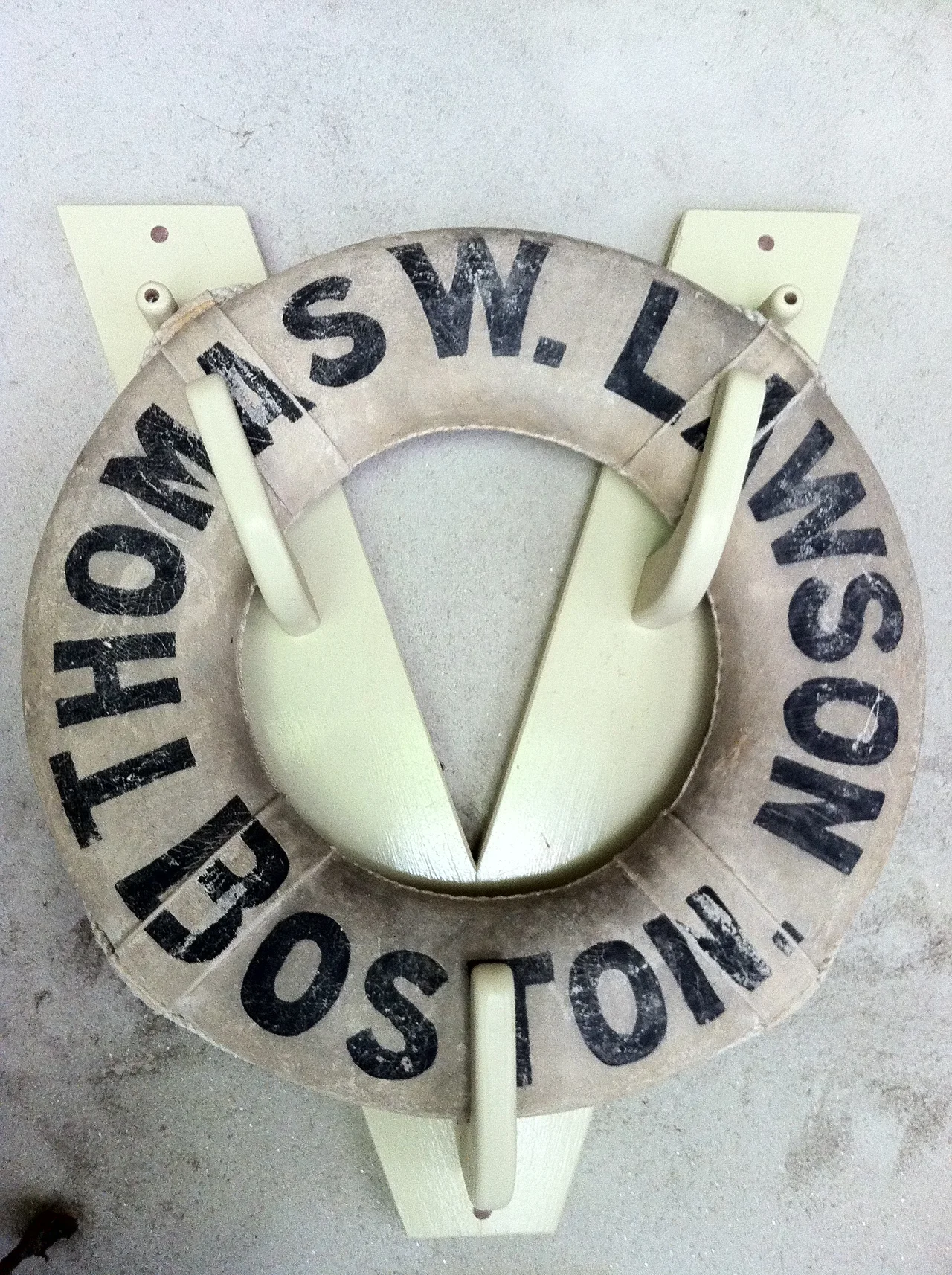
She drove ashore on Shag Rock. All seven masts came down together, throwing the men climbing them into the sea. The stern tore away behind mast number six. In the morning the upturned keel was briefly visible before sliding into deeper water. Sixteen of the eighteen crew, along with the pilot Cook Hicks, were lost - many of them clinging to the spanker rigging, drowned in a slick of paraffin so thick it choked the water itself. Captain Dow and engineer Edward Rowe were the only survivors. They had jumped clear before she capsized, were washed to a rock in the Hellweathers, and were picked up hours later by the pilot's son - a young man rowing the gig Slippen out in heavy seas to look for his father. He found Cook Hicks's body later. Mark Stenton, the cabin boy from Brooklyn, was found too, along with seamen from Germany, Scandinavia, and the Canadian Maritimes. Others were never identified. They were buried in a mass grave in St Agnes cemetery. The 58,000 barrels of paraffin spread across the western approaches in what was very likely the first major marine oil spill in history - a quiet, almost forgotten first that now feels chillingly prescient. The wreck was relocated by divers in 1969, the bow lying 56 feet down northeast of Shag Rock, the stern 400 metres to the southwest. A lifebelt from the ship is preserved at the Valhalla Museum in Tresco Abbey Gardens, alongside the figureheads of other ships the Scilly rocks have taken.
From the Air
Wreck site at 49.89°N, 6.38°W, just off the southwest corner of the uninhabited island of Annet, in the western part of the Isles of Scilly. The bow lies about 56 ft deep near Shag Rock; the stern lies 400 m southwest. Annet itself is a low granite island ringed by white water in any swell, and the wreck zone is between Annet and Bishop Rock lighthouse to the west. Nearest airport: St Mary's (EGHE), about 3 nm northeast. Land's End (EGHC) lies 28 nm east on the Cornish mainland. Recommended viewing altitude 1,500-3,000 ft AGL. The Western Rocks ahead and the long, ragged ridge of Annet make this one of the most visually dramatic stretches of British coastline.
Nearby Stories
- Wolf Rock Lighthouse 17 km away
- The Brisons 18 km away
- SS Irma (1905) 22 km away
- HMS Brisk (1851) 31 km away
- Cape Cornwall Mine 57 km away
- SM U-27 73 km away
- Wolfpack Prien 162 km away
- Tower of Hercules 696 km away