
Throne Hall of Dongola
On May 29, 1317, a Mamluk-installed prince named Abdallah Barshanbu knelt in the upper hall of a two-storey building on a rocky hill above Old Dongola and had the marble inscription carved that made his conversion official. For five centuries the room had been the Throne Hall of the Makurian kings - a Christian audience chamber whose walls showed the Virgin Mary lying beside a crib, angels, the three Magi approaching on horseback. The plasterers moved in behind the inscription. The paintings went under. A mihrab was cut into the wall. And the oldest mosque in Sudan began its six-century run in a building that had been built to host a different faith.
The Makurian Audience Room
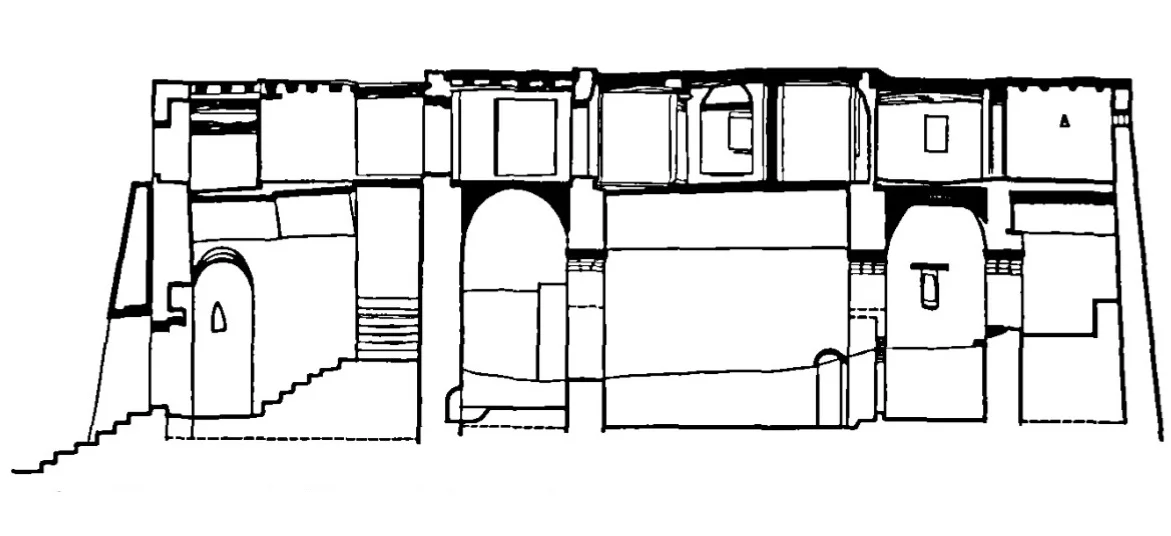
Old Dongola was the capital of Makuria, the Nubian Christian kingdom that had stopped two Arab invasions in the seventh century and then settled into a long golden age between roughly 800 and 1100. In the ninth century, probably during the reign of King Georgios I and his father Zacharias III, the Throne Hall was constructed on a rocky outcrop in the eastern part of the city. From its perch, the two-storey building commanded an impressive view of the Nile valley and the city below. Scholars have debated its purpose - church, monastery, royal residence - but its internal design shows it was official and non-residential, meant to impress visitors. The actual throne hall occupied the upper floor, reached by a monumental staircase. Both the staircase and the hall were painted. Archbishop, king, ambassador, priest: however important your business was, you ascended the stairs under the eyes of the archangel Michael wielding his spear, and of warrior saints on foot and on horseback, before you reached the king.
A Byzantine Kingdom on the Nile
The architecture of the Throne Hall was a conscious choice: Byzantine. Makurian kings saw themselves as inheritors of the Christian tradition that ran from Constantinople, and they built accordingly. Very similar audience halls are known from the First Bulgarian Empire, which borrowed the same Byzantine template on a smaller scale. The Throne Hall measured 12 meters tall, 28 long, and 18 wide - a serious building of mud brick, fired red brick, and sandstone. Its wall paintings, damaged over the centuries by rainwater, termites, and bats, included some that would make an art historian catch her breath. The east wall held a nativity scene - Mary reclining on a mattress, the crib with the Christ Child, angels overhead, the Biblical Magi approaching from the left. The colors were warm ochres and oranges and reds and violets. On the south wall, Mary held the Christ Child, who reached out for a palm tree - a scene with no known parallel in Makurian art, unique in its iconography, the kind of image that argues Nubian Christianity was not copying Byzantium but thinking alongside it.
The Mamluks Arrive
From 1265, Makuria endured repeated invasions by the Mamluk sultanate in Cairo. From 1276 the Mamluks usually installed a puppet king on the Makurian throne. By the end of the thirteenth century, after yet another confrontation, the most prestigious buildings of Old Dongola including the Throne Hall lay in ruins, and the population had dropped catastrophically because of deportations - people carried north in chains by Mamluk armies. The Throne Hall was repaired, though not entirely and with various modifications. In 1316 the Mamluks intervened again and put Abdallah Barshanbu on the throne. In contrast to the kings who had ruled Old Dongola for nearly 800 years, he was Muslim. On May 29, 1317, he converted the building. A mihrab was added to the central hall of the upper floor. Plaster was applied over the Christian wall paintings. Abdallah Barshanbu was not popular - the Nubiologist Wlodzimierz Godlewski speculates that the conversion of the Throne Hall played a part in his fall. He was murdered by his own followers that same year.
A Mosque for Six Centuries
After Barshanbu's murder, Makuria continued for a while under both Muslim and Christian kings, none of whom dared to restore the Throne Hall's original function - the Mamluk sultans would not have allowed it. A civil war destroyed Old Dongola in 1365. The Makurian kings fled to Lower Nubia, where their successors kept a kind of state going for another 150 years. Old Dongola itself came under the control of the Arabic Banu Ja'd tribe and eventually the Kingdom of Dongola Town, absorbed into the Funj Sultanate in the early 1500s. Through all of this, the building served variously as a mosque and as a residence for pilgrims heading to Mecca. In the second half of the 1700s, a local sheikh named Sati Hamid Sawar renovated the mosque extensively. In 1906 it was documented scientifically for the first time. In 1969 the mosque closed, the building was declared a historic monument, and Polish archaeologists from the University of Warsaw began the excavations that have continued ever since. Today, under the plaster applied in 1317, scholars are still uncovering the paintings that Barshanbu covered up. The Christ Child still reaches for his palm tree, six centuries later.
From the Air
Located at 18.22N, 30.75E in Old Dongola, on the east bank of the Nile in Sudan's Northern State, roughly 80 km upstream of modern Dongola. Recommended viewing altitude: 2,000-4,000 feet AGL to see the Throne Hall and the surrounding archaeological zone together. The building itself sits on a low rocky hill in the eastern part of the ancient city, visible as a distinctive two-storey mass against the Nile floodplain. Nearest major airport is Dongola (HSSW) about 80 km to the northwest; Khartoum International (HSSS) is approximately 500 km to the south. The site is part of the larger Old Dongola archaeological area - plan for views of the citadel, the Kom H monastery, and the Islamic domed tombs on adjacent hillsides.
Nearby Stories
- El Khandaq 26 km away
- Northern Sudan 45 km away
- Nubia 49 km away
- Zuma, Sudan 52 km away
- Northern State (Sudan) 93 km away
- Esh Shaheinab 281 km away
- Selima Oasis 338 km away