_(2001).jpg)
Thursday Island Cemetery
On some of the Japanese graves, small concrete birdcages hold food for the spirits of the departed divers. On the newer Torres Strait Islander graves, elaborate tile mosaics in bright colors surround photographs of the dead. At the top of the highest hill, a polished blue granite obelisk marks where a former premier of Queensland chose to be buried -- not in Brisbane or Sydney, but on this small island at the edge of the continent where he had served as government resident for nearly two decades. Thursday Island Cemetery is not merely a place of burial. It is a cross-section of every culture, religion, and ambition that has passed through the Torres Strait since the 1870s.
The Hill and the Flats
The cemetery sprawls across 12.77 hectares of sloping ground on the northern side of the island, running from Summers Street at the top down to Aplin Road on the flats. Its layout is a social map. The most influential groups claimed the hilltop: European elites at the summit, with clear views over Ellis Channel and the southern Torres Strait islands. The original Protestant section sits on the southern and western slopes, where some of the earliest burials date to at least 1887. The Catholic section occupies the steep southwest, its graves marked with marble headstones, crosses, and concrete surrounds -- the graves of at least three Catholic nuns have been specially maintained over the years. At the bottom of the hill, nearest Aplin Road, lies the Japanese pearl-shell divers' burial ground. The hierarchy of the cemetery mirrors the hierarchy of the island itself.
The Divers' Ground
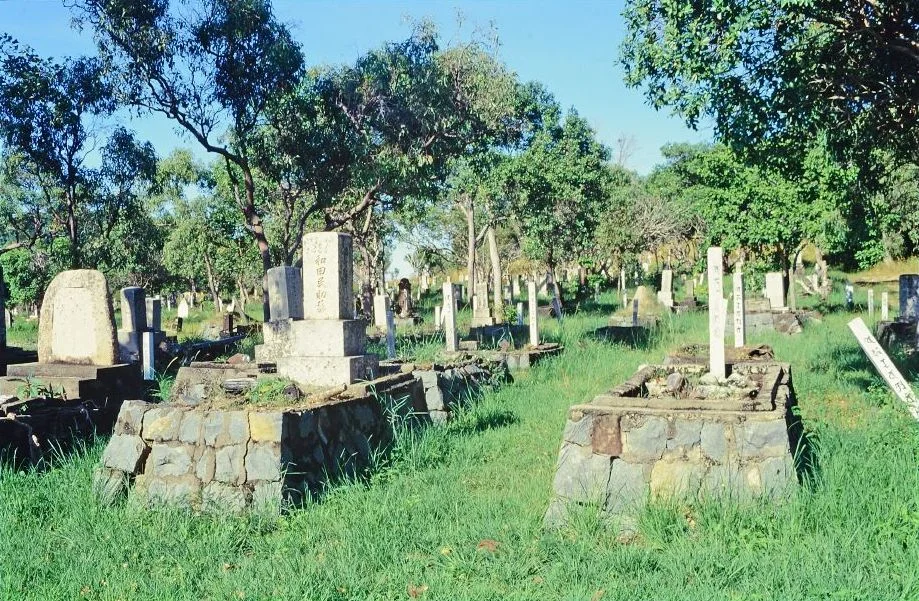
Between 600 and 700 Japanese graves fill the northeastern flats, the single largest section of the cemetery. These were the men who crewed the pearl luggers, diving in deep water with primitive equipment, breathing through rubber hoses connected to hand-pumped compressors on deck. The work was extraordinarily dangerous -- decompression sickness, drowning, and shark attacks claimed divers regularly. Their graves are distinctive: raised mounds covered with stone and concrete, marked by granite or concrete columns typically assembled in three sections. Some headstones bear Japanese characters painted in black on white wooden posts. Others have been left as simple unmarked mounds. The frangipani trees planted on some graves perfume the air in the wet season. These divers built the economic foundation of Thursday Island, and the scale of their burial ground testifies to the price they paid.
Faith and Ceremony
The cemetery holds graves from at least five religious traditions: Christianity, Buddhism, Shintoism, and Islam, with sections for Muslim Indonesians and Malays identifiable by offerings of food and small objects. Most of the early European graves face east, following traditional Christian practice. The Japanese and more recent graves tend to face west. But the most distinctive burial tradition belongs to the Torres Strait Islanders themselves. Although most Islanders are Christians, they have incorporated what is believed to be a pre-1870s mortuary rite into their religious practice: the tomb-opening ceremony. Roughly twelve months after burial, the grave markings are formally installed in a community ceremony. Throughout the year, visitors can see the evidence -- new graves covered by temporary wooden roofing awaiting their opening, tombstones wrapped and waiting, decorations left behind from recent ceremonies.
The Premier on the Hill
At the very top of the cemetery, overlooking the channel and the scatter of islands beyond, stands the obelisk of John Douglas. He served as Premier of Queensland from 1877 to 1879, then took the post of Government Resident on Thursday Island, serving from 1885 to 1886 and again from 1888 until his death on the island in 1904. That a former premier chose to spend the last two decades of his life on this remote outpost -- and to be buried here rather than in the state capital -- speaks to the pull the Torres Strait exerted on those who came to know it. Nearby, a monument honors seven pilots of the Queensland Pilot Service who died in the strait between 1894 and 1917, and two substantial stone cairns with artillery shells at each corner mark the graves of servicemen. The cemetery was listed on the Queensland Heritage Register in 1992, recognized as one of the most ethnically diverse burial grounds in the state.
From the Air
Thursday Island Cemetery occupies the northern slope of the island at approximately 10.58S, 142.22E, running from the central ridge down toward the northern shoreline. From the air, the cemetery is identifiable as a large cleared area with scattered tree cover on the island's northern side. Horn Island Airport (YHID) is on the neighboring island. Recommended viewing altitude: 1,500-2,500 feet. Ellis Channel, visible to the north, is the waterway that John Douglas's grave overlooks.
Nearby Stories
- Jardine River 2.3 km away
- Badu Island 29 km away
- Yam Island 53 km away
- HMS Pandora (1779) 146 km away
- All Saints Anglican Church, Darnley Island 161 km away
- Duyfken Point 186 km away
- Wasur National Park 218 km away
- Australia–Indonesia Border 272 km away