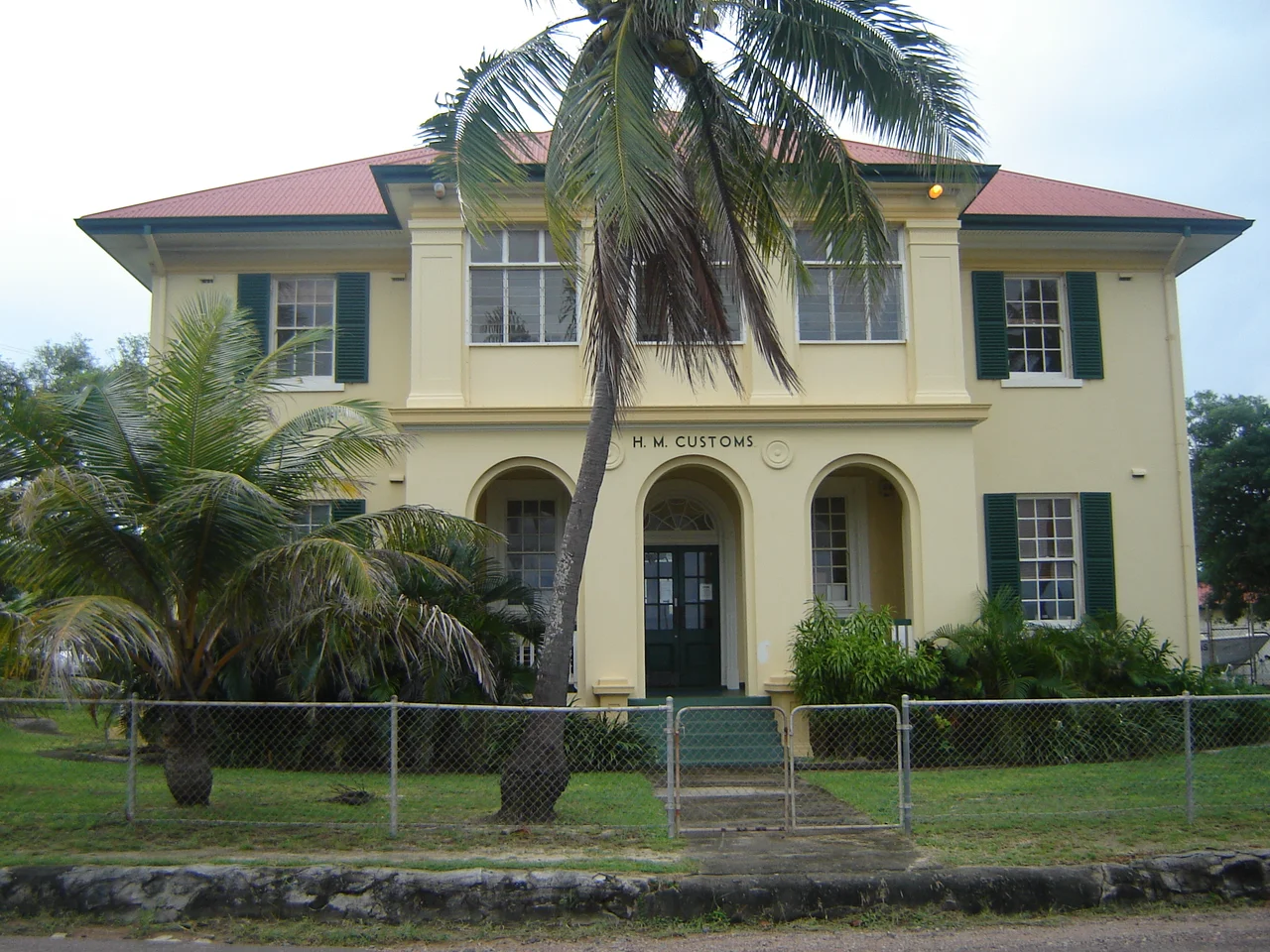

Thursday Island Customs House
Revenue at the Thursday Island customs post for the financial year 1879-80 was 2,493 pounds. Twenty years later, it had grown to 19,411 pounds. The numbers tell the story of a tiny island that became, improbably, one of Australia's busiest and most strategically important ports -- a gateway where pearl luggers, trading ships bound for Asia, and vessels carrying immigrants all converged at the narrows between Cape York and New Guinea. The Customs House that stands today at 2 Victoria Parade was built in 1938 to match that importance: a two-storey masonry building in the stripped Classical style, one of the few non-timber structures on the entire island.
The Timber Predecessor
The first customs house on Thursday Island was erected in 1885, a modest timber building on stumps at the corner of Douglas and Hastings Streets. It cost 797 pounds. Single-storeyed with verandahs on all sides, it contained a public counter, a "long room" where business was transacted, and a private office for the Sub-Collector -- the customs officer who ran the port. H.M. Chester, the first Sub-Collector and Harbour Master, was appointed in 1877, the same year the Port of Entry and Clearance was gazetted. By 1884 the port had been designated a warehouse facility. The staff grew to six officers, and in 1895 the government shipped four cottages from Sea Hill near Rockhampton to Thursday Island to house them. This was a frontier operation -- customs officers tracking pearl luggers crewed by Japanese, Malay, and Pacific Islander divers across hundreds of square miles of reef-studded water.
The Pearl Gate
Pearl handling was the port's main business. Dozens of Asian and Japanese luggers worked the Torres Strait waters, and the customs officers were responsible for monitoring every vessel, every catch, and every trader who stopped at Port Kennedy to refuel with coal or offload cargo. After World War I, the industry bounced back rapidly -- sixty luggers were active in the strait. Contemporary records describe Thursday Island as "the important port... a major gateway to Australia, often being the first port of call for ships from Asia." Europeans had been drawn to the area since the Dutch ship Duyfken arrived in March 1606, followed by Spanish voyagers, then Captain Cook, William Bligh, and Matthew Flinders. But it was the pearl-shell trade that turned the island from a colonial outpost into a genuine commercial hub.
A Building for the Empire
The 1938 Customs House was designed by Harold Barker, head architect of the Commonwealth Department of Works, and cost 9,860 pounds -- more than twelve times the price of its timber predecessor. The Neo-Georgian design features a hipped terracotta tile roof, projecting balconies front and back, and timber shutters on every window -- a practical concession to the tropical climate. The ground floor housed the customs offices, centered on the Long Room where shipping business was conducted. Upstairs was the Sub-Collector's residence, with bedrooms and living areas opening onto balconies that caught the sea breeze. The building's stripped Classical style retained formal symmetry while shedding most ornamental detail, and where decoration appeared it carried Art Deco inflections. Surrounded by lawns, mature trees, and a line of tall palms, the Customs House was immediately one of the most prominent buildings on Thursday Island.
War, Evacuation, and Return
The timing was terrible. A year after the new Customs House opened, war was declared. By January 1942, Thursday Island had been evacuated of its non-essential inhabitants. The customs officers who remained found their world shrinking. Stores closed. Nothing was delivered. One officer recorded that "the office work has fallen to practically nil." They cooked their own meals, did their own washing, and waited. Late in 1942, the military took command of the Torres Strait and requisitioned the Customs House as the residence for the Commander of the Torres Force. It served that purpose for the rest of the war. The building stood empty for several months after the military left in 1945 before the customs service reclaimed it in 1946. A visiting Sub-Collector from Cairns noted that the island remained "an open door to the East" and recommended restoring a permanent customs presence. The building continued in customs service use until it eventually passed out of Commonwealth ownership, and was listed on the Queensland Heritage Register in 2005.
From the Air
Thursday Island Customs House sits on Victoria Parade along the southern coastline of Thursday Island at approximately 10.58S, 142.22E, near the Government Jetty and Engineers Jetty. The building is one of the few masonry structures visible among the island's predominantly timber buildings. Horn Island Airport (YHID) is on the neighboring island to the east. Recommended viewing altitude: 1,500-2,500 feet. The port area and jetties along the southern waterfront are clearly visible from low approaches.
Nearby Stories
- Jardine River 2.3 km away
- Badu Island 29 km away
- Yam Island 53 km away
- HMS Pandora (1779) 146 km away
- All Saints Anglican Church, Darnley Island 161 km away
- Duyfken Point 186 km away
- Wasur National Park 218 km away
- Australia–Indonesia Border 272 km away