.jpg)
Tiger Bay
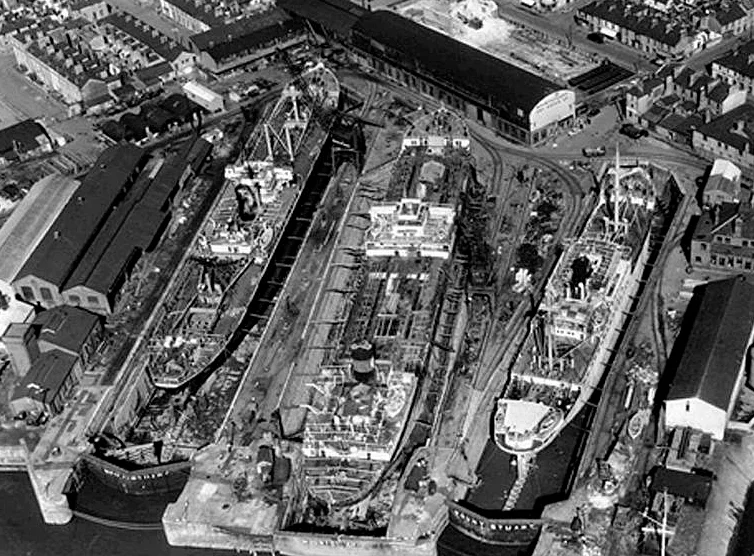
The Cairo Cafe sat on a corner in Butetown, and depending on the hour, it was three different places at once. A restaurant where Yemeni stew shared the counter with Welsh cakes. A boarding house where merchant seamen slept between voyages. A mosque, when the call to prayer came. Ali Salaman, who had crossed the sea from Yemen, ran it with his wife Olive, who had grown up a few streets away. Between 1940 and 1968, theirs was one of the gathering places of Tiger Bay, a Cardiff neighbourhood that became Britain's oldest multi-ethnic community almost by accident. Coal needed ships, ships needed sailors, and sailors from more than fifty countries stepped off onto Cardiff's quays and decided to stay.
The Bay Tiger Got Its Name
The name came from the water itself. Where the River Severn squeezes through its great tidal funnel, the currents turn vicious - rip lines and standing waves that sailors learned to respect. Tiger Bay, they called it, for water that fought back. By the 1840s, the second Marquess of Bute had stitched the place together with industry. His West Bute Dock opened in 1839; the Taff Vale Railway followed two years later, hauling coal down from the Rhondda and the Cynon. Mount Stuart Square and Loudoun Square went up to house the merchants and brokers, three-storey terraces with fanlights over the doors. Coal exports climbed from a trickle to two million tons by 1862, then to ten and a half million by 1913. The third Marquess of Bute, who owned the docks, became the richest man in the world.
Fifty Countries on One Street
The ships brought people. Norwegian whalers, Somali firemen, Yemeni stokers, Spanish sailors, Italian cafe-keepers, Caribbean dockers, Irish navvies - they came on the tramp steamers that hauled Welsh coal to every coaling station from Aden to Buenos Aires, and many never went back. They married Welsh women and Welsh women's daughters, and their children grew up speaking English with a Cardiff accent over a kitchen where the language might be Arabic or Norwegian or Patois. Betty Campbell, born in Butetown to a Jamaican father and a Welsh-Bajan-Madeiran mother, became Wales' first Black head teacher. Shirley Bassey grew up here too - the daughter of a Nigerian seaman and a Yorkshire-born mother, singing in chapels and clubs before the world heard her. The rugby league players Billy Boston, Colin Dixon and Roy Francis came from these streets. So did the boxer Redvers Sangoe. The mixing was ordinary; the world outside found it remarkable.
Tales the Sailors Carried
The reputation was harder to shake than the truth. Sailors carried the name Tiger Bay back to every port they touched, and by the late Victorian era it had become slang for any rough dockside neighbourhood in the world. The actual red-light streets were Charlotte Street and Whitmore Lane, just outside the Bay - long since demolished, now buried under a Marriott Hotel car park. But the legend stuck. A 1934 British film called Tiger Bay starred Anna May Wong. A 1959 remake with John and Hayley Mills was shot in the actual docks. The name became shorthand for somewhere exotic and a little dangerous - which suited some Cardiff sensibilities better than the more complicated truth, which was that ordinary working people from everywhere lived here, raised children here, and got on with one another better than anyone outside seemed to expect.
When the Coal Stopped
Coal exports peaked in 1913 and never recovered. The Great Depression laid up the tramp steamers; the slow shift from coal to oil hollowed out the trade; and in 1964, the last shipment left Cardiff Docks. What followed was harder than the decline. Through the 1960s, planners cleared the old terraces of Butetown and rehoused families in tower blocks the residents hadn't asked for. By the 1970s, sixty percent of working-age people in Butetown were unemployed and a quarter of the buildings stood empty. Then in 1987 the Cardiff Bay Development Corporation arrived with a plan to dam the Taff and the Ely, drown the mud flats, and rename the whole area Cardiff Bay. Glassy apartment blocks went up where Bute Street's cafes had been. The Industrial and Maritime Museum, founded by historian Glenn Jordan to preserve what had been there, was demolished in the 1990s to make way for Mermaid Quay. The local historian Neil Sinclair called the result a tragedy and an architectural monstrosity. He had grown up in the Bay; he watched it disappear.
What Remains, What Returns
Some of the old streets are still there - Loudoun Square is still recognisable, the Coal Exchange in Mount Stuart Square still stands. A bronze statue of an immigrant couple looks out toward the freshwater lake that used to be tidal mud. Shirley Bassey released The Girl From Tiger Bay in 2009, written for her by the Manic Street Preachers; it is about her, and not about her, and about the place all at once. Diana Nneka Atuona's play Trouble in Butetown, about a Black American GI hiding out in a Bay boarding house in 1943, premiered at the Donmar in 2023. The community archive, the Heritage and Cultural Exchange, still keeps the photographs and oral histories. The neighbourhood was renamed, much of it was rebuilt, and the people who made it were largely pushed elsewhere - but the story is still being told, by the descendants of those who lived it.
From the Air
Tiger Bay - now Cardiff Bay - sits at 51.458 degrees north, 3.17 degrees west, on the southern edge of Cardiff where the Taff and Ely empty into the Severn estuary. From cruising altitude, look for the broad freshwater lagoon held back by the Cardiff Barrage, with the white-roofed Wales Millennium Centre at its northern shore. Cardiff Airport (EGFF) lies about 8 nautical miles southwest; Bristol (EGGD) is 30 nautical miles east-northeast across the Bristol Channel. The Severn's vast brown tidal range - second only to the Bay of Fundy - is visible in clear weather as a band of mud and silt outside the barrage gates.
Nearby Stories
- Aberfan Disaster 1.3 km away
- Glastonbury 6.5 km away
- Quantock Hills 7.4 km away
- Tyntesfield 7.5 km away
- Tintern 9.2 km away
- The Mumbles Lifeboat Station 19 km away
- Carreg Cennen Castle 20 km away
- Appledore Lifeboat Station 26 km away