
Timeline of London
Around AD 50, Roman engineers drove the first piles of a wooden bridge into the soft mud of the Thames. The settlement that grew on the north bank, walled and named Londinium, would be sacked by Boudica's forces within fifteen years and rebuilt within twenty. Two thousand years later the city is the largest in Western Europe, has been the capital of an empire that briefly covered a quarter of the earth's land surface, and has buried, burned, plagued, bombed, and rebuilt itself often enough that beneath any single street you may stand on layers of seven cities. There is no way to tell the whole story in seven sections. What follows is seven of the moments when London turned into something it had not been the morning before.
AD 60 — Boudica Burns Londinium
The first London was barely a generation old when it was destroyed. In AD 60 or 61, while the Roman governor Suetonius Paulinus was campaigning in Wales, the Iceni queen Boudica led an uprising that swept through Camulodunum, Verulamium, and the new town at the river crossing. The Roman historian Tacitus reports that Suetonius reached Londinium first, judged it indefensible, and evacuated those who would leave. Those who could not — the old, the sick, those too attached to their property — Boudica's forces killed. Archaeologists have found a thick red layer of burning ash at depth across the City of London, dating to the year. The town that rose on top of that ash had walls. By 122 a forum had been built. By 200 Londinium was the provincial capital of Britannia. The earliest written document found in the United Kingdom — a Roman financial record on a wax tablet, dated 8 January 57 — was unearthed during the 2010-14 excavation for the Bloomberg building, a few hundred metres from where the bridge had first crossed.
1066 — The Conqueror Crowned at Westminster
On Christmas Day 1066, William of Normandy was crowned King of England in the newly completed Westminster Abbey. Edward the Confessor had consecrated the abbey only the previous January and had been buried in it days afterward. Harold Godwinson had been crowned there on 6 January. By mid-October William had burned Southwark in his attempt to take the bridge; by Christmas he had been crowned in the church his predecessor had built. He granted the City of London a charter guaranteeing the rights it had held under Edward the Confessor, a document still preserved in the City of London archives. The next year his masons began work on the keep that would become the Tower of London. The Conquest gave London a new ruling class, a French-speaking court at Westminster, and a thousand years of legal and ceremonial separation between the City and the Crown. The Mayor and the King would never quite be on the same side again.
1348 — The Black Death
In September 1348 plague reached London by ship from continental Europe. By the following May, when the worst was over, somewhere between a third and a half of the city's population was dead. The exact toll is unknowable. Mass burial pits opened at East Smithfield and West Smithfield; archaeological excavations at Charterhouse Square have since recovered thousands of skeletons stacked carefully in shrouded layers. The Black Death broke the feudal labour market. With fewer workers, those who survived could demand wages and conditions previously unimaginable. It also created the Charterhouse itself — a Carthusian monastery founded on the East Smithfield burial site in 1371 by Sir Walter de Manny, in expiation, partly, for surviving when so many had not. The plague would return in 1361, 1665, and many years between. The 1665 outbreak alone killed roughly a hundred thousand Londoners. Samuel Pepys, who lived through it, called that year one of the happiest of his life — "besides that I never got so much."
1666 — The Fire
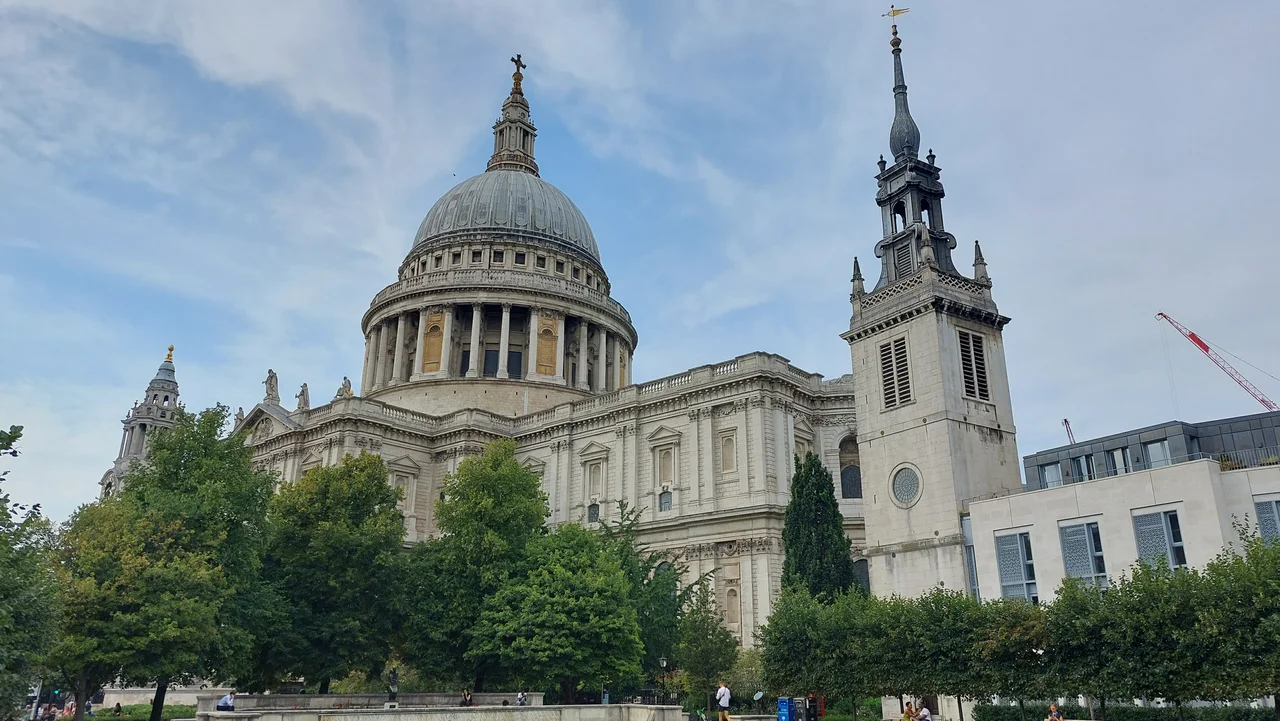
On 2 September 1666, in the bakehouse of Thomas Farriner on Pudding Lane, a fire broke out in the early hours. By the time it was contained four days later, it had consumed roughly four-fifths of the City of London — 13,200 houses, 87 parish churches, the medieval St Paul's Cathedral, the Royal Exchange, the Custom House, and most of the gates in the Roman wall. The official death toll was six. The true number is unknowable; cremated bodies leave little trace, and parishes destroyed do not record the dead. The rebuilding fell largely to Christopher Wren. Over the next forty years he and his colleagues designed fifty-two new parish churches in the City, the new St Paul's (whose dome would not be complete until 1710), the Monument to the Great Fire (1677, on the spot where the bakehouse had stood), the Royal Hospital Chelsea, and Greenwich Hospital. The Fire scoured London. It did not, however, scour the parts of London that had grown up beyond the walls. East London, Southwark, the West End — these survived intact, and after the Fire grew faster than the City itself.
1801 — A Million People
The first national census, taken on 10 March 1801, recorded the population of London at just over a million. It was the largest city in Europe. By 1851 it had doubled. By 1901 it had reached 6.5 million, and Greater London had become the largest city in the history of the world to that date. The nineteenth-century city absorbed the canals, the railways, the docks, the sewers built by Joseph Bazalgette after the Great Stink of 1858, and the millions of arrivals — Irish, Jewish, Italian, Chinese, eventually Caribbean and South Asian — who came to work them. London produced and consumed enough coal that in the worst smogs visibility dropped to a few feet and the death rate climbed by thousands a week. The 1952 Great Smog, which killed at least four thousand Londoners over five days in December, finally triggered the Clean Air Acts. The London of 1801 was not the London of 1900. The London of 1900 was not the London of 1950. The city kept rewriting itself, decade by decade, on top of the foundations of the city before.
1940-41 — The Blitz
From 7 September 1940 to 11 May 1941, German bombs fell on London on fifty-seven of seventy-six consecutive nights. By the end of the war about 30,000 Londoners had been killed in air raids. Whole streets in the East End — Stepney, Bermondsey, Poplar — went down in single nights. St Paul's Cathedral, ringed by burning buildings on 29 December 1940 and photographed by Herbert Mason for the Daily Mail, became the symbol of a city that refused to fall. The bombing did not end with the Blitz. The V-1 flying bombs and V-2 rockets continued through to March 1945; the last V-2 to hit London struck Tottenham on the same month the Allies crossed the Rhine. Postwar London rebuilt with tower blocks, with the New Towns programme, with the National Health Service. The slum clearances that followed often did more to break up working-class neighbourhoods than the bombs themselves had. A city of two million households was reordered in three decades.
The Shard
On 5 July 2012, the Shard at London Bridge was inaugurated. At 309.6 metres it was — and remains in 2026 — the tallest building in the United Kingdom and one of the tallest in Western Europe. From its observation deck on a clear day you can see, simultaneously, the Tower of London and Greenwich, the Olympic Park at Stratford and Wembley Stadium, the City and Canary Wharf, the Thames threading from west to east and dividing the city as it has done since Boudica's time. Two thousand years after the first Roman bridge went down a few hundred metres west of where the Shard now stands, London has roughly nine million residents, the most ethnically diverse population of any major European city, and a skyline that changes by the week. The Roman city was perhaps thirty thousand. The Saxon city was less. Then the Norman, the medieval, the Tudor, the Georgian, the Victorian. Seven cities, stacked. Possibly more. From the air on a clear evening you can see most of them at once.
From the Air
Central London sits at approximately 51.5074 N, 0.1275 W, with the Thames threading west-to-east through the city. From cruise altitude the key landmarks are: the Tower of London and Tower Bridge at the eastern edge of the historic City, St Paul's dome in the centre, the Houses of Parliament at Westminster to the west, and the Shard rising 310 metres above London Bridge station on the south bank. The Roman city occupied the area now bounded by London Wall to the north and Tower Hill to the east — roughly a square mile. Greater London now covers about 1,572 square kilometres. Nearest airports: London City (EGLC) six miles east of Westminster, Heathrow (EGLL) fourteen miles west, Biggin Hill (EGKB) twelve miles south-east, Gatwick (EGKK) twenty-eight miles south, Stansted (EGSS) thirty miles north-east, Luton (EGGW) twenty-eight miles north-west.
Nearby Stories
- Stevenage 5.7 km away
- Malling Abbey 5.7 km away
- 1952 Farnborough Airshow Crash 7.7 km away
- Ingatestone Hall 8.2 km away
- Hellfire Caves 9.1 km away
- The Carrington Event: The Solar Storm That Could Happen Again 9.8 km away
- Bletchley Park 16 km away
- Castle Hedingham 23 km away