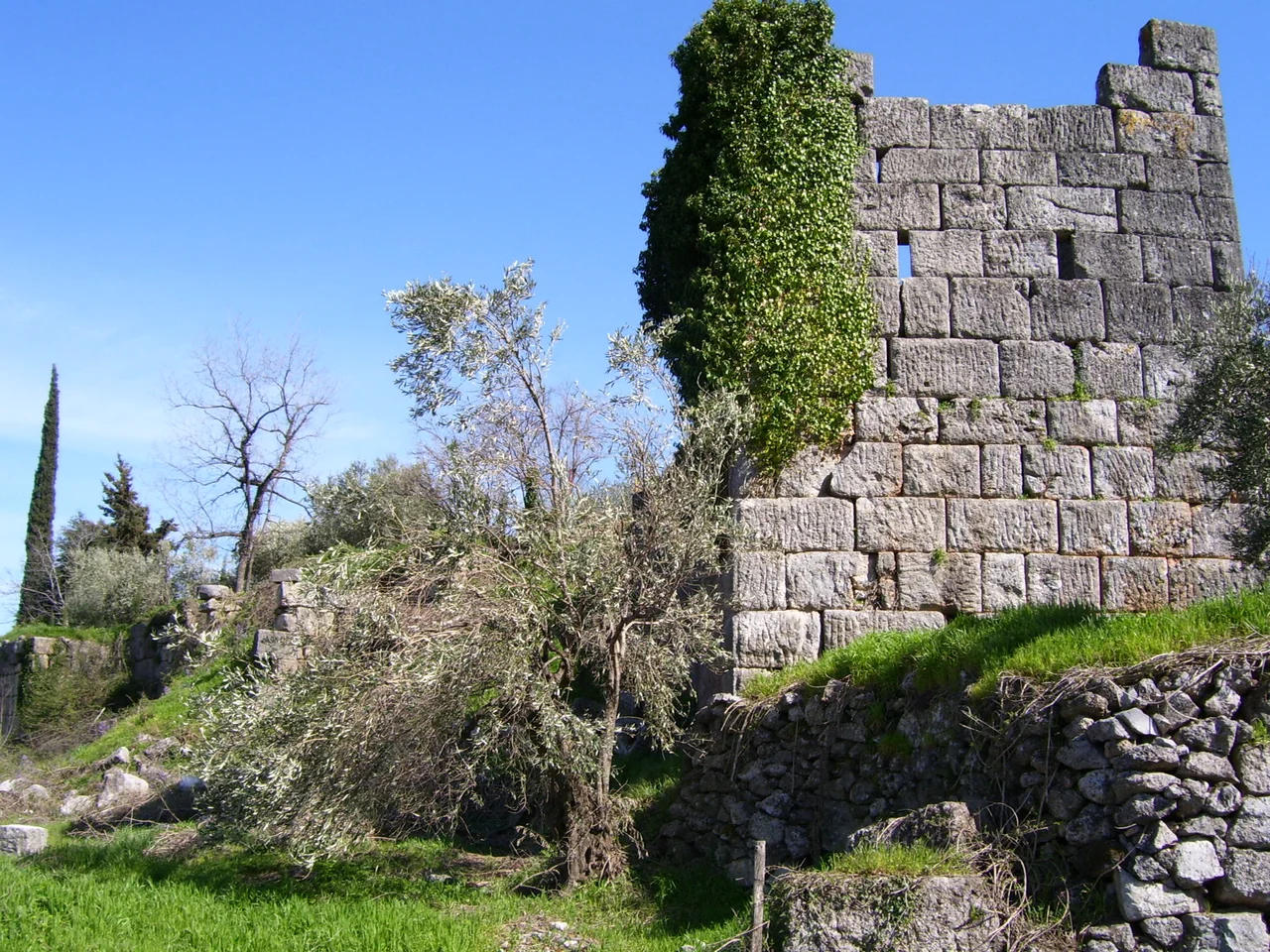

Tithorea (Phocis)
When Xerxes brought his army through central Greece in 480 BCE, the people who lived on the northeast flank of Parnassus did not flee down into the valleys. They went up — into the rocks, into a cavern supplied with water and invisible from below, into the kind of defensible terrain that had kept communities alive on this mountain for centuries. Later tradition identified that refuge with Tithorea, the city that would grow on the same site above the gorge of a stream the locals called, with bleak accuracy, the Kakóreuma: the evil torrent.
Rock as Architecture
Tithorea's geography was its primary defense. Plutarch records that in the time of the Mithridatic War, it was 'a fortress surrounded by precipitous rocks' where the Phocians sheltered from invaders — a function the site had served for generations before that. The city occupied the northeast foot of Mount Parnassus, protected to the northeast and east by the sheer banks of the Cachales gorge and to the south by the steep mountain flank itself. Builders reinforced only the west and northwest faces, where the terrain offered less natural protection. The walls they built there were nearly 9 feet broad. A considerable portion of those walls and many of their towers still stand. The Cachales, now called Kakóreuma, cuts its ravine below the modern village; behind the settlement, ascending the gorge, a large cavern on the cliff face supplied excellent water and was considered impregnable — the probable refuge of the Neon population during the Persian invasion, just as the Delphians used the Corycian Cave to the southwest.
What the City Offered
Inside the walls, Tithorea in its prime was a place of civic substance. Pausanias records a theatre, the enclosure of an ancient agora, and a temple of Athena. The city also maintained the tomb of Antiope and of Phocus — heroic figures whose graves gave the community a sacred lineage. A river, the Cachales, flowed through the lower terrain; the inhabitants had to descend into the gorge to fetch water, a detail Pausanias found noteworthy enough to mention twice. But Tithorea was not defined only by inconvenience. The city produced olive oil of remarkable quality — smaller in quantity than the output of Attica or Sicyon, ancient sources note, but considered superior to oil from the Iberian Peninsula or from Istria. That reputation for quality over volume, in a landscape that rewards stubbornness over ease, feels characteristically Phocian.
The Ritual of the Stolen Earth
One of the stranger practices Pausanias records from Tithorea involves the Theban myth of Amphion and Zethus, twin sons of Zeus, believed to be buried at Thebes. When the sun passed through the constellation Taurus, the people of Tithorea traveled to Thebes and stole earth from the tomb of Amphion and Zethus. Carried back and placed in contact with the tomb of Antiope at Tithorea — Antiope was the mother of Amphion and Zethus — this earth was supposed to guarantee a good harvest for Tithorea at the expense of Thebes. The Thebans, aware of the practice, posted sentinels at the tomb. Pausanias reports this without irony. It is an illuminating snapshot of the ritual economy of ancient Greece: fertility, debt, and competitive piety flowing between cities through the medium of grave-soil and astronomical timing.
The Shrine of Isis and the Dream-Invited
Forty stadia from the city — roughly 7 kilometers — stood a shrine of Isis, within a sacred precinct of unusual character. Only those whom the goddess had personally invited in dreams could enter. Twice a year, in spring and at the end of autumn, festivals were held. Three days of preparation preceded each feast: the first day, officials gathered and buried any remnants of the previous sacrifice. The second day, merchants erected temporary stalls of reed. The third day, a fair was held selling enslaved people, cattle of all kinds, clothes, silver, and gold — a market embedded in sacred ritual. After noon, the sacrifices began: the wealthy offered oxen and deer, the poor offered geese and guinea fowl. Pigs, sheep, and goats were forbidden. The victims were wrapped in the Egyptian manner, processed in a formal procession, and finally the temporary structures were burned. This was an Isis cult with Egyptian ceremonial forms operating in the mountains of central Greece, far from the Nile, tended by a community that had absorbed a foreign divinity into its religious calendar and taken her seriously.
From the Air
Ancient Tithorea lies at approximately 38.583°N, 22.669°E at the northeast foot of Mount Parnassus, roughly 300 to 400 meters above sea level. The modern village that bears the ancient name (formerly called Velitsa) is visible from altitude in the valley below the Cachales gorge. Looking south from the site, the Parnassus massif rises steeply; to the north and east the Cephissus plain opens toward Boeotia. The nearest major airport is Athens International (LGAV), approximately 150 km to the southeast. The Cachales ravine, now called Kakóreuma, cuts a visible shadow line below the village when the light is low.
Nearby Stories
- Martino, Phthiotis 2 km away
- Aigio 9.7 km away
- Helladic Chronology 9.9 km away
- Agia Anna, Euboea 17 km away
- Battle of Alamana 19 km away
- Panagia Varnakova Monastery 20 km away
- 1981 Gulf of Corinth Earthquakes 25 km away
- Karpenisi 31 km away