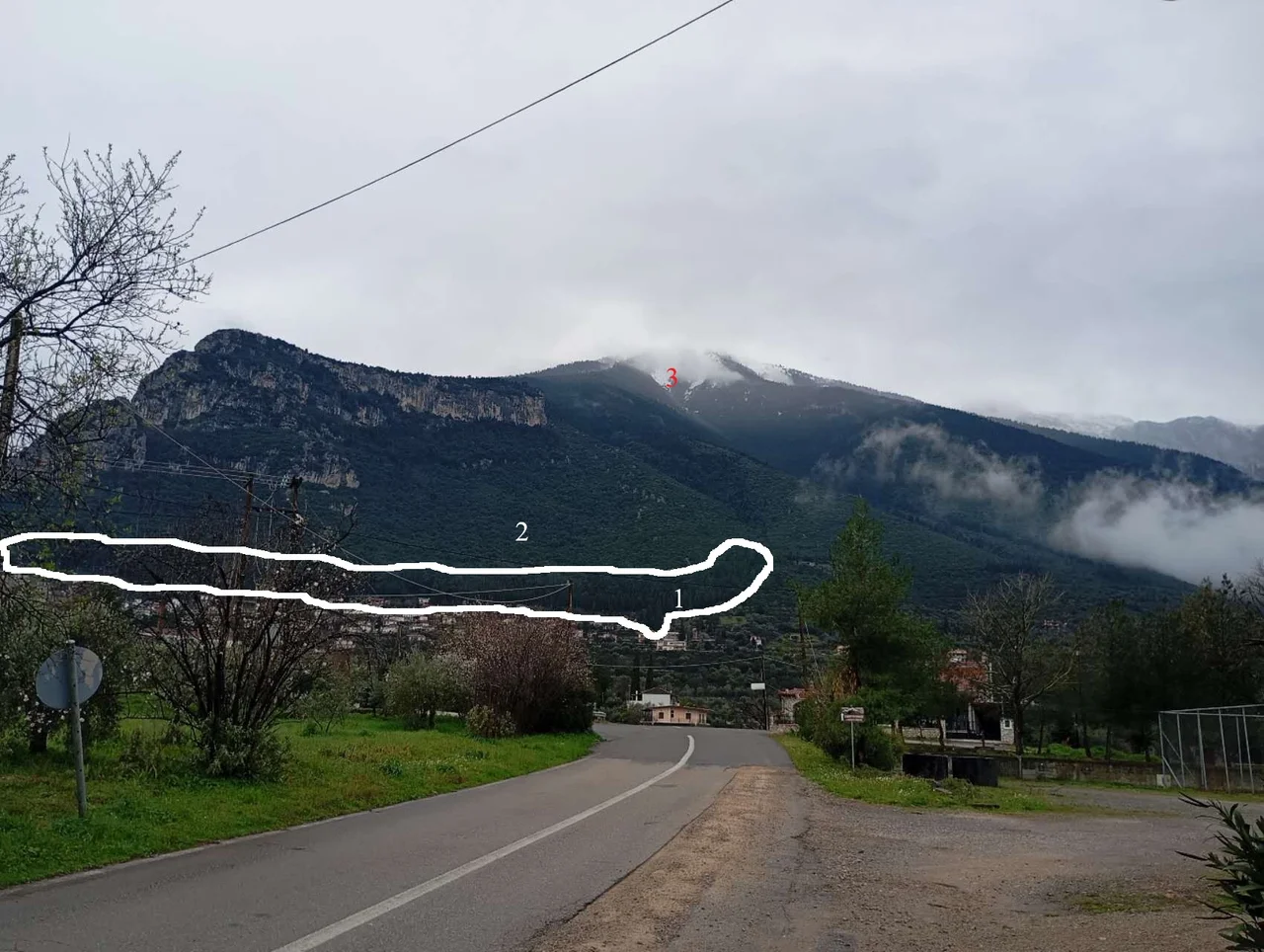

Tithorea
Lambros Katsonis was a sailor, a pirate, a Russian naval officer, and a figure celebrated by Catherine the Great — and Tithorea claims him as its own. That is the kind of place Tithorea is: a village of fewer than six hundred souls clinging to the northern foot of Mount Parnassus, which has nonetheless managed to send extraordinary figures into the wider world for four millennia. With a population of 561 in the 2021 census, it sits 156 kilometers from Athens, close enough to feel the orbit of the capital but far enough to have kept its own character intact. Parnassus rises steeply behind it, sacred in antiquity to Dionysus, to Apollo, to the Corycian nymphs, and to the Muses. To stand in Tithorea is to stand on ground that the ancient Greeks considered inhabited by the divine.
Birthplace of a People
Around 2000 BC, according to ancient tradition, a hero named Phocus and his wife Antiope settled at Tithorea, lived there, and were buried there. Later writers regarded this as the founding of the Phocian people — Tithorea as the birthplace not just of a town but of an entire nation. When Xerxes marched against Greece in 480 BC, the Phocians, unlike most of their central Greek neighbors, refused to submit. The Tithoreans fought at Thermopylae. When Persian forces swept through afterward, survivors from ruined Cephissus valley settlements fled upward to the heights above Tithorea, sheltering in the cliffs that still rise sharply to the south of the modern village. After the Persians withdrew, those refugees came down and rebuilt, and the city that emerged reached its peak in the third century BC, when it was prosperous enough to mint its own coins.
The ancient fortifications from that era survive inside the modern village in nearly complete form. Two square towers, connected by stretches of original wall, still define the line of the ancient city. The locals call the forest tower kastraki — little castle. The walls are built of trapezoidal ashlar masonry, in places still standing fourteen courses high, and scholars class them with the great fortifications of Messene and Eleutherai as the finest fourth-century defensive work in Greece.
Oracles, Mysteries, and a Sanctuary to Isis
Ancient Tithorea was never purely a military place. Pausanias, visiting in the second century AD, found a theater, an ancient agora, a Temple and Grove of Athena, and the tombs of Antiope and Phocus. Nearby stood a Temple of Asklepios. More strikingly, third- and second-century BC inscriptions recovered from the site refer to Isis, Serapis, and Anubis — Egyptian deities worshipped in a sanctuary that Pausanias described as the holiest shrine to Isis in all of Greece. Tithorea's role as a trading crossroads, positioned on the main road across Parnassus toward Delphi, brought Egyptian religious practice to this Phocian hillside.
The fusion of traditions continued through the Christian centuries. The proto-Byzantine church of Ayios Ioannis Theologos holds ancient hagiographies and a mosaic interrupted by burial holes — a practice continuous with pre-Christian temple burials of children at sacred sites. Another local church, called by the people Avas Zosimas, occupies what was likely an Isis sanctuary; the Levantine word avas for abbot reflects the Crusader conquest of Tithorea in the medieval period. A third church, Ayarsali, is built inside a cave over a spring and venerates a female figure — Saint Jerusalem, personified — in a ritual the Orthodox Church does not recognize. Each spring, locals race in a competition called 'the figs' and then climb Parnassus to the cave church in pilgrimage.
Heroes of Liberation
Modern Tithorea — known until 1835 as Velitsa — produced two of the more vivid figures of the Greek War of Independence. Odysseas Androutsos, one of the war's most celebrated and controversial guerrilla commanders, used a cave above the village as his base. The locals still call it mavri trupa, the black hole. It remains a hiking destination today. Lambros Katsonis, who preceded Androutsos by a generation, was celebrated in this region as a local hero; a naval officer in the service of Catherine the Great's Russia, he led a Greek privateer fleet against the Ottomans in the Aegean in the 1780s and 1790s — one of the most remarkable careers in the pre-independence struggle.
In November 1826, forty-seven fighters from Velitsa participated as a percussion group in the Battle of Arachova, one of the Greek revolutionaries' major victories. They also served at the exit of Messolonghi. Then, on 16 April 1943, the village played a decisive role in a different war entirely. The people of Velitsa participated in one of the largest acts of sabotage in wartime central Greece, at Palavitsa between Amfikleia and Tithorea, cutting Rommel's supply line for twelve days. The Italian army retaliated by burning the village and shooting five of its civilians by name: Gazis Christos, Kaperonis Ioannis, Trifylli Kalliopi, Stafyla Panayiou, and the teacher Yiannis Galanis. Their names are recorded.
Colonies Across the Mediterranean
One of the more improbable threads in Tithorea's history is genetic. Genetic comparison of ancient Phocaean samples and modern French populations from Provence and Corsica suggests that roughly one in ten men in southern France descend from Greek Phocian colonists. Tithorea and its sister settlements in the Cephissus valley were co-founders of Phocaea on the Aegean coast of Asia Minor, and Phocaea in turn planted colonies across the western Mediterranean — Massalia (Marseilles), Antipolis (Antibes), Nicaea (Nice), Arelate (Arles), Monoikos (Monaco), and Emporion (Empúries). The philosopher Theon the Tithorean worked here in the fourth century BC. The Alexandrian physician Dorotheos lived and died here. The local olive oil, sweet-flavored and with a distinctive color, was known across Greece. A small village on the side of Parnassus sent its people, its culture, and ultimately its DNA across the known world.
From the Air
Tithorea sits at approximately 38.584°N, 22.668°E on the northern slopes of Mount Parnassus, which rises to 2,457 meters and is visible from considerable distance. Approaching from the south, the mass of Parnassus fills the horizon; Tithorea lies at its base where the mountain meets the Cephissus valley floor. Recommended viewing altitude is 3,000–5,000 feet above the valley for context, with lower passes along the valley for detail on the ancient walls visible within the village. The nearest major airport is Athens International (LGAV), approximately 130 km to the southeast. The nearby town of Amfikleia lies 5 km to the northwest along the valley. Clear weather provides excellent visibility of the dramatic cliff faces south of the village that sheltered Persian-era refugees.
Nearby Stories
- Martino, Phthiotis 2 km away
- Aigio 9.7 km away
- Helladic Chronology 9.9 km away
- Agia Anna, Euboea 17 km away
- Battle of Alamana 19 km away
- Panagia Varnakova Monastery 20 km away
- 1981 Gulf of Corinth Earthquakes 25 km away
- Karpenisi 31 km away