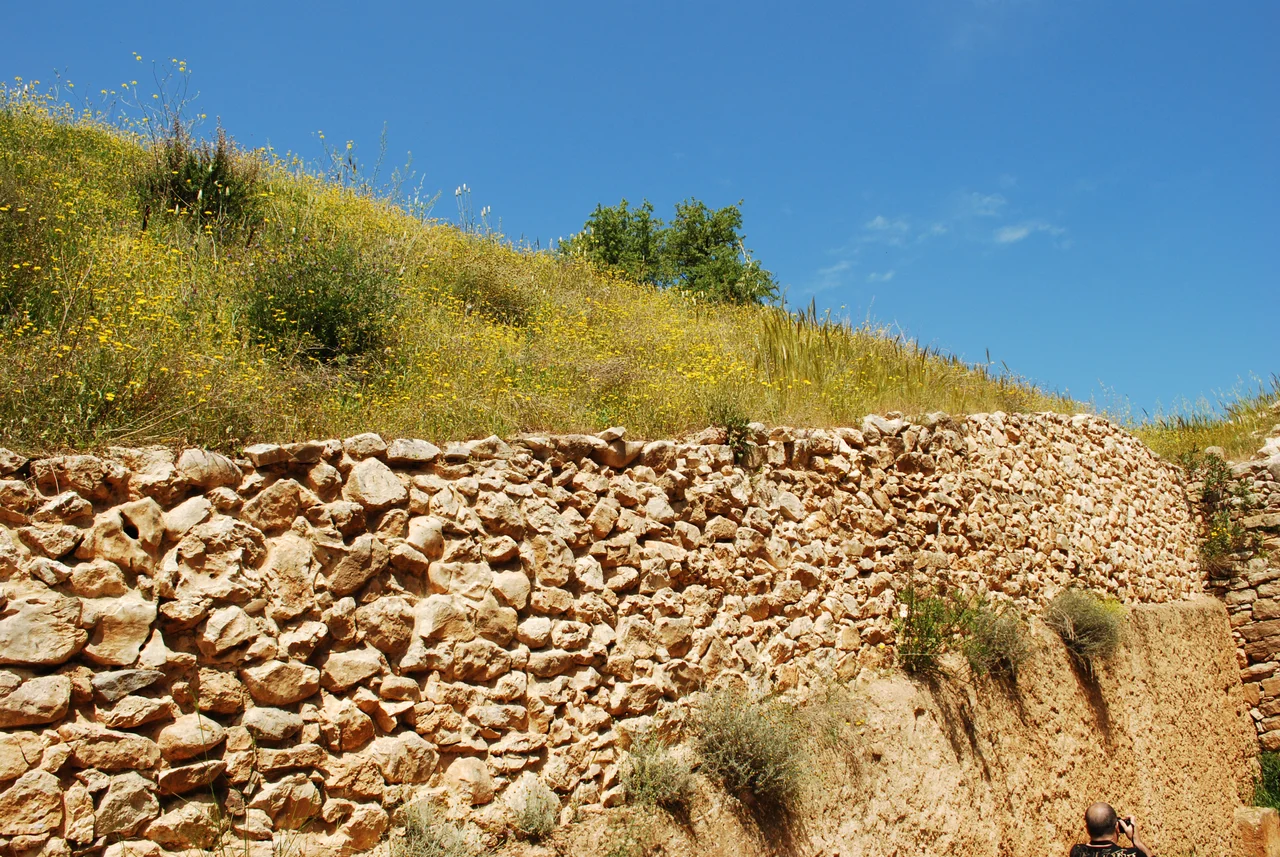

Tomb of Aegisthus
Nobody knows whose tomb this is. The name 'Tomb of Aegisthus' was coined in the late 19th or early 20th century — Aegisthus being the mythological murderer-king of Mycenae, the man who killed Atreus, seduced Clytemnestra, and was eventually killed himself by Orestes. The archaeologist who first formally described the tomb in 1892, Christos Tsountas, did not name it at all; he called it only 'another [tomb] not far from the Lions' Gate.' The name arose by association, borrowed from the nearby tombs already called 'Clytemnestra' and 'Atreus.' It stuck. No burials were found inside. No inscriptions, no remains, no identifying objects. The 'Tomb of Aegisthus' is an architectural fact wrapped in a fictional label — which is itself a fact worth knowing about how the ancient world gets named.
The Oldest Tholos That Could Teach the Others
The Tomb of Aegisthus was built in the Late Helladic IIA period, approximately 1510 to 1450 BCE, making it significantly older than the grander Treasury of Atreus (c. 1350 BCE) and the Tomb of Clytemnestra (c. 1300 BCE). It is the third-largest tholos tomb at Mycenae and, at the time of its construction, was the largest burial chamber in the Aegean region. What makes it architecturally important is not its size but its innovations. It was the first tholos tomb at Mycenae — possibly the first anywhere — to incorporate a relieving triangle above the lintel: a triangular space built into the wall above the doorway to redirect the weight of the masonry away from the lintel stone below, preventing it from cracking under the load. This structural device would become standard in every later tholos at Mycenae. The tomb also introduced ashlar masonry — cut and dressed stone — for its façade, and lined its dromos (the entry passage) with rubble, both techniques that later builders adopted. In this sense the tomb was a laboratory; its builders were experimenting with methods that the great tombs of the following century would take for granted.
How You Build a Monument of Power
Scholar James Wright has described the construction of tholos tombs as a 'monumental expression of power,' and the numbers bear this out. Excavating the dromos of the Tomb of Aegisthus alone required removing approximately 1,810 cubic meters of earth. The main burial chamber added another 585 cubic meters. Wright estimates that a ten-person team working continuously would have needed 240 days just to complete the excavation — before any masonry was placed. That figure does not include quarrying, shaping, and transporting the stone blocks. The total project, Wright calculates, required more than a year of sustained labor from a large workforce that included skilled stoneworkers. The chamber's corbelled dome, built by stacking overlapping rings of stone that gradually closed toward a point above, originally stood about 13 meters tall. That dome has since partially collapsed — only about 8 meters of height now remains — probably because of the ingress of water over the millennia, an erosion problem that damaged the tomb severely enough to require conservation intervention in 1997–1998.
A Debate That Turned on a Tomb
In 1922, a scholar named Winifred Lamb excavated the Tomb of Aegisthus under the direction of Alan Wace of the British School at Athens. Lamb worked between 15 June and 8 July, under conditions made difficult by the partially-collapsed dome — so much so that Wace and Lamb could not complete the full excavation in 1923 as planned, leaving about a third of the chamber floor uncleared. But the work they did complete proved consequential. At the time, the broader archaeological community was divided over a fundamental question: had Mycenaean civilization developed independently on the Greek mainland, or was it an offshoot of Minoan culture transplanted from Crete? Arthur Evans, the excavator of Knossos, believed the latter. Wace and his collaborator Carl Blegen believed the former — a position their colleagues derisively called the 'Helladic Heresy.' The Tomb of Aegisthus, securely dated from its pottery to early LH IIA, demonstrated that the grandest tholos tombs — the Treasury of Atreus and the Tomb of Clytemnestra — were considerably later than both the Shaft Graves and the peak of Minoan civilization. The 'crescendo' of Mycenaean tomb-building did not fit with Evans's picture of a people culturally subordinated to Crete. The evidence from a nameless beehive tomb helped settle, eventually, one of the central arguments in early 20th-century archaeology.
After the Mycenaeans
The tomb was looted in antiquity, probably during the Iron Age, as were all nine of Mycenae's royal tholos tombs. When Lamb excavated it, she found partial remains of a boar's tusk helmet about a meter above the floor, along with fragments of gold, ivory, obsidian, and carnelian objects at the original floor level — likely remnants of the burial goods the looters missed or discarded. Broken Cretan Palace-style jars, made on Crete during the 15th century BCE, were found trodden into the floor, providing additional dating evidence and confirming that the tomb had connections to Minoan Crete during its period of use. In the post-Mycenaean period, the tomb may not have been entirely forgotten. Ash deposits and olive kernels found inside suggest that shepherds or travelers sheltered there in later centuries. Finds of Geometric, Classical, and Hellenistic pottery from the entrance passage have been reinterpreted not as tomb-robbers' leavings but as possible evidence of 'hero cult' — the Greek practice of making offerings at the tombs of legendary figures as a form of ancestor veneration. Whoever was actually buried here, someone kept coming back.
From the Air
The Tomb of Aegisthus is located at 37.7308°N, 22.7556°E, approximately 70 meters west of the Lion Gate of Mycenae, in the Argolid region of the northeastern Peloponnese, Greece. It lies at the base of the citadel's western slope, set into the hillside facing downhill. The site of Mycenae sits on an elevated ridge visible from the Argive plain. The nearest major airport is Athens International (LGAV), approximately 130 km to the northeast. Best approached by VFR from the north through the Corinth corridor, descending into the Argive plain. The remains of the dromos and the partially-intact tholos dome are not easily distinguishable from the air; the citadel walls of Mycenae on the ridge above serve as the primary visual reference.
Nearby Stories
- Villa of Herodes Atticus 3 km away
- Sicyon 3.5 km away
- Battle of Megalopolis 4.5 km away
- Hermione: The City at the Edge of the World 7.5 km away
- Agia Lavra 7.7 km away
- Megara 13 km away
- Agistri 13 km away
- Teuthis 15 km away