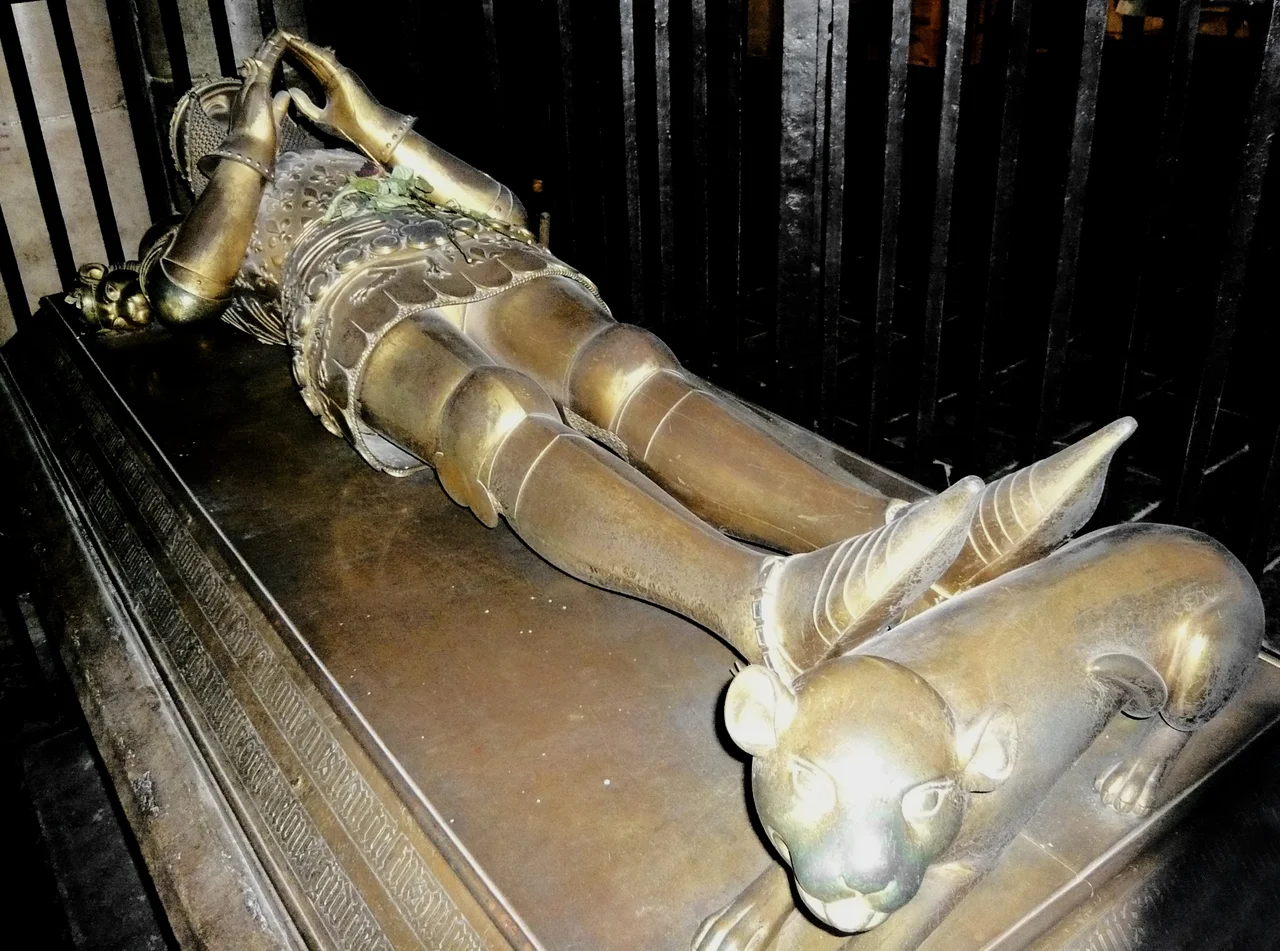

Tomb of Edward, the Black Prince
He knew he was dying, and he had things to arrange. In June 1376, at the Royal Palace of Westminster, Edward of Woodstock - heir to the English throne, victor at Poitiers, the man history would call the Black Prince - signed a will the day before he died. The will, written in French and still preserved at Lambeth Palace Library, did not just dispose of his estates. It described his own tomb in extraordinary detail: the materials, the placement, the iconography, and one final instruction that the effigy should depict him fully armed in plate of war.
A Slow Death and a Specific Plan
Edward was forty-five when dysentery killed him after weeks of decline. He had remained lucid through it. Historians often rank him among the most successful English commanders of the Hundred Years' War; at the Battle of Poitiers in 1356, when he was twenty-six, he had captured King John II of France. Twenty years later he was dying in bed, and his eldest son and heir was already dead. The throne would pass over him to his son Richard, who became Richard II. So Edward wrote out his own commemoration. He chose Canterbury Cathedral - the Trinity Chapel specifically - because he believed Thomas Becket had interceded to help him at Poitiers. The cathedral was the holiest pilgrimage destination in England; the Black Prince meant to be buried where pilgrims would walk past him forever. The funeral on 29 September was conducted to his exact instructions. Two warhorses, draped in the trappings of his armour and equipment, processed before his body carrying all his banners, badges and insignia. Richard, the new king, paid for the monument.
His Armour, Not Just Any Armour
The effigy lies recumbent in gilt bronze, hands joined in prayer, head on a helmet. What stops modern viewers in their tracks is the armour. According to Jessica Barker of the Courtauld Institute of Art, there is something deeply affecting about how Edward's armour is depicted - this is not generic plate, it is his armour, replicated with complete fidelity even down to tiny details like the position of rivets. The metal plates are held together by an intricate system of bolts and pins. Over the armour are the garments of a knight: a bascinet (open-faced helmet), a ceremonial cap, an aventail of mail, a leopard crest. So similar is the metalwork to what real fourteenth-century knights actually wore that modern historians believe the designer was an experienced armourer, not just a sculptor. Since most surviving English plate armour comes from museums and battlefield finds, the Black Prince's effigy is one of the most important documentary records of medieval English military equipment we possess.
The Tester and the Texts
Above the tomb hangs a tester - a wooden canopy - that once held his heraldic achievements: the shield, gauntlets, helm, surcoat, and scabbard he wore in life. The originals were so fragile that they have been replaced with replicas; the actual relics are now in a glass cabinet nearby and were scheduled for restoration as of 2017. The tester's imagery features the Holy Trinity, reflecting Edward's membership in the Order of the Garter, which acted under the Trinity's patronage. The tomb chest itself was made, exactly as Edward had specified, from marble of good masonry. An inscription was added sometime between 1377 and 1380, blending Edward's pride in his military victories at Poitiers and Nájera with a posture of humility before God. Scholars have traced one of its inspirations to the Disciplina clericalis, an early 12th-century collection of verse partly of Arabian origin, originally written in Latin by Petrus Alphonsi.
Standing Over a Prince
The monument sits behind a tall protective iron gate in the Trinity Chapel, close to where Becket's shrine stood until Henry VIII destroyed it. Pilgrims still pass by every day, just as Edward intended. Modern medical imaging has been used to investigate the effigy: in 2017, Canterbury Cathedral commissioned scientific examination that revealed, beneath centuries of polish and patina, the original gilding and the precise sequence of assembly. Edward's body lies in the cathedral floor below. The man who fought at Crécy and Poitiers in his teens and twenties, who became one of the most feared commanders in Christendom, who married for love rather than politics, who died slowly while planning his own monument - he is still here. Pilgrims come for Becket. They leave thinking about Edward.
From the Air
Located at 51.280°N, 1.084°E within the Trinity Chapel of Canterbury Cathedral, Kent. The closest airport is Manston (EGMH, currently closed to scheduled flights) about 13nm northeast; London City (EGLC) lies 47nm west-northwest and Lydd (EGMD) sits 24nm southwest. Recommended viewing altitude is 1,500 to 2,500 feet AGL for the cathedral itself; Bell Harry, the cathedral's central tower, makes an unmistakable landmark from the air. The tomb is inside the cathedral - you cannot see it from above - but the cathedral is one of the most distinctive landmarks in Kent, with the Trinity Chapel forming the eastern apse beyond the choir.
Nearby Stories
- Ringlestone Inn 3.4 km away
- Cliffs Pavilion 3.5 km away
- Citadel of Calais 6.5 km away
- 2021 English Channel Disaster 11 km away
- Stag Inn, Hastings 15 km away
- Dungeness Lighthouse 19 km away
- Clacton Pier 32 km away
- Four Days' Battle 54 km away