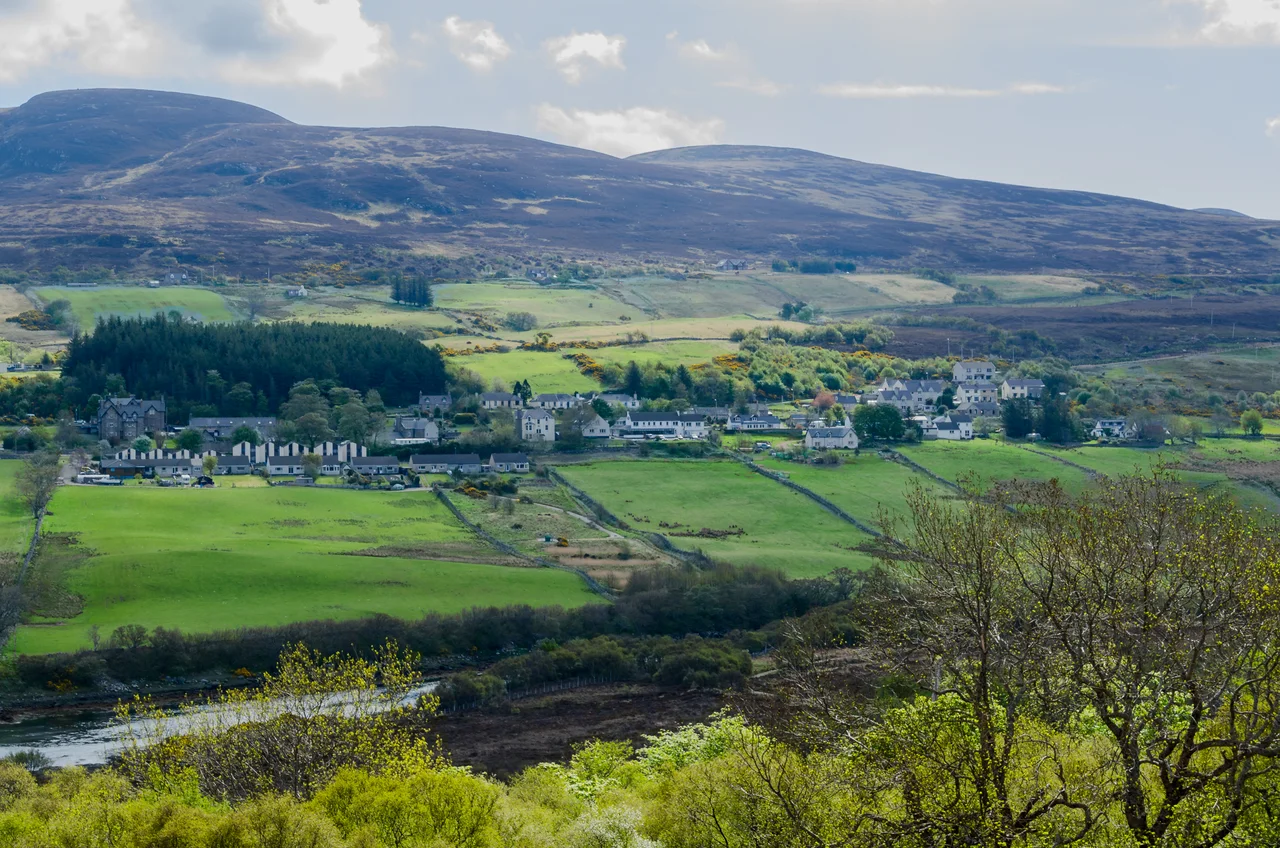

Tongue, Sutherland
The name has nothing to do with anatomy. *Tunga* is Old Norse for a piece of land shaped like a spit - and the tongue in question is the glacial moraine that projects into the sea loch here, the terminal deposit of a long-vanished ice flow. The Vikings named it, the Gaels kept it, and the village that grew up beside it has been a crossroads ever since. Tongue sits on the east shore of its Kyle, sheltered under Ben Hope and Ben Loyal, looking across the water to the mountains of the far west.
Layers of Settlement
The area was a crossroads for Gaels, Picts, and Vikings, each leaving their language stratified into the local place names. Tongue itself comes from Norse. The Gaelic *Tunga* indicates the village and *Caol Thunga* the kyle; older Gaelic speakers also called it *Ceann Tàile* and, further back, *Circeabol*. The main village threads through a string of crofting townships - Coldbackie, Dalharn, Blandy, the small harbour at Scullomie - and ends at the deserted township of Slettel, abandoned during the Clearances. Today's village has the essentials of a Highland community: a youth hostel, a general store and garage, a bank, a post office, two hotels, and a craft shop. The 1971 Kyle of Tongue Bridge and Causeway connects east to west.
Castle Varrich and Clan Mackay
Above the village stands Castle Varrich - *Caisteal Bharraich* - the ruined eleventh-century stronghold that Clan Mackay built after they were expelled from Moray and forced north into Sutherland. Tongue House replaced it as the clan seat in later centuries. Around 1427 to 1433, two factions of the Mackays fought the Battle of Drumnacoub on Carn Fada, between the Kyle and Ben Loyal - a succession dispute settled by violence in the way Highland succession disputes generally were. The castle ruins still draw visitors up the hill behind the village, where the view down the kyle remains one of the finest in the Highlands.
The Jacobite Gold
In March 1746, two Royal Navy ships intercepted a Jacobite treasure vessel in the waters near Tongue. The Jacobite crew tried to slip ashore with their gold - intended to pay troops in Bonnie Prince Charlie's army - but were caught by the Navy with support from local people loyal to the Hanoverian crown. The episode cost Charles Edward Stuart valuable resources in the weeks before Culloden, the battle that ended the rising. The lost gold of Loch nan Uamh and the Tongue cargo are still subjects of treasure-hunting folklore in the area, though the historical record is clear enough: most of it was recovered, and what remained behind has never been credibly found.
The Poet of the Clearances
Ewen Robertson, the Gaelic poet, lived in Tongue his entire life - born 1842, died 1895. The Highland Clearances had pushed many families from interior Sutherland to coastal villages like this one, and Robertson grew up in the bitter aftermath. His most famous song, *Mo mhallachd aig na caoraich mhòr* - *My Curses on the Border Sheep* - mocks the Duchess of Sutherland and Patrick Sellar, the factor who oversaw some of the most brutal evictions in Strathnaver. Julie Fowlis and Kathleen MacInnes have recorded the song in modern times, keeping Robertson's anger alive in the language he wrote it in. A monument to him stands in Tongue. The village also produced George W. Campbell, a Tennessee senator and US Treasury Secretary who emigrated to North Carolina as a young man.
From the Air
Tongue sits at 58.48°N, 4.42°W on the east shore of the Kyle of Tongue on Scotland's far north coast. Best viewed at 2,000-3,500 ft AGL for the full kyle, causeway, and surrounding peaks. Ben Loyal (763 m) rises 6 nm to the south with its distinctive four-summit ridge; Ben Hope (927 m) - Scotland's most northerly Munro - sits 9 nm to the south-west. Nearest ICAO airports: Wick (EGPC) approximately 47 nm east, Inverness (EGPE) 66 nm south. The 1971 Kyle of Tongue Bridge and Causeway makes a clear linear feature across the inlet.
Nearby Stories
- Ardvreck Castle 4.7 km away
- Kinlochbervie 7.8 km away
- HMS King Edward VII 11 km away
- Loch Shin 12 km away
- Helmsdale 14 km away
- Flow Country 15 km away
- Old Man of Hoy 32 km away
- The Laki Eruption: The Volcano That Changed World History 923 km away