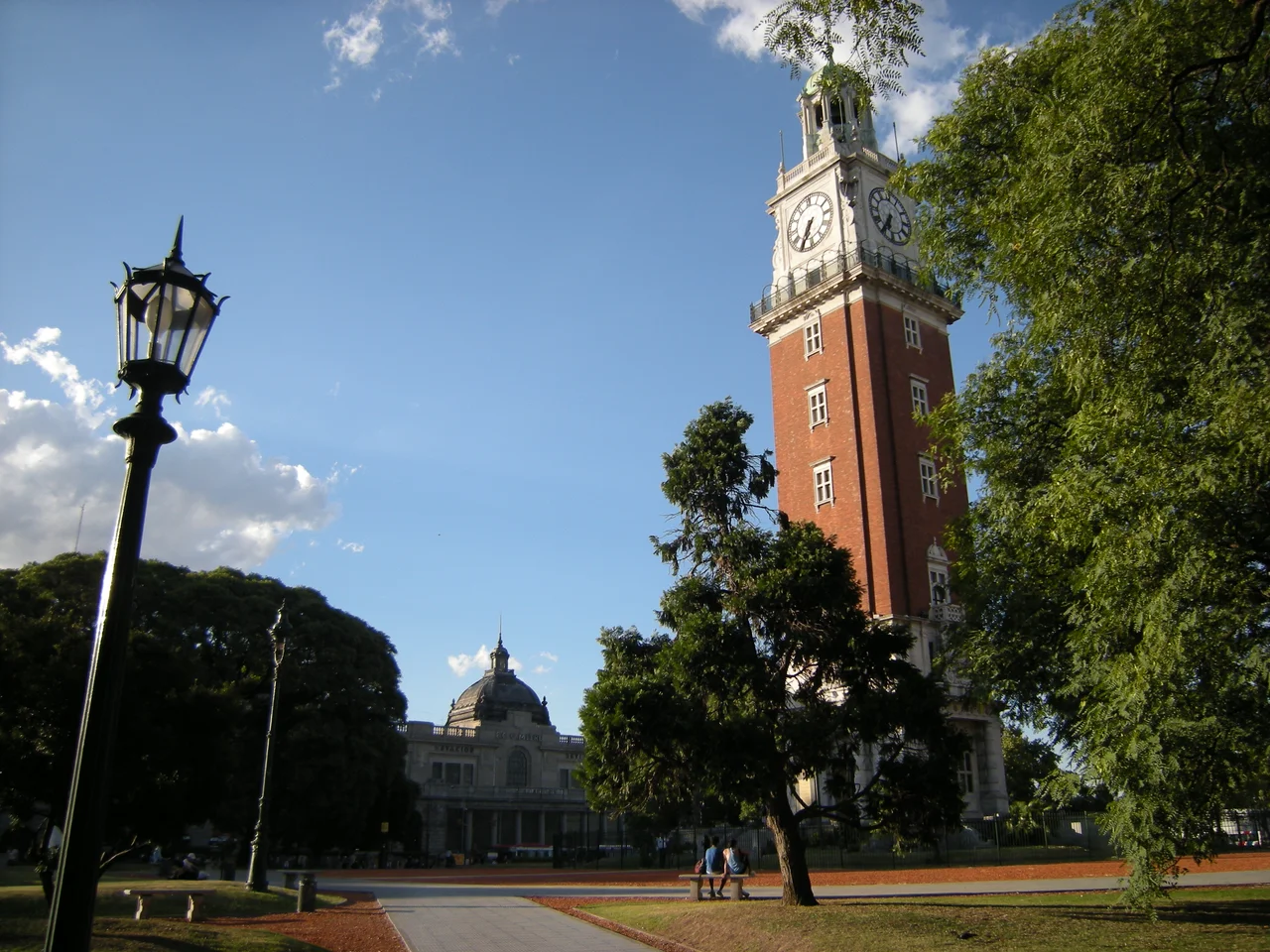

Torre Monumental
The clock keeps Westminster time in a city that no longer wants to say so. For sixty-six years this tower in Retiro was simply the Torre de los Ingleses, the Tower of the English, a Big Ben in miniature gifted to Buenos Aires by the city's British residents. Then, in 1982, Argentine and British soldiers killed each other over a cluster of islands in the South Atlantic, and a name that had been a gesture of friendship became an embarrassment. The square was rechristened for the Argentine Air Force. The tower became, blandly, the Torre Monumental. But the carillon still chimes the Westminster quarters, the Portland stone still glows pale above the railway terminal, and locals still call it by the old name when no one is keeping score.
Shipped Across an Ocean
Almost nothing about this tower is Argentine. The white Portland stone came from England by sea. So did the bricks, fired in Stonehouse, Gloucestershire, an English market town that exported a piece of itself to the far side of the Atlantic. The English firm Hopkins y Gardom built it; the technical crew sailed over too. The design came from Sir Ambrose Macdonald Poynter, a London architect whose uncle had helped found the Royal Institute of British Architects. He won the commission at a 1910 competition staged in a Buenos Aires department store, the Salón del Bon Marché, now the gilded Galerías Pacífico. The plan to build it had been formalized the year before, when the Argentine National Congress passed a law in September 1909 accepting the British residents' offer to erect a centennial monument. The brief was a monument for Argentina's centennial, and the British community delivered one made almost entirely of England.
A Gift Delayed
Argentina turned a hundred in 1910, but the tower took until 1916 to finish, dogged by setbacks that read like a catalogue of bad timing. King Edward VII died suddenly in May 1910, and Britain cancelled its centenary delegation; the cornerstone wasn't laid until November. A gas company occupying the square dragged its feet. Then the First World War broke out, and a tower made of English brick became a low priority for a nation at war. When it finally opened on May 24, 1916, President Victorino de la Plaza attended alongside British dignitaries. Above the entrance, an inscription still salutes "the great Argentine people" from "the British residents," dated to the centennial it arrived too late to celebrate.
The Empire in Stone
Look closely and the tower becomes a coded map of Britain. Built in a restrained classical style, it carries the four floral emblems of the British Isles: the thistle of Scotland, the rose of England, the dragon of Wales, the shamrock of Ireland. The clock and bells were modeled on those of Westminster, so that a fragment of London's soundscape rings out over the River Plate. An octagonal cupola roofed in copper crowns its eight floors, rising 75.5 meters above Retiro. For decades, a glass lift built around the original British machinery carried visitors to the sixth floor, where a small exhibition displayed pieces of that original lift and a window opened onto the rail terminal, the streets of Retiro, and the working port beyond. One floor higher, the clock's great pendulum swings on, marking out London's hours over a South American river.
When the Stone Became a Target
A monument made of England could not stay neutral when England and Argentina went to war. After the 1982 Falklands defeat, anti-British feeling swept the country, and the tower absorbed it. In November 1984 someone set off dynamite at its base, though the sturdy structure shrugged off the blast with only minor damage. Graffiti still appears on its walls from time to time, the resentment never quite spent. Yet the tower endures, restored in the late 1990s under Mayor Fernando de la Rúa. There is something stubbornly Argentine in that survival: a city that renamed the thing, defaced it, even bombed it, and then quietly preserved it anyway, unwilling to lose a landmark just because its history had become complicated.
From the Air
The Torre Monumental stands at 34.593°S, 58.373°W in the Retiro district of Buenos Aires, beside Plaza Fuerza Aérea Argentina and the Retiro railway terminal. At 75.5 meters with a copper-green cupola and pale Portland-stone facade, it is easy to pick out against the rail yards and the Río de la Plata waterfront just to the northeast. Best viewed at lower altitudes in clear conditions; the river haze can soften the skyline. Nearest airport is Aeroparque Jorge Newbery (SABE), roughly 3 km north along the coast; Ezeiza International (SAEZ) lies about 30 km southwest.
Nearby Stories
- Ezeiza Massacre 1.9 km away
- Luján, Buenos Aires 5.1 km away
- Curutchet House 13 km away
- Colonia del Sacramento 17 km away
- Martín García Island 28 km away
- Atucha Nuclear Power Plant 37 km away
- Lobos 43 km away
- Cry of Asencio 87 km away