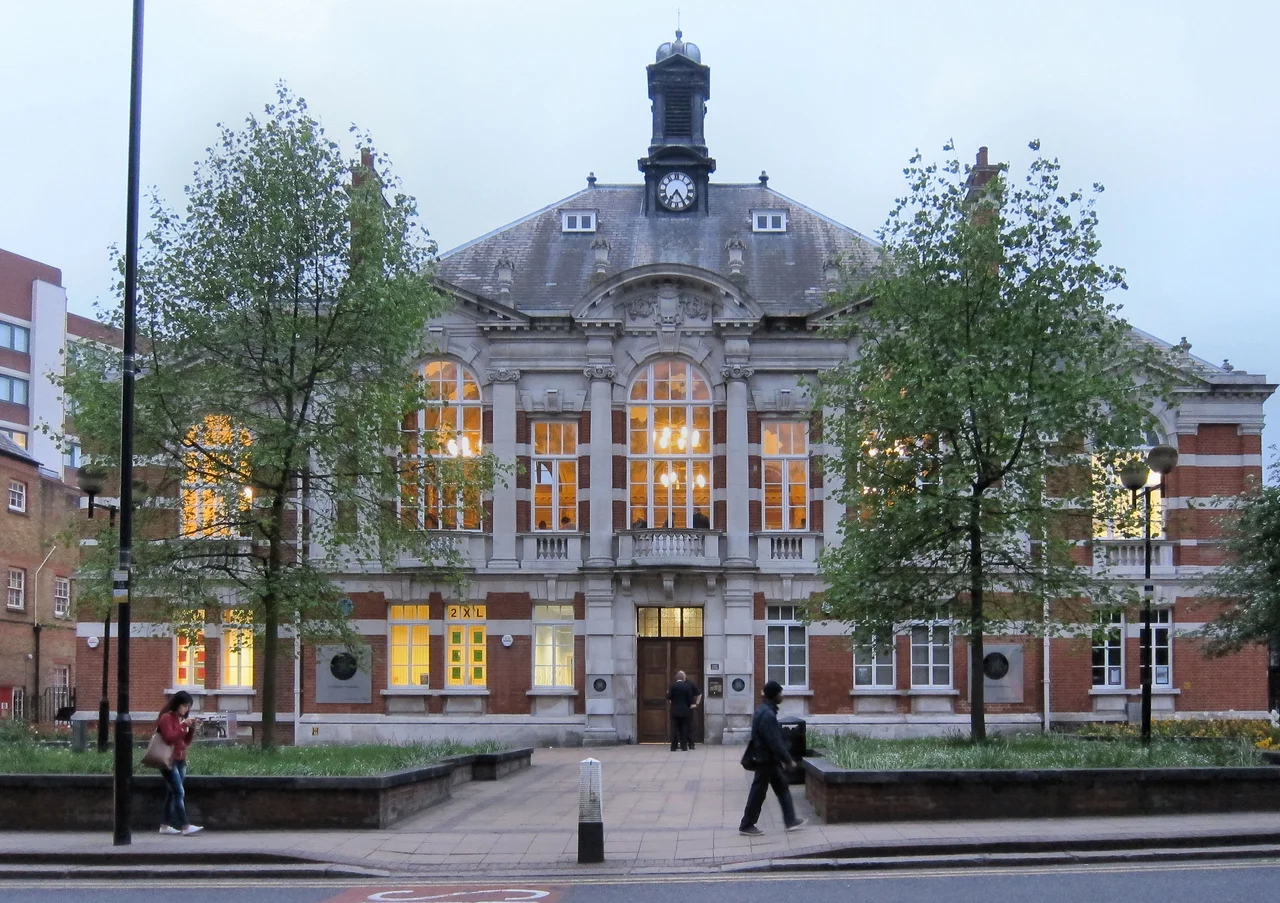
.jpg)
Tottenham
The name comes from a Saxon farmer called Tota, whose hamlet was written down in the Domesday Book of 1086 as Toteham. Tota's hamlet — Tottenham. For nine hundred years after Tota the place stayed small: a string of houses along the old Roman road that became the High Road, fields and market gardens running east to the River Lea. Then the Great Eastern Railway built workman's fares in the 1870s and Tottenham filled up in a decade — terraced houses for shopworkers, clerks, and labourers who could commute cheaply to inner London. By 1934 it was a municipal borough. By 1965 it was part of the London Borough of Haringey. By the 2011 census 129,237 people lived here, and Tottenham had become — through the Windrush generation, through later arrivals from West Africa, Eastern Europe, South America, and South Asia — one of the most ethnically diverse neighbourhoods in Britain. It is also home to the Premier League's Tottenham Hotspur, to Bruce Castle Museum, to the Markfield Beam Engine, and to a Tottenham cake whose pink icing came from mulberries in a Quaker burial ground. None of those facts is the first thing most outsiders associate with Tottenham. The first thing is usually the riots. So we should start there.
Cynthia Jarrett
On 5 October 1985, four Metropolitan Police officers entered the home of Cynthia Jarrett, a forty-nine-year-old Black woman, on Thorpe Road in Tottenham. They had come to search the house in connection with her son Floyd, who had been arrested earlier that day on suspicion of theft. The search was conducted without a warrant on the day required by the relevant Act, and during it Cynthia Jarrett collapsed with heart failure and died. She was a mother. She was someone's neighbour. The death came one week after Cherry Groce was shot and paralysed by police during a raid in Brixton — an incident that had triggered riots in south London the previous weekend. On the afternoon of 6 October 1985, members of the Black community in Tottenham gathered outside Tottenham police station to demand answers about how Cynthia Jarrett had died. By evening the protest had moved to the Broadwater Farm estate. By nightfall it was a riot.
PC Keith Blakelock
Keith Blakelock was a forty-year-old police constable from Sunderland. He had three sons. He had joined the Metropolitan Police in 1980 and was assigned to a Home Beat unit on the Broadwater Farm estate, where he was known to the children as the friendly officer who let them ride his police bicycle. On the night of 6 October 1985, he was part of a unit sent in to protect firefighters tackling a blaze in a supermarket on the estate. The unit was attacked. Blakelock was separated from his colleagues, surrounded, and killed by repeated stab wounds. He was the first British police officer to be killed in a public-order incident since 1833. The investigation that followed was conducted under enormous pressure, and the convictions it produced — of three men, Winston Silcott, Mark Braithwaite, and Engin Raghip — were quashed by the Court of Appeal in 1991 after forensic evidence proved that police interview notes had been falsified. No one has ever been convicted of Keith Blakelock's killing. Two losses, then, that the Tottenham riot of 1985 leaves us with: a woman who died during a police search of her home, an officer who died trying to protect firefighters, and three men whose lives were derailed by convictions that should never have been secured.
Mark Duggan
On 4 August 2011, Metropolitan Police officers from Operation Trident stopped a minicab in Tottenham Hale carrying a twenty-nine-year-old man named Mark Duggan. He was shot dead. Initial reports suggested he had fired at police; a 2014 inquest concluded the gun he had been carrying had been thrown clear of the cab moments before the shooting, and that he was unarmed when he was killed. His family went to Tottenham police station on the evening of 6 August asking for information about his death. The lack of response was the catalyst for what came next. Riots spread from Tottenham High Road that night through Wood Green and Tottenham Hale, then to other parts of London, then to Manchester, Birmingham, and Bristol. Five people were killed in the unrest nationwide; thousands were arrested. Mark Duggan's mother, Pamela, has spoken in the years since about her son's life rather than the controversy of his death — a father of four, a man with friends and a family, killed at twenty-nine. The inquest's lawful-killing verdict was upheld at judicial review. Duggan's family continue to dispute it.
Bruce Castle
On Lordship Lane, in a sixteenth-century manor house ringed by what is now Bruce Castle Park, sits one of the oddest small museums in London. The building takes its name from Robert the Bruce, whose family held the manor in the medieval period. Henry VIII visited it. Later it became a progressive school run by the Hill family — and in 1840, when its first headmaster, Rowland Hill, was Postmaster General of the United Kingdom, the Uniform Penny Post was being designed largely from this house. The Penny Black, the world's first adhesive postage stamp, came out of Bruce Castle. The building is now a local history museum and holds the archives of the London Borough of Haringey. Around it the cemetery of All Hallows Church preserves the parish boundary that has been here since Norman times. The church bell, given in 1802, came from the Quebec garrison and was captured from the French at the Plains of Abraham in 1759.
Tottenham Hotspur
Spurs were founded in 1882 by a group of grammar-school boys from Tottenham who wanted somewhere to play cricket in the summer and football in the winter. They were originally called Hotspur F.C., after Harry Hotspur of Shakespeare's Henry IV, whose ancestral family held land nearby. The club moved to White Hart Lane in 1899 and stayed for one hundred and eighteen years. The new Tottenham Hotspur Stadium opened on the same site on 3 April 2019. It seats 62,850, making it the third-largest football stadium in England, and is engineered with a retractable pitch that slides out to reveal an artificial surface underneath for NFL games. The stadium is part of a wider Northumberland Development Project intended to regenerate the surrounding High Road. Walk down Tottenham High Road on a match day and the neighbourhood is a different place — the pubs full, the chants audible from streets away. Walk it midweek and the regeneration is partial at best. The 2011 unemployment rate here was the highest in London.
The Tottenham Cake
If the wider Tottenham story is heavy with politics and pain, the cake is a relief. Tottenham cake is a sheet sponge, baked in large trays, covered in pink icing. The pink came originally from mulberries growing in the Tottenham Friends burial ground — the Quakers had a strong presence here from the seventeenth century onward, and one of them, baker Henry Chalkley, sold the cake from 1901 at one old penny a piece, with mis-shaped pieces at a halfpenny. There is an earlier reference, to "tottenham cakes" from 1891 by the Far Famed Cake Company. The cake travelled. Greggs sells a version of it now across Britain. The mulberries are long gone from the Friends burial ground, replaced by housing. But the recipe persists, and the pink remains the same pink, and on a Saturday afternoon at the right bakery on the High Road you can still buy a square of Tottenham cake that costs not far off what Henry Chalkley charged.
What the Neighbourhood Carries
Drive up the A10 from the City and Tottenham announces itself with the Spurs stadium and the Bruce Grove plaque to Luke Howard, the meteorologist who in 1802 named the clouds. Behind those landmarks is a borough that has carried more than its share. The 1985 riot lost it a woman during a botched search, an officer doing his job, and three men to convictions later quashed. The 2011 riot lost it Mark Duggan, much of its High Road, and twenty-six homes in the Union Point building above Carpetright. The neighbourhood that took these losses also produced David Lammy, Tottenham's MP since 2000, who has spent much of his political career arguing that what happens here matters to the rest of the country. The cake is pink. The clouds, named on Bruce Grove, are still named the same things. The bell from Quebec still rings at All Hallows. And on a Saturday in the right pub, the chant rises again for the team named after a fifteenth-century knight who in Shakespeare's telling was "the theme of honour's tongue."
From the Air
Tottenham sits at 51.5975 N, 0.0681 W in the London Borough of Haringey, about seven miles north-east of Charing Cross. From the air the Tottenham Hotspur Stadium dominates the High Road — its asymmetrical roof and 62,850-seat bowl unmistakable. The River Lea forms the eastern boundary, threading between Tottenham and Walthamstow in the parallel borough of Waltham Forest, with the Lee Valley Park's reservoirs and marshland stretching north. Nearest airports: London City (EGLC) ten miles south-east, Luton (EGGW) twenty-two miles north-west, Stansted (EGSS) twenty-five miles north-east, Heathrow (EGLL) seventeen miles south-west. The Tottenham Marshes, part of the Lee Valley Regional Park, are the easiest natural landmark from the air; the Markfield Beam Engine sits in a small park just south of them.
Nearby Stories
- Stevenage 5.7 km away
- Malling Abbey 5.7 km away
- 1952 Farnborough Airshow Crash 7.7 km away
- Ingatestone Hall 8.2 km away
- Hellfire Caves 9.1 km away
- The Carrington Event: The Solar Storm That Could Happen Again 9.8 km away
- Bletchley Park 16 km away
- Castle Hedingham 23 km away