.jpg)
Tower Hamlets Cemetery Park
By 1889, 247,000 people had been buried in Tower Hamlets Cemetery. The gates stayed open for another 77 years. In the first two years of operation, 60 percent of burials were in public graves—used for those whose families could not afford a private plot. By 1851 that proportion had risen to 80 percent. Some graves were reportedly dug 40 feet deep and held up to 30 unrelated people. This was the East End of London burying its dead: not grandly, not individually, but in the only way the economics of poverty allowed.
A Victorian Solution to a Victorian Problem
Before the Victorian era, London's dead were buried in small parish churchyards that had become grotesquely overcrowded. The dead lay too close to the living—causing disease, contaminating groundwater, and occupying land that the expanding city desperately needed. Parliament passed legislation allowing joint-stock companies to purchase land outside the City of London and establish large commercial cemeteries. Between 1832 and 1841, seven such cemeteries were laid out in a ring around London: Highgate, Nunhead, West Norwood, Kensal Green, Brompton, Abney Park, and Tower Hamlets. These became known as the Magnificent Seven. Tower Hamlets—formally the City of London and Tower Hamlets Cemetery—was consecrated by the Bishop of London, Charles James Blomfield, on Saturday 4 September 1841. The morning consecration was followed by the first burial that same afternoon.
Who Lies Here
The people buried in Tower Hamlets Cemetery tell a story of the East End. Charlie Brown, publican at Charlie Brown's in Limehouse for 40 years, died in 1932 and was mourned by 16,000 people at his funeral—one of the largest turnouts in the cemetery's history. Major John Buckley VC, one of the first recipients of the Victoria Cross for his bravery in the Indian Rebellion of 1857, died in poverty and obscurity and was laid in an unmarked grave. A researcher from the Friends of Tower Hamlets Cemetery Park found it in 2012. A headstone was placed in a 2014 ceremony. Hannah Maria Purcell, widow of William Purcell, who served as carpenter on HMS Bounty, is buried here. So is Dr Rees Ralph Llewellyn, who performed the autopsy on Mary Ann Nichols—considered the first victim of Jack the Ripper.
Bombed, Abandoned, Reclaimed
German bombing struck the cemetery five times during the Second World War. Both cemetery chapels were damaged. Shrapnel damage is still visible on the graves near the Soanes Centre in the northwest corner of the park. Burials continued until 1966, when the Greater London Council bought the company for £100,000 and closed the ground. An initial plan to clear the chapels and some graves—at a further cost of £125,000—was stopped by strong local opposition and lack of funds. The cemetery sat untended. Then, slowly, nature took over. By the time the Friends of Tower Hamlets Cemetery Park was established in 1990, what had been a formal Victorian burial ground had become something else: a woodland, with wildflowers growing between the gravestones, birds nesting among Victorian monuments, and rare insects finding habitat in the accumulated leaf litter and dead wood.
A Nature Reserve in Disguise
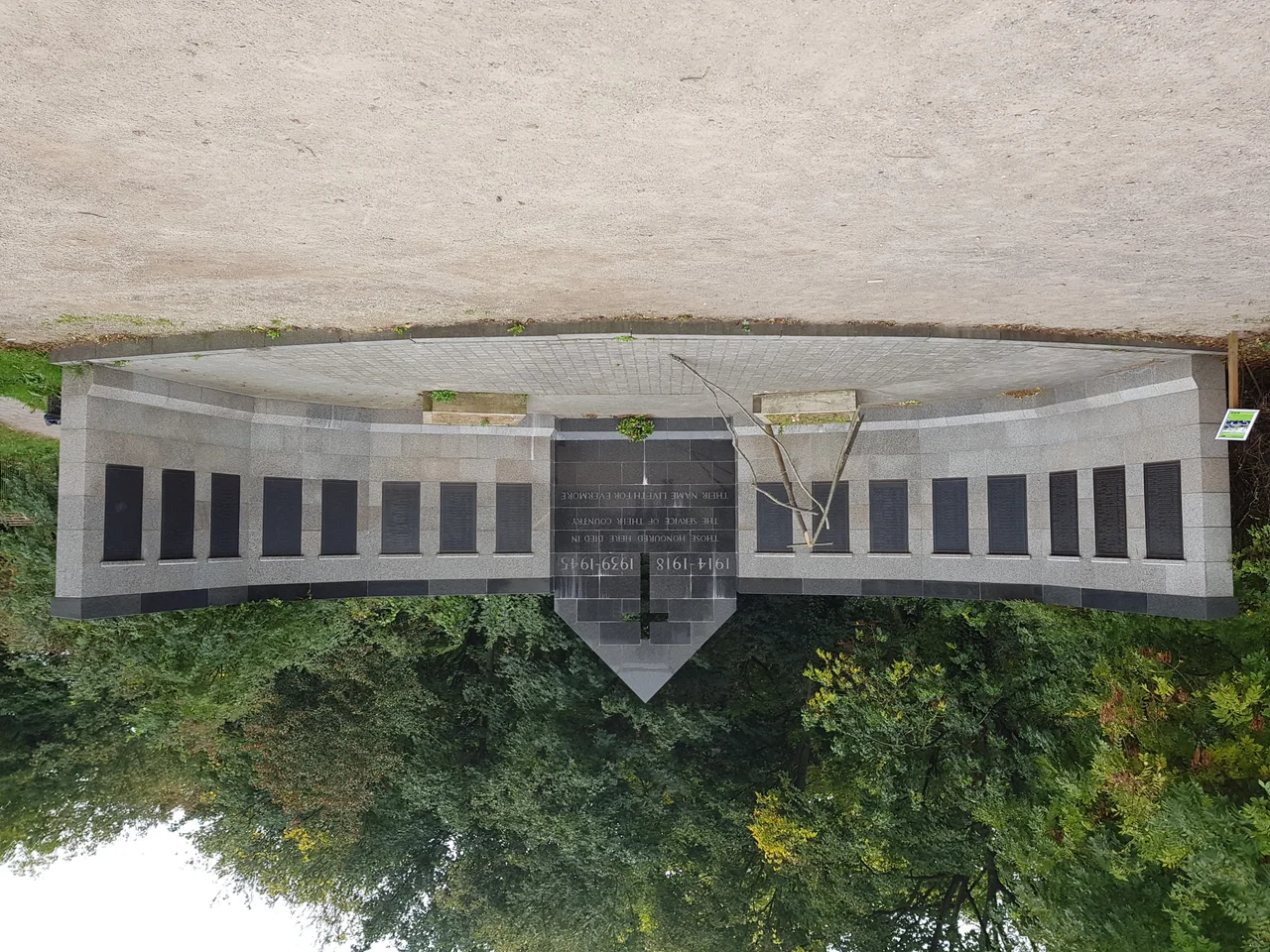
Today Tower Hamlets Cemetery Park is a Local Nature Reserve and a Site of Metropolitan Importance for Nature Conservation. The Friends manage it under agreement with the borough, maintaining trails, conducting heritage research, and hosting community events. The graves have not been cleared—they remain, tilted and mossy, integrated into the woodland. Seven individual monuments and two sections of the historic brick walls are Grade II listed. The War Memorial near the Southern Grove entrance records 279 Commonwealth service personnel buried here from both world wars, along with four Dutch merchant seamen. Nine British merchant seamen killed when their ship SS Bennevis was bombed on 7 September 1940 are buried here. The park is open 24 hours a day. The main gate is locked at dusk; the smaller foot gates remain open.
From the Air
Tower Hamlets Cemetery Park lies at 51.523°N, 0.028°W in the London Borough of Tower Hamlets, in the Mile End and Bromley-by-Bow area. From altitude, the park is visible as an irregularly shaped area of green woodland in the dense East End urban fabric—distinct from the formal geometry of maintained parks. The nearest tube stations are Mile End and Bow Road; the nearest DLR is Bow Church. Nearest airport is London City (EGLC, about 5 miles east). The site sits at approximately 5 metres elevation on flat ground. Look for the surrounding historic brick walls that define the cemetery boundary.
Nearby Stories
- Stevenage 5.7 km away
- Malling Abbey 5.7 km away
- 1952 Farnborough Airshow Crash 7.7 km away
- Ingatestone Hall 8.2 km away
- Hellfire Caves 9.1 km away
- The Carrington Event: The Solar Storm That Could Happen Again 9.8 km away
- Bletchley Park 16 km away
- Castle Hedingham 23 km away