
Tower Hill Memorial
They were not soldiers, and that is exactly the point. The men and women named on the bronze panels at Tower Hill carried fish from the North Atlantic. They carried Argentine beef and Canadian wheat and South African coal. They carried mail, oil, lumber, ammunition, and one another's children. They were merchant seafarers and they were civilians, and Germany sank their ships anyway. The first memorial here lists about 12,000 names from the First World War. The second, just behind it through a sunken garden, lists about 24,000 from the Second. Their dedication is the same, carved into Portland stone in both places: WHO HAVE NO GRAVE BUT THE SEA.
The Argument Over Recognition
When the Imperial War Graves Commission was set up in 1917, it was given charge of "members of the military and naval forces of the Crown" - the Royal Navy, the Army, the new Royal Air Force. The Admiralty took the view that merchant seamen were not their problem; they would handle their own commemorations. The Commission disagreed. Fabian Ware, the IWGC's founder, insisted that civilians who died in the war effort deserved the same individual, equal commemoration as anyone in uniform - regardless of rank, regardless of social status. After years of negotiation, the commissioners formally resolved in 1921 to extend the Commission's remit to the Mercantile Marine. The numbers made the argument: by November 1918, more than 3,300 British and Empire-registered merchant ships had been sunk, costing over 17,000 lives. The largest single loss commemorated here came from one ship - the RMS Lusitania, torpedoed by U-20 off the coast of Ireland on 7 May 1915. Of the 1,200 people who died, more than 350 British crew members have their names on these bronze panels.
Lutyens's Compromise
Edwin Lutyens was the IWGC's principal architect and the designer of the Cenotaph. His first proposal for a merchant marine memorial was a great arch on the bank of the Thames itself, a structure to be seen by everyone passing on the river. The Royal Fine Art Commission rejected it. Lutyens called their opinion "bosh" and wanted to push ahead anyway; Ware, more diplomatic, found a different site. Trinity Square Gardens on Tower Hill was already saturated with maritime associations - the Port of London Authority headquarters next door, Trinity House nearby, the ancient church of All Hallows-by-the-Tower. The Gardens were Crown land, and a special Act of Parliament had to be passed in June 1927 to allow construction. The historian David Crane has written that the memorial "never recovered from its miserable start" - that this is the least-known of Lutyens's First World War works. That obscurity is part of what makes a visit feel personal. Queen Mary unveiled the memorial on 12 December 1928 in torrential rain. It was her first solo royal engagement and her first broadcast on radio.
The Names
The First World War memorial is a Doric pavilion of Portland stone, open at both ends, 21.5 metres long. Inside, the floor is laid in a black and white chequerboard pattern. The walls are clad in bronze panels, divided into 24 numbered sections, organized first by ship and then alphabetically within each crew starting with the captain or master. The vessels of the Merchant Navy and the Fishing Fleets are listed separately. Read down a panel and you find a ship's whole roster - cooks, firemen, deckhands, apprentices barely out of childhood - all sailing together, all lost together. The Fishing Fleet names matter especially: many of these men were trawlermen requisitioned to sweep mines, and they died doing dangerous, anonymous work nobody at home knew about until afterwards. The dedication above reads: TO THE GLORY OF GOD AND TO THE HONOUR OF TWELVE THOUSAND OF THE MERCHANT NAVY AND FISHING FLEETS WHO HAVE NO GRAVE BUT THE SEA.
Maufe's Sunken Garden
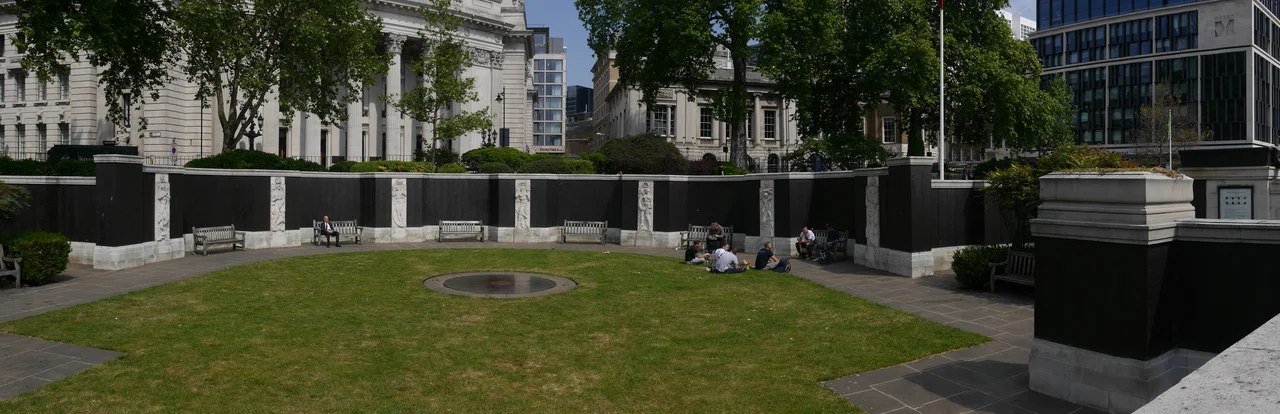
Second World War losses were worse. 4,786 ships sunk, around 32,000 lives lost - the Battle of the Atlantic the longest continuous campaign of that war. The Commission asked Edward Maufe, by then its principal UK architect, to design a complementary memorial. He proposed extending Lutyens's pavilion with another colonnade; rejected. He proposed a sunken garden behind it; accepted. The depth had to be reduced at the south end because of a London Underground tunnel directly beneath. Queen Elizabeth II unveiled it in November 1955. Afterwards, 16,000 relatives of those named came forward to lay flowers - a procession that lasted until late into the evening. The walls of the sunken garden carry 132 bronze panels with the names. Between the panels are seven allegorical sculptures by Charles Wheeler representing the Seven Seas. Two of Wheeler's other sculptures stand sentry at the entrance - a Merchant Navy sailor on the east, an officer on the west, both watching over the dedication: THE TWENTY FOUR THOUSAND OF THE MERCHANT NAVY AND FISHING FLEETS WHOSE NAMES ARE HONOURED ON THE WALLS OF THIS GARDEN GAVE THEIR LIVES FOR THEIR COUNTRY AND HAVE NO GRAVE BUT THE SEA.
Falklands and Forward
A third memorial was added in 2005, after years of campaigning by the Merchant Navy Association. The work of sculptor Gordon Newton, it is a three-metre bronze sundial mounted on a granite base with a bronze anchor at its centre. Around the base are plaques naming 17 merchant seafarers killed in the 1982 Falklands War - the dead from Atlantic Conveyor, sunk by an Exocet missile, and from other Royal Fleet Auxiliary ships under fire. The First Sea Lord, Admiral Sir Alan West, unveiled it on 4 September 2005. Since 2000, 3 September has been observed as Merchant Navy Day, and a service is held here close to that date each year. The Lutyens memorial was upgraded to Grade I listed status in November 2015 - the highest level of architectural protection, granted to about 2.5 percent of all listed buildings in England - when his war memorials were declared a national collection. Maufe's extension carries Grade II* listing. The Falklands memorial is unlisted, but the wreaths still pile up every September.
From the Air
Tower Hill Memorial sits at 51.5097°N, 0.0778°W in Trinity Square Gardens, immediately northwest of the Tower of London. The Lutyens pavilion is small but recognizable in aerial views by its low rectangular footprint and central drum, set back from the Thames. Best viewed at low altitude in clear conditions; the memorial is dwarfed by the Tower itself and the Port of London Authority building (10 Trinity Square).
Nearby Stories
- Stevenage 5.7 km away
- Malling Abbey 5.7 km away
- 1952 Farnborough Airshow Crash 7.7 km away
- Ingatestone Hall 8.2 km away
- Hellfire Caves 9.1 km away
- The Carrington Event: The Solar Storm That Could Happen Again 9.8 km away
- Bletchley Park 16 km away
- Castle Hedingham 23 km away