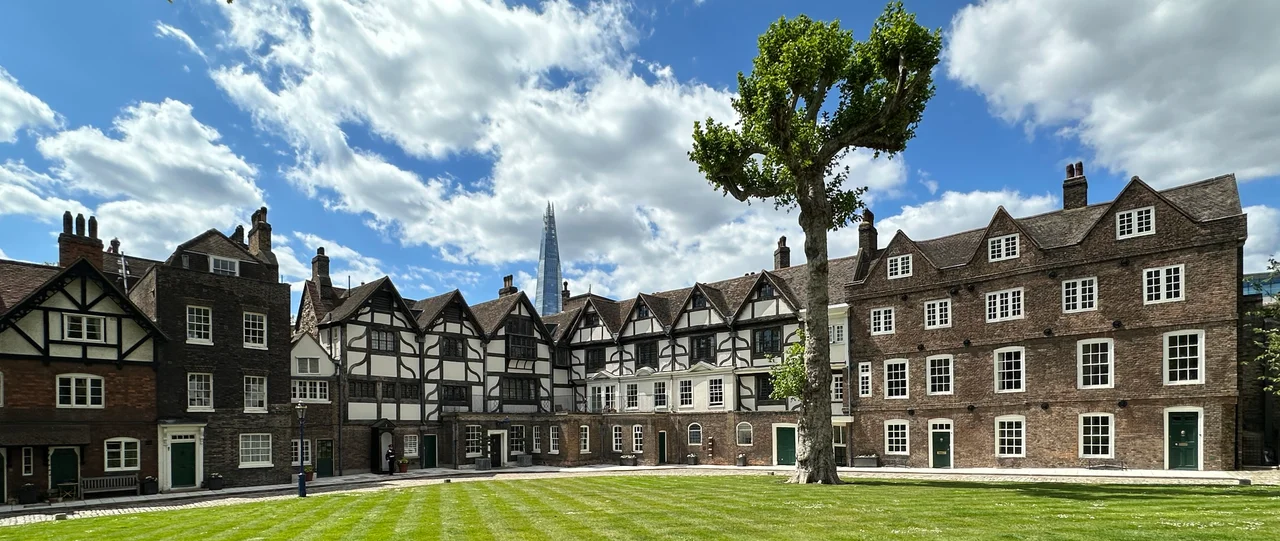

Tower of London
It was supposed to be hated. When William the Conqueror started building the White Tower in 1078, the chroniclers of the time describe it without admiration - a foreign keep imposed on an English city by an army that had won at Hastings twelve years earlier and was not letting anyone forget. The Normans wanted the Saxon Londoners to see this castle every time they looked east, and the castle was positioned so the strongest defences faced inward, at the city. Nearly a millennium later, Londoners walk under those same walls on their way to work. The hatred wore off. The stone did not.
The White Tower
The keep that gives the whole castle its name is one of the largest medieval keeps in the Christian world. It measures 36 metres by 32 at the base, rising 27 metres to the southern battlements, originally three storeys high. Norman keeps were entered above ground for defensive reasons, and the White Tower was no exception - a wooden staircase, removable in an attack, led to the south face. Inside, each floor was divided into three chambers, with St John's Chapel taking the south-east corner across the upper levels, its apse projecting outwards. The walls are thick enough to contain latrines and four fireplaces. The west and north corners are square towers; the north-east corner houses a spiral staircase in a round tower. The basement, partially below the natural ground level because the building was terraced into a mound, served as undercroft storage. One of its rooms contained a well. The interior of that basement was largely rebuilt in the 18th century, with brick vaulting replacing the original timber. The original windows have nearly all been enlarged.
Rings Within Rings
What you see today is essentially the castle Edward I finished in 1285. The White Tower sits inside the innermost ward, the earliest enclosure. Around that is the inner ward, walled and towered under Richard I in the 1190s. Around that, the outer ward, completed by Edward I, with the moat beyond. Tower Wharf, on the Thames bank, was started under Edward I and reached its current size under Richard II in the late 14th century. The castle proper encloses nearly 12 acres, with another 6 acres of Tower Liberties around it - land cleared for military reasons in the 13th century when Henry III ordered a defensive perimeter. The general layout has hardly changed in 700 years. The Tower has been an armoury, a treasury, a menagerie (lions, tigers, polar bears - the polar bear was let out on a chain to fish in the Thames), the home of the Royal Mint, a public record office, and the home of the Crown Jewels. From the early 14th century until Charles II, monarchs spent the nights before their coronation here and processed from the Tower to Westminster Abbey to be crowned.
Prisoners
It functioned as a prison from 1100 to 1952 - from Ranulf Flambard, Bishop of Durham, who escaped down a rope smuggled in a wine cask, to the Kray twins, the East End gangster brothers held briefly here for failing to report for National Service. The peak of its use as a prison was the 16th and 17th centuries. Anne Boleyn was held here before her execution on the green within the walls. Sir Walter Raleigh was held here for years and wrote his History of the World in his cell. Elizabeth Throckmorton, Raleigh's wife, was imprisoned alongside him. The young Elizabeth I was held here by her sister Mary I before becoming queen. The two boy princes - Edward V and his brother Richard - disappeared from rooms inside the castle in 1483, presumed murdered. Despite the Tower's reputation, only seven people were executed within its walls before the World Wars - a fact 16th-century religious propagandists and 19th-century writers worked hard to obscure. The notorious public executions happened on Tower Hill to the north, where about 112 people died over a 400-year period. In the World Wars, 12 men were shot inside the Tower for espionage.
Restoration and Survival
By the mid-19th century the Tower had a problem - it was full of empty buildings. The Royal Mint moved out. The Ordnance Survey left. Various administrative functions relocated. Anthony Salvin and John Taylor took on the task of restoring what remained to a more uniformly medieval appearance, clearing post-medieval structures that did not fit the romantic vision. The Tower took bomb damage during the Blitz - the Old Hospital was destroyed, and the North Bastion was hit - but the core survived. After 1945 it reopened to the public. Today, around 2.5 million visitors a year come through the gates. The castle is administered by Historic Royal Palaces, the independent charity that also runs Hampton Court Palace, Kensington Palace, the Banqueting House, and Hillsborough Castle. UNESCO inscribed it as a World Heritage Site in 1988.
The Yeomen and the Ravens
The ceremonial guardians of the Tower, the Yeomen Warders, have lived here since 1485, when Henry VII established the bodyguard. They live with their families inside the walls and conduct visitor tours by day. At 9:53 each evening they perform the Ceremony of the Keys - locking the outer gates in a sequence essentially unchanged for 700 years. The ravens are the other ceremonial residents. Legend, codified in the 19th century, holds that if the ravens leave, the Tower will fall and the kingdom with it. Six are kept at all times, with a seventh as backup. Their wings are clipped enough to keep them in the grounds but not so much that they cannot fly within. The Constable of the Tower, a ceremonial appointment held since 1078, formally outranks every officer in the British Army when within the castle walls. Forty-three Constables have served. The first was Geoffrey de Mandeville, in 1078; the current one is a senior retired general. The institution is still functioning. The Norman keep is still standing. London is still here.
From the Air
The Tower of London sits at 51.5082°N, 0.0762°W on the north bank of the Thames, immediately west of Tower Bridge in the London Borough of Tower Hamlets. The complex is highly recognizable from altitude - a roughly square fortress with prominent white keep at center, set against the river. Best viewed at low altitude in clear conditions. Nearest airports: London City (EGLC) east; London Heathrow (EGLL) west.
Nearby Stories
- Stevenage 5.7 km away
- Malling Abbey 5.7 km away
- 1952 Farnborough Airshow Crash 7.7 km away
- Ingatestone Hall 8.2 km away
- Hellfire Caves 9.1 km away
- The Carrington Event: The Solar Storm That Could Happen Again 9.8 km away
- Bletchley Park 16 km away
- Castle Hedingham 23 km away