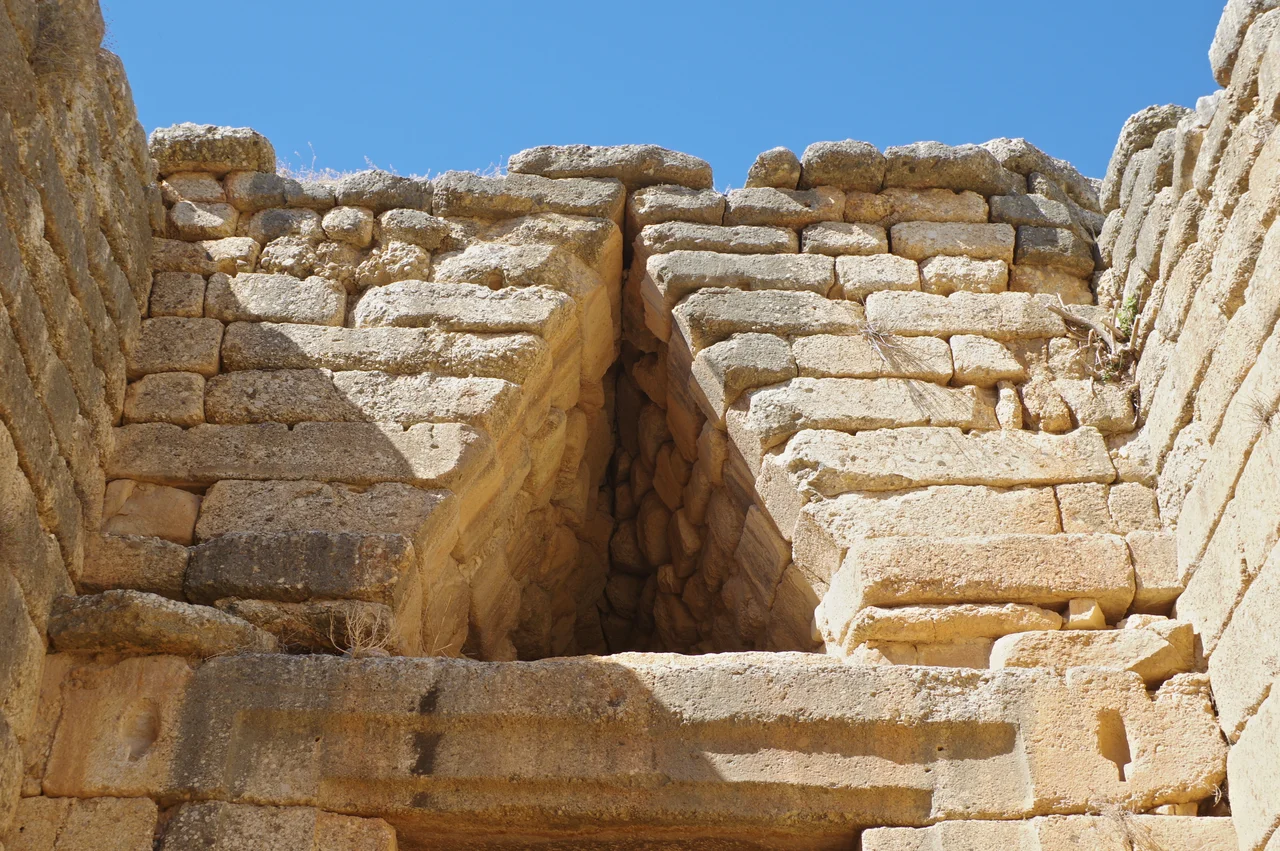

Treasury of Atreus
For over a thousand years, it was the largest dome on Earth. Not a modest lead — a commanding one. The corbelled vault of the Treasury of Atreus at Mycenae, completed sometime around 1350 to 1250 BC, measured 14.5 meters in diameter and rose 13.5 meters to its apex. It held that record through the entire Greek Classical and Hellenistic periods, through the conquests of Alexander, through the rise of Rome, until Roman engineers finally built larger stone vaults in the late 1st century BCE and the Pantheon in the 2nd century CE. Even now, it remains the world's largest corbelled dome — a dome built by stacking overlapping rings of stone that gradually close toward a point, without mortar, without a keystone, relying entirely on the geometry of the structure and the weight of the earth mounded above. The name 'Treasury of Atreus' — like the nearby 'Tomb of Agamemnon,' which refers to the same monument — is a later romantic label, probably dating to the 18th century. The legendary Atreus and Agamemnon are figures of Greek mythology. The dome is real.
The Names and the Myth
The mythological House of Atreus is one of the most blood-soaked dynasties in Greek legend. Atreus, the king of Mycenae, tricked his brother Thyestes into eating the flesh of his own children as revenge for a betrayal. Thyestes, guided by an oracle, then fathered a son with his own daughter to beget a killer of Atreus — that son was Aegisthus. Aegisthus duly murdered Atreus and ruled Mycenae, until Atreus's sons Agamemnon and Menelaus returned to overthrow him. Agamemnon led the Greeks at Troy, then returned home to be murdered in his bath by Clytemnestra and Aegisthus, who in turn were killed by Agamemnon's son Orestes. The tomb was not called 'Atreus' or 'Agamemnon' in antiquity — when the geographer Pausanias visited in the 2nd century CE, he described both rulers as buried inside the city walls, not outside them. The name in use today was likely coined in the early 18th century by a French traveler named Claude-Louis Fourmont, who visited in 1729–1730, and it has held ever since. The nearby tombs known as 'Clytemnestra' and 'Aegisthus' are named by the same logic of association. None of these identifications are supported by inscriptions or burial evidence.
How It Was Built
The Treasury of Atreus follows the standard tripartite layout of Mycenaean tholos tombs: a long stone-lined passage (dromos), a deep doorway (stomion), and a circular burial chamber (thalamos) surmounted by the corbelled dome. But it takes every element of that template to its extreme. The dromos is 36 meters long and 6 meters wide — the walls increase in height from 0.5 meters at the entrance to 10 meters at the façade, their thickness growing correspondingly as the pressure of the hillside behind them increases. Wace estimated the total volume of masonry in the dromos alone at over 600 cubic meters, or more than 1,200 tons. The inner lintel block above the doorway — 8 meters long, 5 meters wide, 1.2 meters thick — is the heaviest single piece of masonry known from ancient Greek architecture, weighing approximately 120 tons. Moving it to the site may have required up to 1,000 people. The thalamos itself was built in 33 courses of ashlar limestone. Traces of nails hammered into the interior of the dome have led scholars to suggest that golden rosettes once hung from inside the vault. The construction is estimated to have required at least 20,000 worker-days of labor, possibly involving up to 1,600 people over several years or decades.
A Façade Taken Apart and Scattered
The original façade of the Treasury of Atreus was spectacular — marble columns flanking the doorway, red and green marble friezes, spiral decoration, gypsum reliefs carved with bulls. The marble came from the Mani Peninsula at the southern tip of the Peloponnese, quarried and transported to Mycenae for an effect that must have been striking against the earth-colored hillside. Almost none of it survives in place. In 1801, Lord Elgin — the same British aristocrat who removed the Parthenon sculptures — tasked agents to investigate ancient sites in Greece for removable antiquities. Philip Hunt visited Mycenae that August and described the Treasury as 'a most stupendous conical subterranean building.' Elgin visited in 1802, crawling through the relieving triangle to enter the chamber, and arranged for parts of the flanking columns to be removed and shipped to England. In June 1810, Veli Pasha, the Ottoman governor of the Morea, excavated the monument and entered the chamber by ladder, reportedly discovering bones covered with gold along with gemstones and other precious objects. Four more columnar fragments were removed; pieces eventually reached a marquess's estate in County Mayo, Ireland, where they sat in a basement until rediscovered in 1904. Fragments from both Elgin and the Marquess of Sligo are now in the British Museum.
The Dome That Settled an Argument
In the early 20th century, the Treasury of Atreus became the pivot of one of archaeology's most consequential debates. Arthur Evans, excavator of Knossos on Crete, argued that the tholos tombs — and the whole of Mycenaean civilization — were the work of Minoan rulers transplanted from Crete, and that the Treasury of Atreus dated to around 1600–1500 BCE to fit this theory. Alan Wace, working at Mycenae for the British School at Athens, disagreed: he argued instead for the independent development of mainland Greek culture, and dated the Treasury to 1400–1200 BCE based on the stratigraphic evidence. This chronological dispute was derisively called the 'Helladic Heresy' by Wace's critics. The excavations of the 1920s, including the careful dating of the Tomb of Aegisthus as earlier than the Treasury, provided the framework that eventually confirmed Wace's position. The Treasury of Atreus was a late product of an indigenous Mycenaean tradition — not a copy of Cretan structures, not the grave of a Minoan dynast, but the culmination of two centuries of architectural development on the Greek mainland. Who was buried inside it still is not known. The identity of the occupant has been dissolved by time and by thieves who came in the Iron Age and left nothing.
From the Air
The Treasury of Atreus is located at 37.7268°N, 22.7536°E, approximately 500 meters south-southwest of the Lion Gate of Mycenae, on the west side of the road leading to the citadel. The site of Mycenae occupies a ridge in the Argolid region, northeastern Peloponnese, Greece, on the eastern edge of the Argive plain. The nearest major airport is Athens International (LGAV), approximately 130 km to the northeast. The dome of the tomb is set into the hillside and not visible from the air, but the citadel of Mycenae on the ridge above provides a clear landmark. At 3,000–5,000 feet in clear weather, the Argive plain extends visibly south to the Gulf of Argos. Approach via the Corinth corridor from the northeast; the villages of Mykines and Charvati mark the location on the northern edge of the plain.
Nearby Stories
- Villa of Herodes Atticus 3 km away
- Sicyon 3.5 km away
- Battle of Megalopolis 4.5 km away
- Hermione: The City at the Edge of the World 7.5 km away
- Agia Lavra 7.7 km away
- Megara 13 km away
- Agistri 13 km away
- Teuthis 15 km away