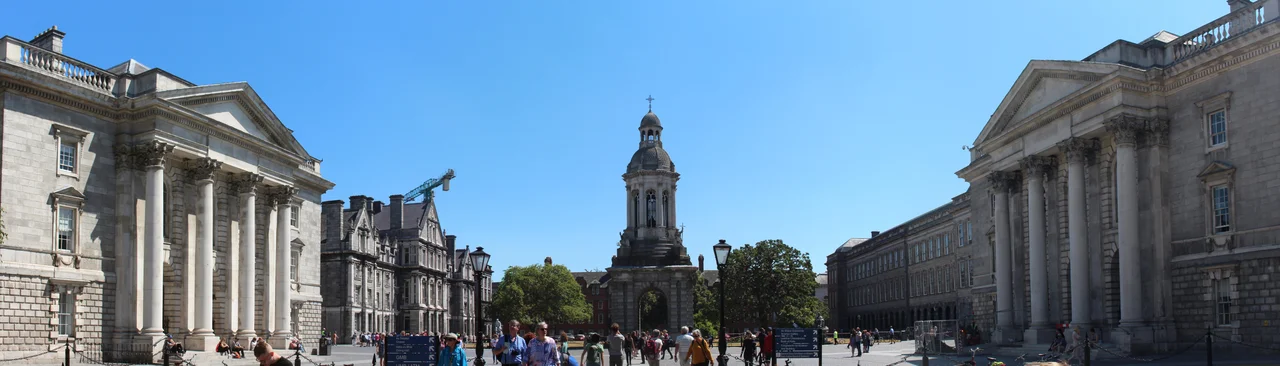

Trinity College Dublin
Cross under the gate at College Green and the noise of Dublin drops away by a measurable amount. The traffic, the tour buses, the buskers on Grafton Street - all of it goes quiet behind walls that have looked inward since 1592. The cobbles of Front Square crunch under your feet. The Campanile stands ahead like a Victorian rocket. Off to the right is the Examination Hall, holding an organ case reputedly built in 1684 by Lancelot Pearse - the oldest surviving Irish-made organ case. To the left, behind a Georgian facade, sits the Long Room of the Old Library, where the eighth-century Book of Kells draws roughly two million visitors a year. The college occupies the heart of a capital city and somehow remains a sanctuary.
A Tudor Plant
Queen Elizabeth I issued the royal charter on 3 March 1592, naming herself mater universitatis - mother of the university. Trinity was meant to consolidate Tudor authority in Ireland, a Protestant institution in a Catholic country. That tension shaped the college for centuries. As late as 1944, the Catholic Archbishop of Dublin, John Charles McQuaid, required Catholics in his archdiocese to obtain a special dispensation before entering Trinity, under threat of automatic excommunication. The ban was extended nationally at the 1956 Plenary Synod of Maynooth. It was not until 1970 that the Catholic Church lifted the prohibition, and Trinity invited a Catholic chaplain to be based on campus. Today there are two Catholic chaplains alongside the Anglican Dean of Residence and a Methodist chaplain. The Chapel, completed in 1798 to a design by Sir William Chambers, became Ireland's only chapel shared by all Christian denominations.
Scholars and Sizars
On Trinity Monday in mid-April, the Provost stands on the steps in Front Square and reads aloud the names of the newly elected Scholars. Election to the Foundation Scholarship is widely considered the most prestigious undergraduate award in Ireland. Scholars receive free rooms, free Commons in the Dining Hall, an annual stipend, and exemption from fees for fifteen terms - the privilege traces back to Elizabethan statute. Samuel Beckett was elected a Scholar. So was Ernest Walton, who in 1932 split the lithium atom with John Cockcroft and won the Nobel Prize in Physics. Sally Rooney was a Scholar in English. The day she walks past those names being read aloud on a damp April morning, Trinity feels less like a tourist attraction and more like a continuous experiment that has been running for four centuries.
The Library That Receives Everything
Under the Copyright and Related Rights Act 2000 in Irish law and the Legal Deposit Libraries Act 2003 in UK law, Trinity College Library is entitled to a copy of every book published in Britain and Ireland. More than 100,000 new items arrive each year. The collection now exceeds seven million printed volumes scattered across the Old Library, the Berkeley wing - renamed in October 2024 the Eavan Boland Library after the poet, making it the first building on the Trinity city-center site named for a woman - the William Hamilton Science and Engineering Library, and the John Stearne Medical Library at St James's Hospital. The Glucksman Library holds half a million printed maps, the largest cartographic collection in Ireland, including the first Ordnance Surveys of the early 19th century. Wikipedia describes it as Ireland's largest research library. Looking at the queue snaking through Front Square on a summer morning, you would call it Ireland's most-visited.
Commons and the Dramatic Slam
At 18:15 on weekdays during term, the doors of the College Dining Hall slam shut with calculated drama. Inside, Scholars, Fellows, Sizars, and their guests sit down to a three-course Commons under portraits of past Provosts. A Latin grace is read by one of the Scholars. During Advent the Chapel Choir - the university's oldest choir - sings carols between courses. The Dining Hall doors slamming is one of those small theatrical traditions that universities accumulate; the choir, the Latin, the slammed door, the Scholar's robe with its velvet mortarboard, none of them are necessary, but losing any of them would be missed. In 2021 Linda Doyle became Trinity's first woman Provost in 429 years.
A Capital City's Quiet Heart
Forbes ranked Trinity one of the fifteen most beautiful college grounds in the world in 2010. Walk the perimeter - it is about a kilometer - and you pass through five squares, a cricket pitch and rugby pitch in College Park, the Provost's House on Grafton Street with its private garden, the Samuel Beckett Theatre, the Douglas Hyde Gallery, the Sphere Within Sphere sculpture by Arnaldo Pomodoro outside what is now the Eavan Boland Library. From the second-floor windows of the Arts Building you can look across to the modern science buildings, three rows of glass and concrete rather than quadrangles, where research on infectious disease and quantum physics happens daily. Trinity has produced eight Nobel laureates, fifty-six Fellows of the Royal Society, presidents of Ireland including Mary Robinson and Mary McAleese, and the actor Paul Mescal. In June 2025 it became the first Irish university to fully divest from Israeli universities and companies.
From the Air
53.3444 N, 6.2578 W, near sea level in the center of Dublin. The Trinity campus forms an unmistakable green rectangle just south of the River Liffey, bordered by Pearse Street, Nassau Street, and College Green. Dublin Airport (EIDW) sits 9 km to the north - arrivals frequently descend over the city. Look for the Campanile in the center of Front Square as a visual landmark. Best visibility comes on bright winter mornings when low-angle sun catches the granite facade of the Old Library. Dublin's prevailing south-westerlies typically bring Atlantic cloud and showers; a brief clear window often follows a frontal passage.
Nearby Stories
- Wicklow Mountains 12 km away
- Mornington 14 km away
- German submarine U-1051 16 km away
- Abbey of Kells 18 km away
- Irish Military Intelligence Service 20 km away
- HMS Manners (K568) 37 km away
- Templemore 42 km away
- Irish Sea Bridge 43 km away