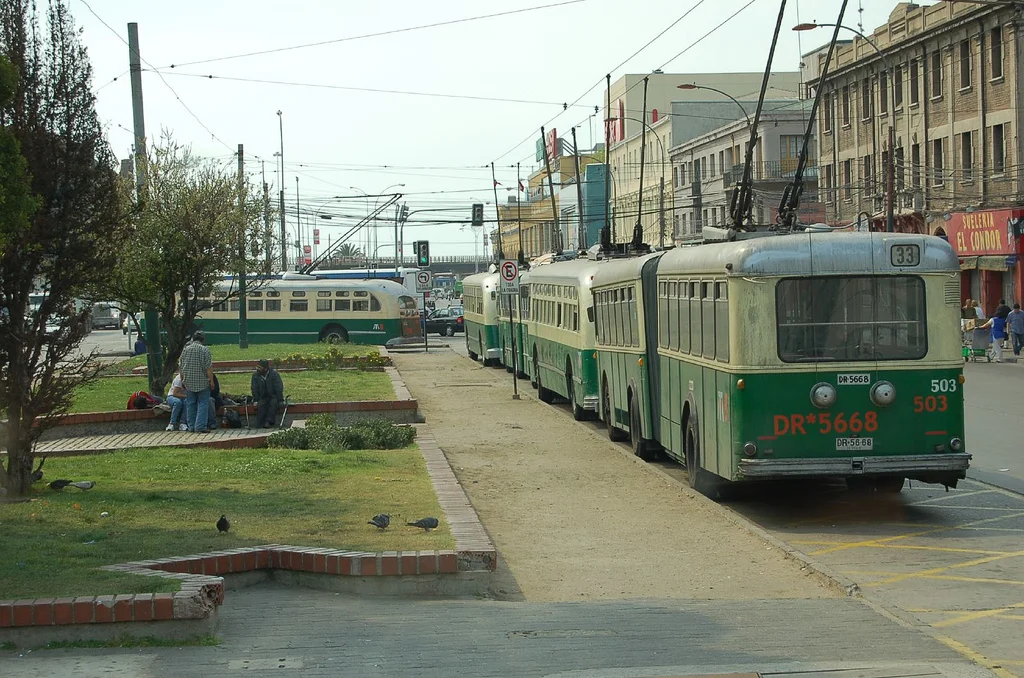

Trolleybuses in Valparaíso
Most cities scrap their old buses. Valparaíso declared them national treasures. The green-and-cream electric trolleybuses that hum quietly along Avenida Pedro Montt are no ordinary city transit. The first of them rolled out of the workshops of the Pullman-Standard Car Manufacturing Company in late 1952, the very last trolleybuses that famous American maker ever built. They have been carrying passengers along the same flat avenue ever since, and for years the oldest of them held an extraordinary distinction: they were the oldest trolleybuses still running in regular service anywhere in the world.
The Last Pullmans Ever Made
The story begins with an order placed at the very end of an era. Chile's national transit company commissioned thirty trolleybuses from Pullman-Standard, and those vehicles, built in October and November of 1952, turned out to be the final trolleybuses the company would ever produce. The first seven arrived on Valparaíso's docks in November 1952, and the system opened to riders on New Year's Eve. The choice of electric trolleybuses made sense for a port hemmed in by steep hills: quiet, clean, and powered from overhead wires, they could work the long flat corridor of the lower town without filling its narrow streets with diesel smoke.
The Oldest Still Running
Decades passed, fleets elsewhere were retired and replaced, and still the Valparaíso Pullmans ran. By 1999 they had become the oldest trolleybuses in regular passenger service anywhere on the planet, rolling antiques that happened to also be a working part of daily life. Riders climbed aboard machines older than most of the cities they might have come from, paid a fare, and rode to work in a museum piece. The very last active Pullman finally came out of service in March 2023, closing a run of more than seventy years, though the system itself carried on with newer vehicles brought in over the decades.
Saved by a City That Cared
Survival was never guaranteed. The trolleybuses lurched through repeated financial crises, and in 2000 they lost their home when the city sold the old tram depot, opened back in 1904, for redevelopment. For roughly eight years the fleet had nowhere to sleep. The vehicles were parked on public streets overnight, and every repair had to be done outdoors in the open air. Relief came in 2008, when the operator leased a building just ninety meters from the route and, for the first time in years, could shelter and service the trolleybuses indoors. Through it all, the people of Valparaíso fought to keep their beloved troles on the road.
A Monument You Can Ride
Recognition came in 2003. That year Chile's Council of National Monuments granted the surviving Pullman-Standard trolleybuses national historic monument status, the formal decree signed on 26 September. It is a rare honor: not a statue or a building, but a fleet of working buses, declared part of the nation's heritage while still carrying passengers. The trolleybuses share their hillside city with the famous funicular elevators, those creaking cable cars that have hauled residents up the cerros since the 1880s. Together they make Valparaíso a place where old machinery never quite retires, where getting around town is itself a ride through history.
A City That Loves Its Troles
There is a reason the people of Valparaíso, the porteños, fought so hard for these machines. The trolleybuses are woven into the city's sense of itself, as much a part of the streetscape as the painted houses and the rattling funiculars. When the system's future looked bleak in 2007, the troles became a cause, defended in the press and in public sentiment as something worth saving. Over the following years the fleet was reinforced with secondhand vehicles brought from Europe, including trolleybuses that had once served the streets of Swiss cities, keeping the wires alive along Avenida Pedro Montt. Quiet, electric, and stubbornly enduring, the trolleybuses remain a moving emblem of a port city that prizes its own past.
From the Air
Valparaíso's trolleybus route runs through the flat lower town of the port city, centered near 33.046°S, 71.605°W, tracing the long civic corridor of Avenida Pedro Montt and the streets of the plan below the hills. From the air the system is not a single point but a line: look for the dense, straight commercial avenue running parallel to the coast at the foot of the amphitheater of cerros. Nearest is Viña del Mar Airport (SCVM), a Chilean Navy base roughly 16 km north with limited civilian service, and the small Rodelillo airfield (SCRD) on the heights to the southeast. Santiago's Comodoro Arturo Merino Benítez International (SCEL) is the main gateway, about 110 km east beyond the coastal range. A viewing altitude of 2,000 to 3,500 feet AGL best shows the city's flat-and-hill geography; coastal fog often softens the morning before clearing toward midday.
Nearby Stories
- Battle of Papudo 24 km away
- Casa de Isla Negra 28 km away
- Battle of Chacabuco 31 km away
- Battle of Maipú 38 km away
- Aconcagua 94 km away
- Constitución, Chile 237 km away
- Santa Olga 278 km away
- 1687 Peru Earthquake 1982 km away