
Turaida Castle
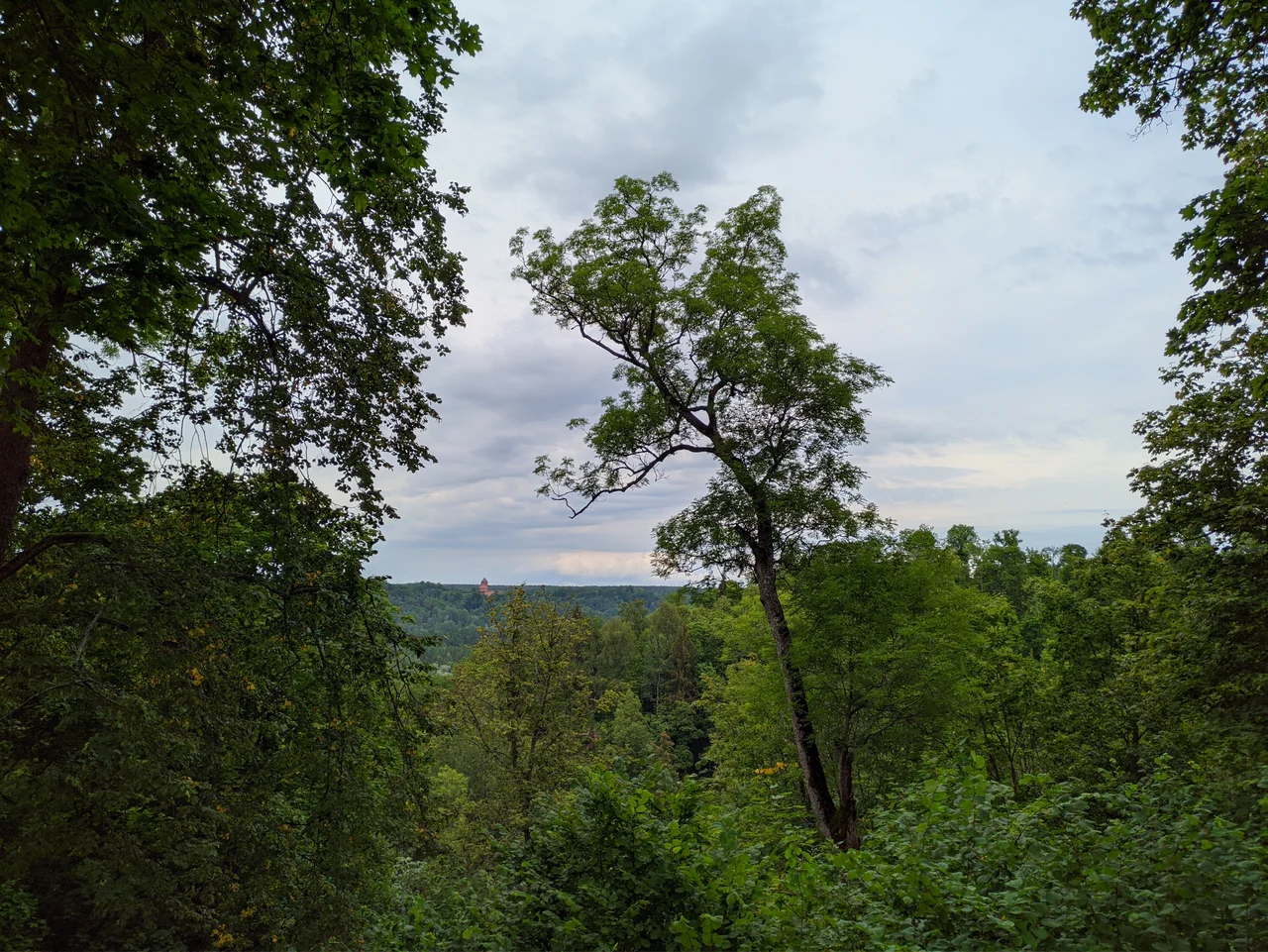
The walls are red, which is the wrong color for a Latvian castle. Most stone fortifications in this part of Europe are gray fieldstone — granite hauled out of moraines and piled up by Baltic peasants. But Turaida is brick, the deep oxide red of the Brick Gothic that the German crusading orders carried with them as they conquered the eastern Baltic. From the opposite bank of the Gauja river at Sigulda, the round tower rises out of the pines as if a small piece of Lübeck had been dropped into the Latvian forest. It was not dropped. It was carefully placed, in 1214, on the foundations of a wooden castle the Livs had built to defend themselves against the same crusaders who would build over it.
Thor's Garden
The local Liv people called the place Toreida — Thor's garden, in their now nearly extinct Finnic language related to Estonian. The Germans Latinized it Turaida and also gave the new stone fortress a German name, Fredeland, the Land of Peace, which has the wry quality of crusader naming everywhere. Bishop Albert of Riga ordered the castle built in 1214, after the Livonian Brothers of the Sword had subdued the region. The Brothers were a German crusading order, soon to merge into the larger Teutonic Order, and Turaida became one of the residences of the bailiffs (Vogts) who governed the Archbishopric of Riga's lands. The castle changed in stages — the southern tower added in the 14th century, a semi-rounded western tower added at the start of the 15th when firearms made the older walls inadequate. By the 1500s it was the seat of a Vogt at the head of one of the most important administrative districts in Livonia.
Two Battles of Turaida
Turaida saw real fighting. In 1211 it was the site of one of the largest battles of the Livonian Crusade, when an Estonian army from the north came south to challenge the Brothers of the Sword and was defeated near here. In 1298, on 1 June, came a more famous defeat — the Battle of Turaida, also called the Battle on the Aa, when Riga's burghers, who had revolted against the Livonian Order and allied themselves with the Grand Duchy of Lithuania under Grand Duke Vytenis, met the Order's army on the banks of the Gauja and crushed it. The Livonian Master Bruno was killed in the battle, along with much of the Order's command. The Livonian Order survived the disaster, but the alliance between Riga and Lithuania showed how fragile the Order's grip on the region really was. The bailiffs of Turaida went on appointing one another from the German-Baltic noble families — the von Rosens, the von Tiesenhausens — for another two and a half centuries.
The Rose of Turaida
The castle's most famous story has nothing to do with battles. In 1620 a young woman named Maija — known to history as Turaidas Roze, the Rose of Turaida — was murdered in a cave called Gūtmaņala below the castle. The traditional account, recorded shortly after her death and preserved in court documents, holds that she was killed by a Polish soldier named Adam Jakubowski while defending herself from his attempt to force her into marriage. She had been engaged to a gardener at Sigulda Castle across the river, Viktor Heils, and went to meet him at the cave; Jakubowski lay in wait. To save her honor she offered him a scarf she said was magic and would protect against blade-strikes, and asked him to test it on her own neck. He swung. She died. He fled. Heils was at first accused of the murder but cleared when Jakubowski's accomplice Skudritis confessed. Maija is buried in Turaida churchyard. Her grave is still tended. The story has been told and retold in Latvian poetry, opera, and ballet for four hundred years.
Ruin and Reconstruction
By the 1600s, after the Reformation had stripped the archbishopric of its lands and the Polish-Swedish wars had crossed the region repeatedly, the castle was already losing its strategic role. A fire in 1776 finished it off. For nearly two centuries Turaida was a romantic ruin in the forest — its red brick towers half-collapsed, its inner courtyard grown over, painted by 19th-century landscape artists who came up the Gauja by boat. Systematic archaeological excavation began in 1976 under the Latvian SSR, and reconstruction followed in stages. The main tower was rebuilt and made climbable; the western section was reconstructed; exhibitions on the Gauja Livonians were installed in the restored buildings. Today the Turaida Museum Reserve covers more than 40 hectares and includes the castle, the church and Maija's grave, the manor house grounds, and the Folk Song Hill — Dainu Kalns — where 26 sculptures by Indulis Ranka commemorate Latvian folk poetry.
What You See From the Tower
Climb the spiral stair of the main tower — about 38 meters above the courtyard — and you see what the Vogts of Turaida saw. The Gauja river makes a long sandy bend below, the cliffs at Sigulda on the opposite bank, the dark ridge of the Gauja National Park stretching east. This is some of the most varied landscape in Latvia, a country mostly of low rolling forest and bog. The Gauja has cut a small canyon here, a so-called Latvian Switzerland, popular with hikers and white-water boaters in summer and skiers in winter. From the air the brick towers are unmistakable against the green. From the courtyard, on a quiet weekday in May before the tour buses arrive, you can hear the wind in the pines and the river below, and it is not difficult to feel the weight of eight centuries pressing on this small bluff.
From the Air
Located at 57.182°N, 24.850°E on a high bluff above the Gauja river, in the Vidzeme region of central Latvia about 53 km northeast of Riga. From altitude, look for the river's distinctive sandstone canyon (the Latvian Switzerland) and the brick castle on the north bank opposite the town of Sigulda. Riga International Airport (EVRA) is about 65 km southwest. The pine and birch forests of Gauja National Park surround the site.
Nearby Stories
- Freedom Monument 8.8 km away
- Daugavgrīva Fortress 23 km away
- Lielvārde Castle 27 km away
- Koknese Castle 36 km away
- Battle of Salis 40 km away
- Battle of Ērģeme 47 km away
- Battle of the Gulf of Riga 54 km away
- Battle of Selburg 73 km away