
Tyburn
The shoppers crossing from Selfridges toward Marble Arch tube station walk past a small traffic island most do not notice. Three young oak trees grow on it. Between them lies a small bronze roundel set into the pavement, with an inscription: "The site of Tyburn Tree." The roundel marks the place where, between 1196 and 1783, somewhere around 50,000 people were hanged in front of crowds that sometimes reached the tens of thousands. They were Catholic priests killed for their faith. They were highwaymen and pickpockets. They were Cromwell's exhumed corpse, dragged from Westminster Abbey to be hanged again. They were ordinary people, and they deserve to be remembered as people - not as the carnival the crowds came for.
The Boundary Stream
Tyburn began as a manor and a small river. The Tyburn Brook ran from springs near today's Hampstead down through what is now Marylebone (named for the parish's church of St Mary - Mary on the Bourne, Marybourne, with the French "le" added in the 17th century). The name Tyburn itself comes from Teo Bourne, meaning "boundary stream." The Domesday Book of 1086 records eight households here, perhaps 40 people, the land held by Barking Abbey nunnery. In 1236, the City of London contracted with Sir Gilbert de Sandford to draw water from Tyburn Springs to supply the first piped water in London. The lead pipes ran from what is now Bond Street, three miles east through Fleet Street to a public conduit at Cheapside, climbing Ludgate Hill by gravity. Water was free to anyone who came. By the 14th century the place where modern Edgware Road, Oxford Street and Bayswater Road meet had become the principal execution site for the City of London and Middlesex. There was no reason to choose it except that it was outside the city walls and close to a Roman road. The first recorded execution at the stream was in 1196, when William Fitz Osbert, a populist leader from a London revolt, was dragged naked behind a horse from St Mary-le-Bow to be hanged.
The Triple Tree
In 1571 a new permanent gallows was erected near today's Marble Arch, 200 metres to the west. It was a triangular wooden frame supported by three legs - what people called a "Triple Tree" or a "three-legged mare." Multiple people could be hanged from it at once. On 23 June 1649, 24 prisoners - 23 men and one woman - were hanged simultaneously, brought up in eight carts. The first person executed on the new Tree was John Story, on 1 June 1571. Story was a Roman Catholic, a former MP and ecclesiastical lawyer, convicted of treason for his loyalty to the old faith. Between 1535 and 1681 the Tyburn Tree killed at least 105 Catholic men and women for their faith - priests who refused to swear the Oath of Supremacy, laypeople who hid them, women who would not abandon their religion. A plaque at 8 Hyde Park Place, the site of Tyburn Convent, lists their names. The convent itself - a community of Catholic nuns who came in 1903 - exists specifically to pray for these martyrs. Among the notable dead were Saint John Houghton, prior of the London Charterhouse, hanged on 4 May 1535 for refusing to acknowledge Henry VIII as head of the church; Saint Edmund Campion, the Jesuit theologian, hanged on 1 December 1581; and Saint Oliver Plunkett, Archbishop of Armagh, hanged on 1 July 1681, the last Catholic martyr to die at Tyburn.
The Procession
The condemned came from Newgate Prison, about three miles east in the City. They travelled in an open horse-drawn cart, sometimes seated on their own coffin, hands tied. The journey could take three hours through streets jammed with onlookers. The cart usually stopped at the Bowl Inn on St Giles High Street - the "halfway house" - where the condemned were given a final drink of strong ale from a wooden bowl. Convicts were expected to dress well and to die well: wearing their best clothes, addressing the crowd briefly, going to the noose with what was called "insouciance." Many did. Jack Sheppard, the burglar who escaped Newgate four times, wore silk and bowed to the crowd in 1724. The highwayman Claude Du Vall in 1670 was already a celebrity - women allegedly fainted at his execution. The Tyburn jig was the act of being hanged. "Going west" became slang for going to the gallows because Tyburn was west of Newgate. "Lord of the Manor of Tyburn" was the public hangman. After death, bodies were usually buried nearby or claimed by anatomists for dissection - the dissectors sometimes had to fight the crowd, who believed dismemberment would prevent resurrection on Judgement Day.
The Spectacle
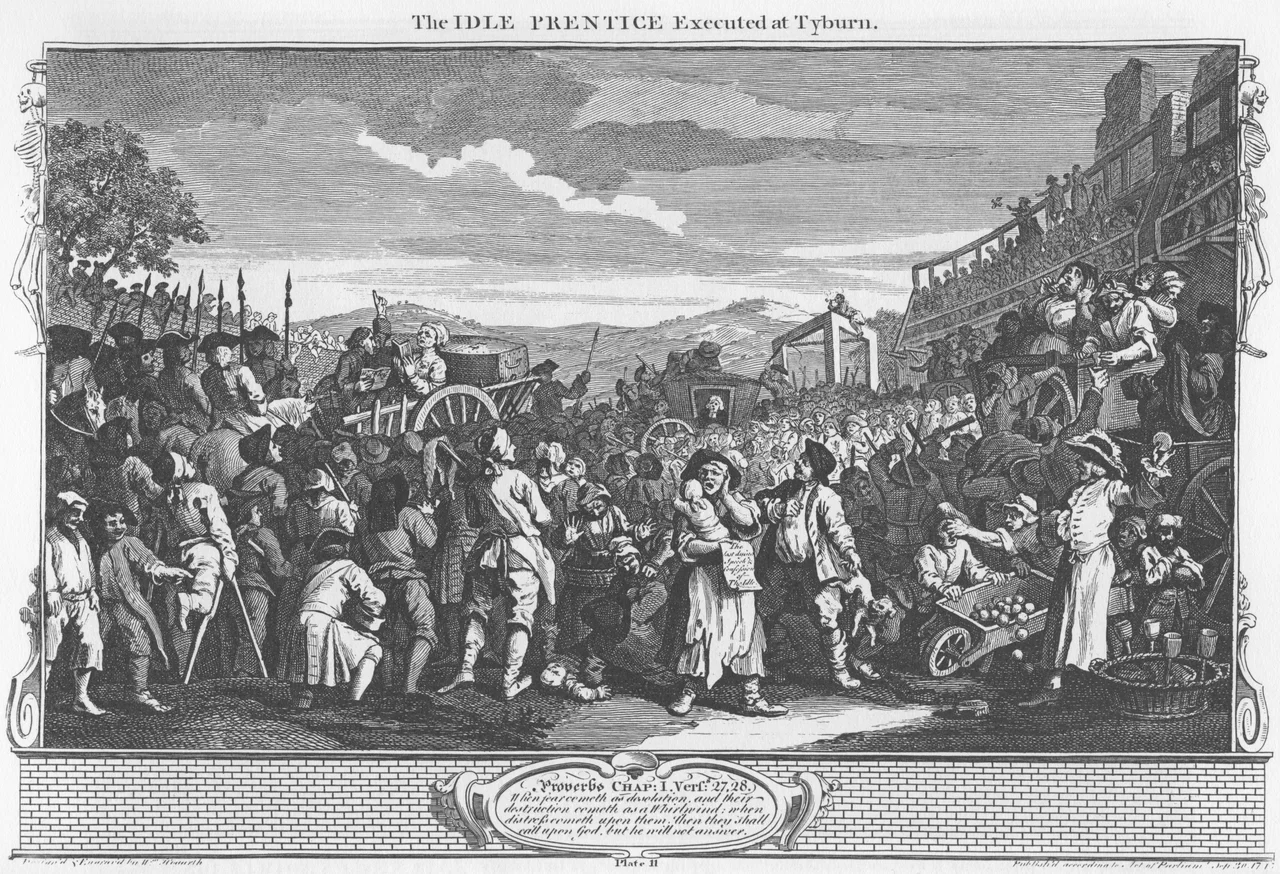
Wealthy spectators paid to sit in temporary wooden grandstands erected for each execution. On at least one occasion the stands collapsed, reportedly killing and injuring hundreds of people who had come to watch others die. William Hogarth captured the scene in his 1747 print The Idle 'Prentice Executed at Tyburn - drunkenness, vendors, pickpockets working the crowd in a mockery of capital punishment as deterrent. Pickpocketing was a hanging offence; pickpockets worked execution crowds. A popular belief held that the hand of a hanged man could cure cancer, and mothers were sometimes seen brushing the hands of corpses across their children's cheeks. The historian who described Tyburn executions as "carnivalesque occasions in which the normative message intended by the authorities is reappropriated and inverted by an irreverent crowd" was being precise. The state intended a lesson. The crowd held a party. The condemned, in the middle of it, were sometimes the most composed people present.
The Last Hanging and What Remains
On 19 April 1779, clergyman James Hackman was hanged at Tyburn for the 7 April murder of Martha Ray, a courtesan and singer who was the mistress of John Montagu, the 4th Earl of Sandwich. Hackman had been obsessed with her; she had refused him; he shot her outside Covent Garden as she left the opera. The case scandalized London. The last execution at Tyburn was on 3 November 1783 - John Austin, a highwayman. After that, hangings moved to Newgate Prison itself. In 1868 they moved inside the prison entirely, ending public execution in England. The fixed gallows had been replaced in 1759 with movable ones; the permanent Tree was gone. The site became commercial London. Marble Arch arrived in 1851, moved from Buckingham Palace. The convent on Hyde Park Place arrived in 1903. The three oak trees on the traffic island were planted in 2014 to mark the site - young trees, but the second generation; the original three planted in 2014 replaced an earlier marker. The plaque commemorates everyone who died here. Most of them have no other monument. The convent of Tyburn keeps their names.
From the Air
Tyburn is at 51.5129°N, 0.1640°W on the traffic island where Oxford Street, Bayswater Road and Edgware Road converge, immediately west of Marble Arch in the City of Westminster. The site is marked by three young oak trees and a small bronze roundel - hard to see from altitude. Hyde Park lies immediately south; Tyburn Convent at 8 Hyde Park Place is on the south side of Bayswater Road.
Nearby Stories
- Stevenage 5.7 km away
- Malling Abbey 5.7 km away
- 1952 Farnborough Airshow Crash 7.7 km away
- Ingatestone Hall 8.2 km away
- Hellfire Caves 9.1 km away
- The Carrington Event: The Solar Storm That Could Happen Again 9.8 km away
- Bletchley Park 16 km away
- Castle Hedingham 23 km away