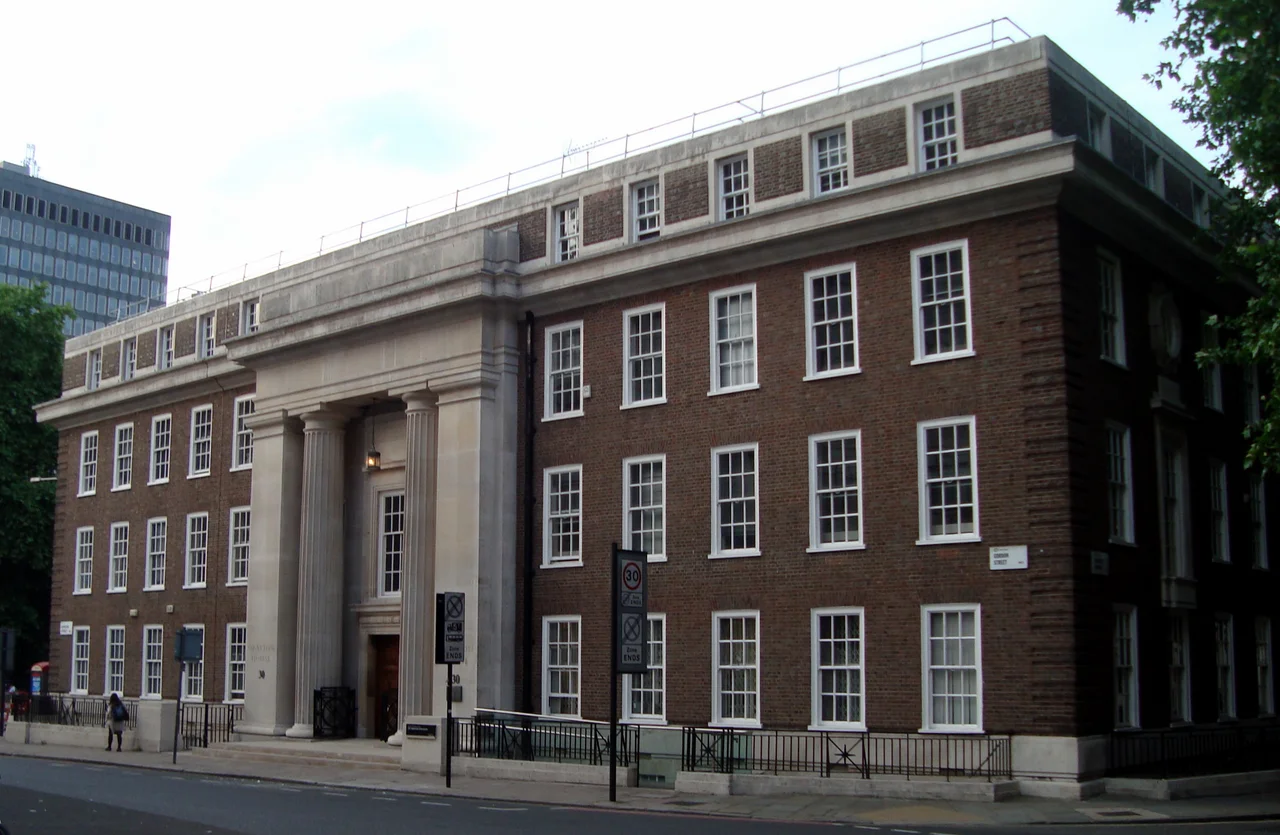

University College London
Jeremy Bentham is in a wooden cabinet in the south cloisters of the main building. He has been there, more or less, since his death in 1832. The philosopher who pioneered utilitarianism left instructions in his will that his body should be preserved and dressed in his own clothes and displayed for the use of his friends and disciples. The skeleton wears his actual suit. The head on top is a wax replica - the original mummified head was deemed too unsettling and is now kept in the university's vaults, having been kidnapped at least once by King's College London students who held it for ransom. The cabinet was wheeled into a council meeting once. The minutes recorded Bentham as "present but not voting." This is the kind of place UCL is.
The Godless College
When UCL was founded on 11 February 1826, Oxford and Cambridge were closed to anyone who would not subscribe to the Thirty-Nine Articles of the Anglican Church. This excluded Catholics, Jews, Nonconformists, Hindus, Muslims, and most of the British population by simple arithmetic. London University - as UCL was originally called - opened its doors to all of them. It was the first university institution in London and the first in England to be entirely secular. King's College London was founded three years later as an Anglican corrective, on Christian principles, and the two institutions immediately developed a rivalry that has lasted nearly two centuries. King's students called UCL students "the Godless Scum of Gower Street." UCL students called King's "the Strand Polytechnic." In 1922, King's students kidnapped UCL's mascot - a wooden statue called Phineas MacLino - prompting a pitched battle in the King's quad. King's later adopted Reggie the Lion as their own mascot. UCL students castrated Reggie. In October 1975, King's students stole Bentham's mummified head and held it for ransom; UCL paid the ransom (to charity) and recovered the head. None of this is metaphor.
Firsts
The original London University was a joint-stock company - £100 shares sold to proprietors - and had no charter, no degree-awarding power, and no recognition as a university. It took until 1836 for a royal charter to be granted, incorporating it as University College, London under a parallel new University of London that would issue the actual degrees. The first degrees followed in 1839. The institution's habit of being first kept asserting itself. In 1828 it created the first chair of political economy in Britain. In 1829 it appointed the first professor of English in England. In 1833 it created the first chair of geography in Britain. In 1834, North London Hospital - now University College Hospital - opened as a teaching hospital for medicine. In 1878, UCL became the second institution in the UK (after University College Bristol) to admit women alongside men, two years late but well ahead of Oxford and Cambridge, which would not admit women to full degrees until 1920 and 1948 respectively. The Slade School of Fine Art opened in 1871, funded by a bequest from Felix Slade.
Discoveries
UCL academics discovered the noble gases. Sir William Ramsay, professor of chemistry at UCL, found argon (1894), helium (1895), neon, krypton, xenon (all 1898), and won the Nobel Prize in Chemistry in 1904. UCL scientists isolated the first hormone (secretin, by William Bayliss and Ernest Starling, 1902). Ambrose Fleming, professor of electrical engineering at UCL, invented the vacuum tube in 1904, the device that made all subsequent electronics possible. Francis Crick took his undergraduate degree at UCL before going on to co-discover the structure of DNA. Otto Hahn discovered nuclear fission while a researcher at UCL in 1907 (he would receive the Nobel Prize for it in 1944). Peter Higgs, who proposed the Higgs mechanism that predicts the existence of the Higgs boson, took his MSc and PhD at UCL. Karl Pearson founded the world's first university statistics department here in 1911 - and also ran a eugenics laboratory funded by Francis Galton, a fact UCL formally apologized for in 2021, removing the names of Pearson and Galton from lecture theatres. As of 2025, 33 Nobel laureates and three Fields Medallists have been affiliated with UCL.
The Internet, Almost First
In 1973, Peter Kirstein's research group at UCL became one of only two international nodes on the ARPANET - the experimental network that would become the internet. The other was in Norway. UCL's implementation of internetworking between the ARPANET and early British academic networks was the first international heterogeneous resource sharing network in history. UCL adopted TCP/IP in 1982, ahead of the rest of ARPANET. The university was building the infrastructure of the modern world before most of the world had heard of it. Around the same time, in 1969, the Housman Room - the senior common room - finally agreed to admit women, having spent a century as men-only. Brian Woledge (Fielden Professor of French) and the young pharmacology lecturer David Colquhoun pushed the motion through after two failed attempts.
Notable Alumni and the Present
UCL's alumni include Mahatma Gandhi, who took English classes with Henry Morley in 1888-89; Jomo Kenyatta, the first president of Kenya; Itō Hirobumi, the first prime minister of Japan; Sir Anerood Jugnauth, the founder of independent Mauritius; and John Stuart Mill, who attended John Austin's lectures on jurisprudence. The Bloomsbury main campus, designed by William Wilkins around the great Corinthian portico, sits on Gower Street in Camden. The Wilkins Building is Grade I listed; the dome was finished in 1829 but the rest of the original vision was not completed for nearly a century because the founders kept running out of money. UCL East, the second campus, opened in stages from 2022 at Queen Elizabeth Olympic Park in Stratford, the first major university expansion onto a former Olympic site in Britain. UCL became formally recognized as a university in its own right - while remaining part of the federal University of London - in April 2023, nearly two centuries after its founders first asked for that recognition. The mummified philosopher is still in his cabinet. The institution he never quite founded (his actual involvement was buying one share for £100 in installments and recommending an unsuccessful candidate for the first English chair) is still doing what its founders wanted it to: educating anyone.
From the Air
UCL's main campus is at 51.5246°N, 0.1340°W in Bloomsbury, London Borough of Camden, between Gower Street and Tottenham Court Road. The Wilkins Building's columned portico and central dome are visible from low altitude. The British Museum lies a short distance south; King's Cross and St Pancras stations lie east. UCL East is at Queen Elizabeth Olympic Park in Stratford.
Nearby Stories
- Stevenage 5.7 km away
- Malling Abbey 5.7 km away
- 1952 Farnborough Airshow Crash 7.7 km away
- Ingatestone Hall 8.2 km away
- Hellfire Caves 9.1 km away
- The Carrington Event: The Solar Storm That Could Happen Again 9.8 km away
- Bletchley Park 16 km away
- Castle Hedingham 23 km away