
University of Dublin
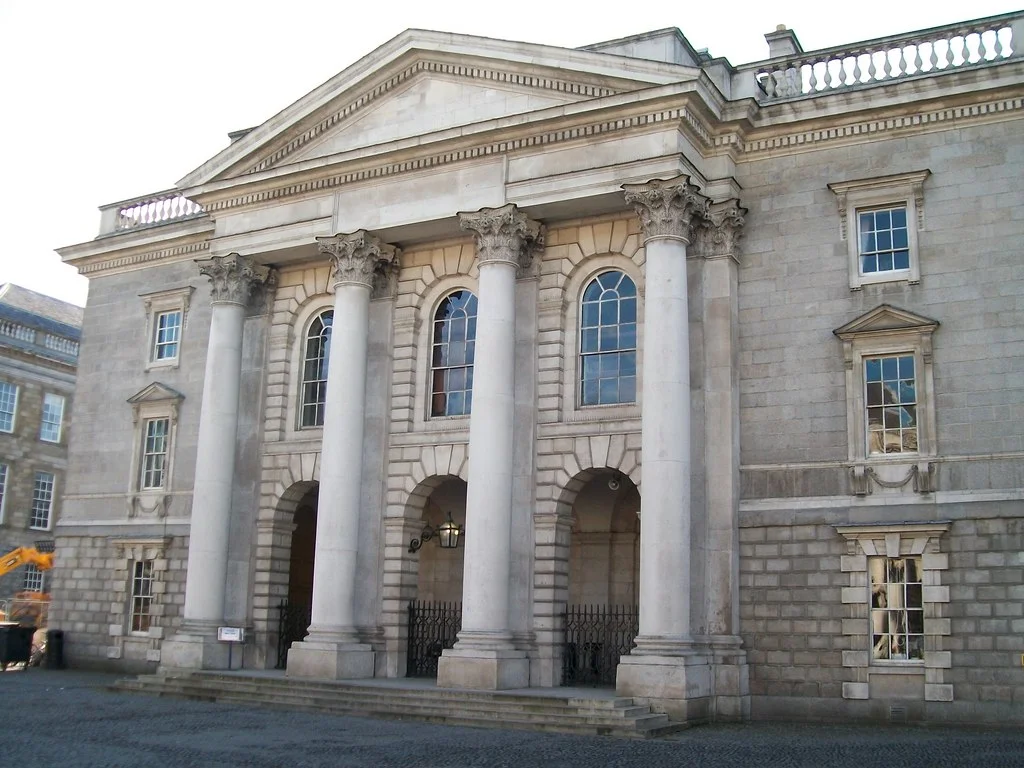
On four mornings each academic year, a procession winds through Parliament Square at Trinity College. A mace-bearer leads. Behind him come the registrar, the proctors, the Provost, and a knot of black-robed senior academics in colored hoods - doctors and masters of the University of Dublin. They are heading to the Public Theatre, where they will conduct the only business the University of Dublin has ever really conducted: voting on degrees. The Chief Steward will call ad scrutinum. The voting will happen in Latin. The candidates whose names have already been approved by Trinity's Board, an entirely separate body that occupies the same buildings and largely the same people, will be made graduates. The University and the College have been ruled by the High Court to be one body. Mostly nobody minds.
Mater Universitatis
Queen Elizabeth I issued a royal charter on 3 March 1592 establishing both Trinity College and a University of Dublin to which Trinity would belong. The charter named her mater universitatis - the mother of the university. The First Baron Burghley, William Cecil, was named the first chancellor. The idea, borrowed from Oxford and Cambridge, was that several colleges would eventually federate into a single university. Burghley's protege Adam Loftus was made first provost of the college. Money was found. Books were collected. But no second college was ever founded - the project was considered seriously at least twice, and each time the required endowment failed to materialize. So Trinity remained the sole constituent college, and the University of Dublin became, in practice, a slightly larger ceremonial label for the same institution. In a remarkable 1898 High Court case the judge ruled that 'Trinity College and the University of Dublin are one body.' He could not resist noting that the advisers of Queen Victoria 'knew how to incorporate a University when they meant to do so.'
The Steamboat Ladies
For a few extraordinary years at the turn of the 20th century, the University of Dublin became a quiet engine of educational fairness. Women had been allowed to study at Oxford and Cambridge, to sit examinations, to see their results published - and were then refused the degrees their work had earned. Trinity Dublin had a reciprocal arrangement called ad eundem gradum: a graduate of Oxford or Cambridge could be conferred with the equivalent degree at Dublin without further examination. Women began booking passage on steamers from Holyhead to Dublin, traveling specifically to receive degrees that their own universities denied them. They became known as the steamboat ladies. They had no other connection with Dublin - no rooms, no lectures, no Commons. They came, they paid the fee, they walked the procession in academic dress, they received the parchment, and they steamed back across the Irish Sea with a degree their alma maters refused to confer. Oxford finally allowed women degrees in 1920. Cambridge waited until 1948.
Conducted in Latin
The public commencements remain rigorously formal. Each meeting is headed by a caput consisting of the chancellor, the provost of Trinity College, and the senior master non-regent - any of whom can veto any decision. The Chief Steward calls 'ad scrutinum' to bring candidates under scrutiny. The Doctors and Masters of the Senate, gathered in their academic dress, then vote in turn by group, saying 'placet' to consent or 'non placet' to dissent. In practice nobody dissents, because the lists have already been approved by Trinity's Board and discussion is not permitted at commencements. The senior master non-regent is elected for a one-year term by Latin voice vote each year. Hilary Term hosts a single business meeting in English, where statutes are amended and honorary degrees are agreed in advance. The whole ritual machinery is the legacy of a 1857 Letters Patent issued by Queen Victoria that turned an informal customary body into a corporate one - and froze the procedure in place.
Three Senators
The University of Dublin has elected representatives to parliament since 1613, when James I granted it the right to send two members to the Irish House of Commons. The franchise was originally limited to the Provost, Fellows, and Scholars of Trinity. In 1832 it expanded to include holders of MA degrees, and in 1918 to all graduates. After Irish independence the university continued to elect representatives, eventually settling on three senators to Seanad Éireann under the 1937 Constitution - a privilege shared only with the National University of Ireland. Notable holders of the seat have included the historian W. E. H. Lecky, the prosecutor of Oscar Wilde Edward Carson, the doctor and politician Noel Browne, the writer Conor Cruise O'Brien, and Mary Robinson, who held a Trinity Senate seat for twenty years before becoming President of Ireland in 1990. The current senators are David Norris, Lynn Ruane, and Tom Clonan.
From the Air
53.3444 N, 6.2578 W. The University of Dublin shares its campus with Trinity College - the entire institution occupies the same green rectangle in the heart of Dublin, just south of the River Liffey. Dublin Airport (EIDW) lies 9 km to the north. Approaches from the south frequently descend over central Dublin. From the air, look for College Park - the cricket and rugby pitches inside the campus - bracketed by Pearse and Nassau Streets. Atlantic weather dominates; clear visibility most reliable in winter high-pressure systems. The Public Theatre, where commencements take place, sits in Parliament Square at the western edge of the campus.
Nearby Stories
- Wicklow Mountains 12 km away
- Mornington 14 km away
- German submarine U-1051 16 km away
- Abbey of Kells 18 km away
- Irish Military Intelligence Service 20 km away
- HMS Manners (K568) 37 km away
- Templemore 42 km away
- Irish Sea Bridge 43 km away