
University of East Anglia
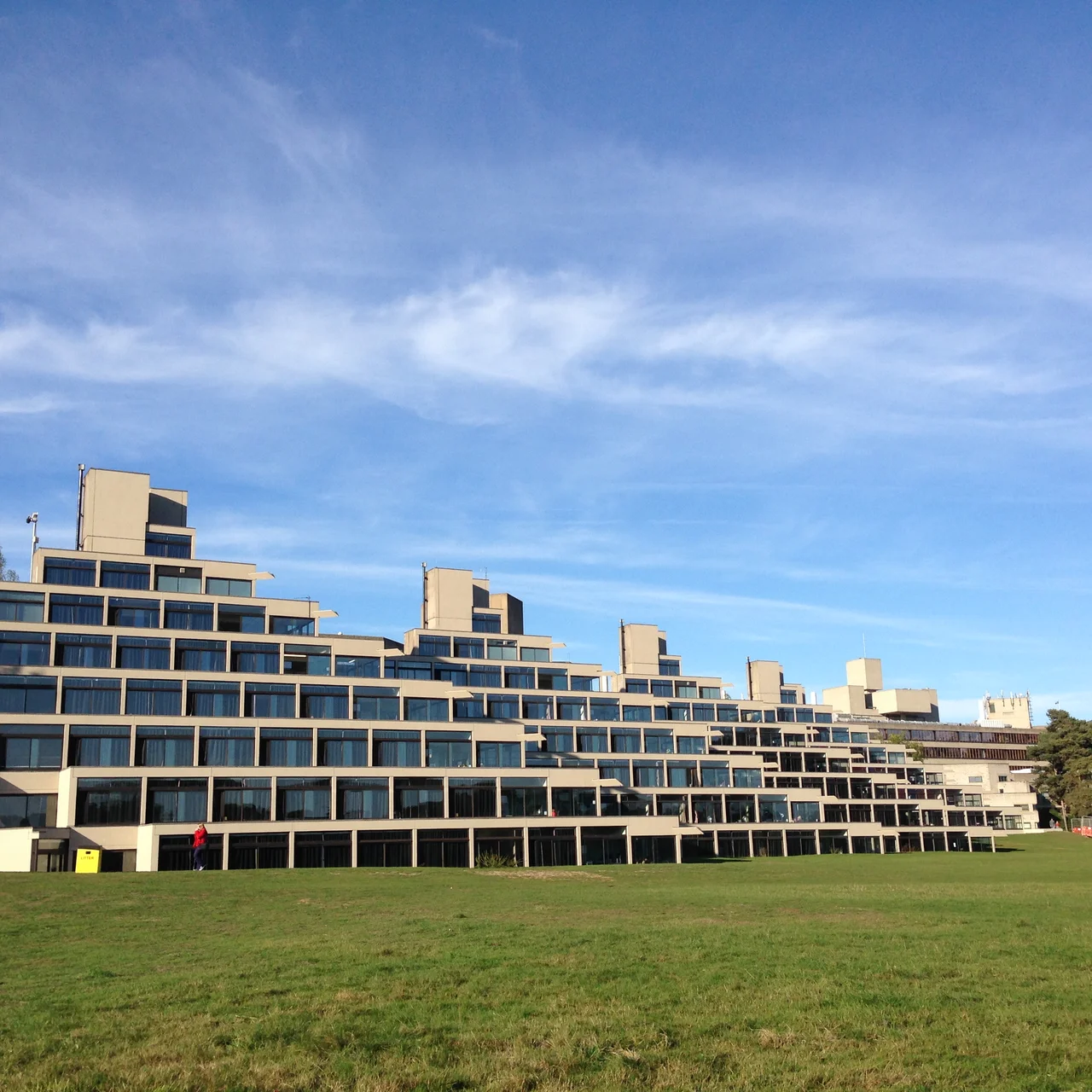
Denys Lasdun told his architects he wanted the student residences to look like 'vineyards in France or a rocky outcrop on a slope.' What rose from a Norwich field between 1966 and 1968 was something else entirely: angled concrete terraces that students promptly named the Ziggurats, after the stepped temples of ancient Mesopotamia. Fifty-eight years later, the same buildings briefly closed in September 2023 over concerns about a building material called RAAC. The Ziggurats are Grade II* listed, regarded as some of Britain's finest postwar architecture - and they sum up the University of East Anglia's strange gravity. UEA is a place where serious institutions show up in unexpected forms.
A University Out of Plywood
Norwich tried twice to found a university, once in 1919 and again in 1947, and twice government money failed to arrive. The third attempt finally succeeded in April 1960, when UEA opened on the opposite side of Earlham Road from its present campus, in a collection of prefabricated huts built for 1,200 students. The vice-chancellor and administrators worked out of nearby Earlham Hall, the 1580s manor where the Quaker prison reformer Elizabeth Fry had grown up. In 1961, the new vice-chancellor Frank Thistlethwaite approached Denys Lasdun, then working on Fitzwilliam College, to design a permanent home. Lasdun's plan diverged dramatically from the model he presented; the first buildings did not open until late 1966. By 1968 Lasdun was gone, replaced by Bernard Feilden, who had restored both the Great Wall of China and the Taj Mahal. Feilden finished the library and the wall and the central square, and the campus became one of the most architecturally cohesive in Britain.
The Climate Question
In 1972, climatologist Hubert Lamb founded the Climatic Research Unit inside the School of Environmental Sciences. By 2000, the UK government had chosen UEA as the home of the Tyndall Centre for Climate Change Research, named for the 19th-century scientist who first measured how carbon dioxide traps heat. Then, in November 2009, computer servers at the CRU were hacked. Over a thousand emails and two thousand documents were released to the public on the eve of the United Nations Climate Change Conference. The episode was nicknamed Climategate. Eight investigations were launched in the UK and the US. None found evidence of fraud or scientific misconduct, and in 2011 the Berkeley Earth project independently concluded that the CRU's studies were done carefully and that the climate signal was real. In 2021, the BBC dramatised the whole affair as 'The Trick,' filming on the UEA campus itself, with Jason Watkins playing the CRU's Phil Jones.
The Workshop That Became a Genre
In 1971, the novelists Malcolm Bradbury and Angus Wilson founded a postgraduate Master of Arts in Creative Writing at UEA. There had been nothing like it in Britain before. The course became, gradually then suddenly, a launching pad for serious literary careers - Kazuo Ishiguro, Ian McEwan, Anne Enright, and Tracy Chevalier among them. The German emigre novelist W. G. Sebald taught European literature here and founded the British Centre for Literary Translation in 1989, until his death in a car crash in 2001. UEA won its second Queen's Anniversary Prize in 2011 for the creative writing programme - a state recognition of what had been, at the start, a quietly subversive experiment in teaching writing as craft.
Three Treasures and a Quiet Broad
The campus contains three things that genuinely belong on any short list of postwar British achievement. The Ziggurats, with their concrete steps falling down towards the lake. The Sainsbury Centre, Norman Foster's silver shed of a museum that helped launch high-tech architecture. And the UEA Broad, an 18-acre body of water created between 1973 and 1978 by an aggregate company who took the gravel and left behind a fed-by-the-River-Yare lake. Add a Sainsbury Laboratory for plant science, a Nobel Prize for Sir Paul Nurse (UEA alumnus, 2001, for the cell cycle), the small interfering RNA work, a co-inventor of the Oxford-AstraZeneca vaccine, and a campus where Sir Antony Gormley figures stand on rooftop edges, and the modesty of the Norfolk setting begins to feel like deliberate camouflage.
From the Air
Located at 52.62 degrees N, 1.24 degrees E on the western edge of Norwich. The 360-acre campus shows from cruising altitude as the long concrete spine of the Lasdun teaching wall flanked by the stepped Ziggurats facing southwest, with the UEA Broad lake to the south. Best viewing 2,000-4,000 feet AGL. Nearest airport: Norwich International (EGSH) approximately 4 nm north-northeast. RAF Marham (EGYM) 25 nm west; former RAF Coltishall (EGYC) 9 nm north-northeast (closed 2006).
Nearby Stories
- Sheringham 2.7 km away
- Wingfield Castle 4.4 km away
- Castle Acre Castle and Town Walls 6.3 km away
- Brancaster 7.1 km away
- West Stow Anglo-Saxon Village 9.3 km away
- Four Days' Battle 80 km away
- Battle of Lowestoft 80 km away
- SM U-97 110 km away