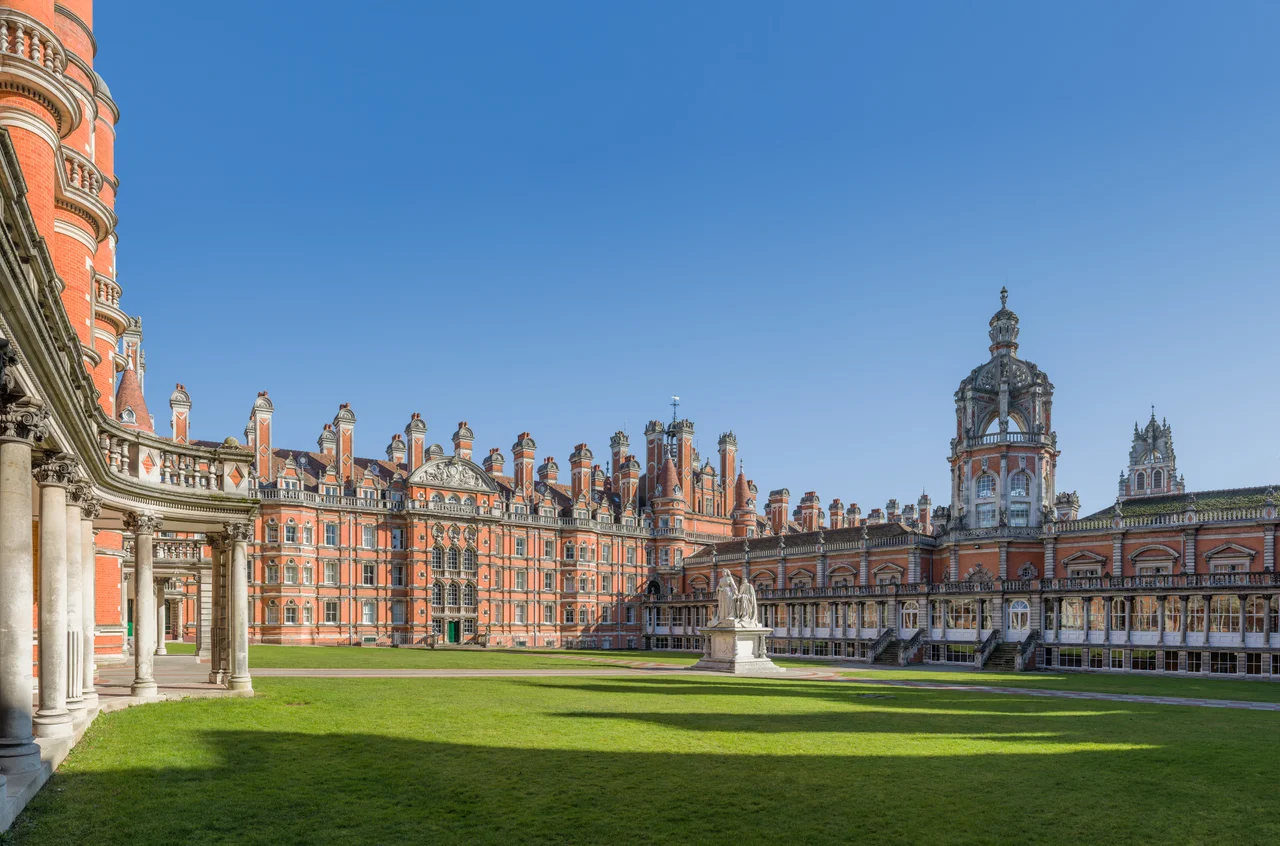

University of London
The story is probably apocryphal, but Londoners have been telling it since 1945. The reason Senate House survived the Blitz, the legend says, was that Adolf Hitler had picked out the white Portland-stone tower for his London headquarters and ordered the Luftwaffe to leave it alone. The truth is that Senate House did take bomb hits and emerged largely intact. The legend persists because the building looks the part - Charles Holden's massive 1932-37 art deco tower in Bloomsbury, the second-tallest building in London when it was finished, designed with the brief "not to suggest a passing fashion inappropriate to buildings which will house an institution of so permanent a character as a University." George Orwell used it as the model for the Ministry of Truth in Nineteen Eighty-Four.
An Examining Board for the Empire
When the University of London received its first royal charter in November 1836, it was not a university in any normal sense. It owned no buildings. It taught no students. It was an examining board with the power to grant degrees - in arts, laws and medicine, but not theology - to students from University College London, King's College London, and any other institutions the government chose to recognize. UCL had wanted recognition as a university itself; the government refused and instead created this examining body as a compromise. The death of King William IV in June 1837 created an immediate problem: the charter had been granted during "our Royal will and pleasure," which meant it lapsed when the will and pleasure stopped. Queen Victoria issued a second charter on 5 December 1837 to fix the problem. The first University of London degrees were awarded in 1839. By 1858 the examinations had been opened to anyone, anywhere - a third of the qualifying students that year were studying outside London entirely. In 1878, the University of London became the first university in the UK to admit women to degrees, predating every other British university.
The External Degree
This is the part of the story that does not appear in most rankings. The University of London External Programme - now called University of London Worldwide - allowed students anywhere in the world to study for a London degree without ever travelling to London. The list of major universities that began as University of London external students includes Birmingham (1900), Manchester (1903), Liverpool (1903), Leeds (1904), Sheffield (1905), Bristol (1909), Reading (1926), Nottingham (1948), Southampton (1952), Hull (1954), Exeter (1955), and Leicester (1957). The University of the West Indies, the University of Ghana, the University of Ibadan, the University of Zimbabwe, the University of Nairobi - all started as colleges in "special relation" with London, granting London degrees until they became independent. Nelson Mandela studied for a London law degree by correspondence while imprisoned on Robben Island. Today around 48,000 distance-learning students take University of London degrees from approximately 180 countries. The campus-based total is about 205,400 internal students, making it the largest university by enrolment in the United Kingdom.
From Examination Board to Federation
The university operated as a pure examining body for sixty years, accused increasingly of being a centre for the administration of tests rather than a place of teaching. By the 1890s UCL and King's were threatening to break away and form a separate "teaching university" - variously proposed as Albert University, Gresham University, or Westminster University. Two royal commissions and the University of London Act 1898 created a federal structure that came into force in 1900. UCL, King's, Bedford College, Royal Holloway and the London School of Economics all became schools of the federation. Goldsmiths joined in 1904. Imperial College was founded in 1907. Queen Mary College in 1915. SOAS in 1916. Birkbeck in 1920. UCL actually went further than affiliation - in 1907 it merged into the University of London entirely, surrendering its 1836 charter. UCL did not regain its own legal independence until 1977; King's followed in 1980. The University of London Act 2018 gave member institutions the right to call themselves universities while remaining federated - twelve of the seventeen members applied for that status.
The Headquarters at Senate House
The university had bounced from Somerset House (1837-1870) to 6 Burlington Gardens (1870-1900) to the Imperial Institute in South Kensington (1900s-1920s) to its current Bloomsbury site, acquired from the Duke of Bedford. Charles Holden was hired to build something permanent. His brief - to design something not faddish - produced Senate House, a 19-storey Portland-stone block opened in stages from 1932 to 1937. During the Second World War it was requisitioned by the Ministry of Information. The roof became an observation post for the Royal Observer Corps. The bombs that fell on London largely missed it; the legend of Hitler's special interest in Senate House grew from this and from the building's deliberately monumental scale. Orwell, who worked for the BBC in nearby Portland Place during the war, used Senate House for the Ministry of Truth in his 1949 novel. The building still houses Senate House Library, one of the largest academic libraries in the UK, and the chancellor's official residence.
Two Million Alumni
The number is approximate but the scale is correct. Around two million people hold University of London degrees. They include Nobel laureates (98 affiliated with the university across its institutions), Fields Medalists (five), Turing Award winners (four), Oscar winners (two), Grammy winners (six), Olympic gold medallists (three), and at least 14 monarchs or royalty. Five British Prime Ministers studied here. Mahatma Gandhi qualified as a barrister via UCL. Jawaharlal Nehru studied at LSE. Mandela took his London law degree. The current chancellor is Princess Anne, in post since 1981. The Queen Mother preceded her from 1955 to 1981. The list of present-day member institutions covers an extraordinary range: LSE, the Royal Academy of Music, the London School of Hygiene and Tropical Medicine, the Royal Veterinary College, City St George's, Goldsmiths, Queen Mary, Birkbeck, SOAS, Royal Holloway, the Courtauld Institute of Art, the Institute of Cancer Research, the London Business School, the Royal Central School of Speech and Drama, Brunel, King's, and UCL. They share Senate House, the squares of Bloomsbury, and the inheritance of an idea: that a university could grant a degree to anyone, anywhere, if they could pass the examination. The idea is still operating.
From the Air
Senate House at 51.5215°N, 0.1287°W is the visible headquarters of the federal University of London, in Bloomsbury (London Borough of Camden). The white Portland-stone tower is distinctive from altitude - a stepped art deco block 19 storeys tall, surrounded by the squares of Bloomsbury (Russell Square to the east, Gordon Square and Tavistock Square nearby). The British Museum lies a short distance south.
Nearby Stories
- Stevenage 5.7 km away
- Malling Abbey 5.7 km away
- 1952 Farnborough Airshow Crash 7.7 km away
- Ingatestone Hall 8.2 km away
- Hellfire Caves 9.1 km away
- The Carrington Event: The Solar Storm That Could Happen Again 9.8 km away
- Bletchley Park 16 km away
- Castle Hedingham 23 km away