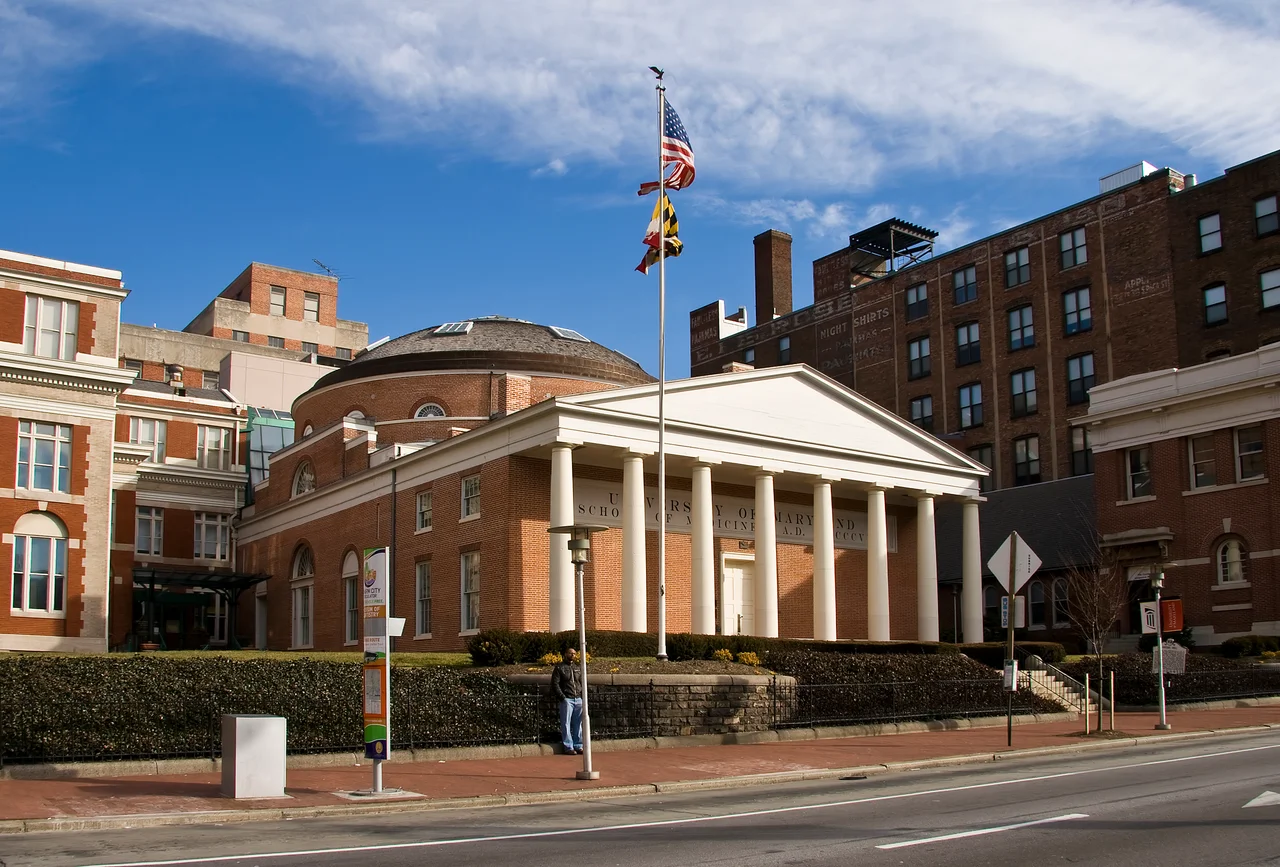

University of Maryland, Baltimore
Edgar Allan Poe is buried on the law school's doorstep. The cemetery at Westminster Hall, on West Fayette Street, was first laid out in 1787, and the Presbyterian church above it was built on brick arched piers in 1852 - which means the dead arrived before the church did. The University of Maryland School of Law sits next door, on the northwest corner of West Baltimore and North Paca Streets, making it the only law school in the United States with a famous author buried on campus. The students walk past Poe on their way to torts.
Two Centuries on Greene Street
UMB began in 1807 as the College of Medicine of Maryland, which makes it the second-oldest college in Maryland. Five years later the legislature rechartered it as a university with the authority to add faculties of law, divinity, and arts and sciences. The law school followed in 1816, though it operated only intermittently until 1868. The arts and sciences faculty came and went too, even briefly federating with St. John's College in Annapolis from 1907 to 1920. What stuck was the cluster of professional schools on the west side of downtown Baltimore - dentistry, law, medicine, pharmacy, nursing, social work - the trade schools of grown-up ambition. By 1970 the General Assembly had organized them and four sister institutions into a single network with a system president in College Park. UMB kept the old name and the old buildings, and the city grew up around them.
The First Dental School in the World
When the University of Maryland School of Dentistry opened, no such school existed anywhere else. The world's first dentists trained themselves; UMB taught them. The school has spent the two centuries since defending that claim, and it still ranks among the top ten dental programs in the nation for NIH research funding. In October 2006 it moved into a new building on Baltimore Street, adjacent to the old one. Construction and equipment cost the state more than $140 million - the most Maryland had ever spent on a single academic building. The pharmacy school, founded in 1841, is the fourth-oldest in the country. The nursing school, founded in 1889 by Florence Nightingale-trained nurse Louisa Parsons, would later create the first nursing informatics program in the world. UMB collects firsts the way other universities collect trophies.
The Dean's Sermon Across the Wall
The law school is the third-oldest in the nation, founded by David Hoffman, whose course of legal study influenced programs across the country and helped invent the field of legal ethics. In 2002 it moved into a building of English Tudor Revival architecture next to Westminster Hall, the restored Presbyterian church where Poe lies buried. Inside the law school stands the Thurgood Marshall Law Library, named for the Baltimore native who became the first Black justice of the Supreme Court. It holds more than 400,000 volumes of Anglo-American legal materials and is open to alumni, attorneys, and the public. The library and the cemetery share a sightline. A student looking up from a casebook sees the church where Poe's body rests; a tourist visiting Poe sees the windows where future judges study. Few campuses braid literature, law, and death so tightly.
Alumni You Already Know
Maryland politics flows through this campus. Six governors of Maryland came through UMB, including Martin O'Malley, who became mayor of Baltimore in 1999 and governor in 2007. Senators Ben Cardin and Barbara Mikulski both took degrees here. So did Elijah Cummings, the congressman from Maryland's 7th District who spent decades representing the city. Some alumni found stranger paths. Samuel Mudd, the physician convicted of aiding John Wilkes Booth's escape after Lincoln's assassination, trained at the medical school. Archibald 'Moonlight' Graham, the doctor and one-game Major League outfielder later memorialized in the film Field of Dreams, graduated in 1908. F. Mason Sones, class of 1943, invented coronary angiography, the imaging technique that lets cardiologists see the heart's arteries. And Robert M. Parker Jr., who took his law degree in 1973, became the most powerful wine critic in the world - rating Bordeauxs on a hundred-point scale from a Maryland farmhouse.
The Campus and the City
The 32-acre campus packs 58 buildings into the western edge of downtown, near Camden Yards, the Convention Center, and the famous Lexington Market. There is no football team, no marching band, no fraternity row - UMB does not field NCAA sports. What it has instead is the BioPark, a 10-acre west-campus expansion that added ten new buildings and more than a million square feet of lab and office space. The University of Maryland Medical Center sits beside it. The Charm City Circulator runs a free orange bus between them, and the light rail stops at the eastern edge of campus. The university polices itself: the UMB Police Department won an International Association of Chiefs of Police award in 2021 for community policing, and its Community Outreach and Support Team works with the Law Enforcement Assisted Diversion program to send low-level drug offenders into treatment rather than jail. It is a campus that has decided the city is the curriculum.
From the Air
UMB sits at 39.29 degrees north, 76.63 degrees west, on the west side of downtown Baltimore between Camden Yards and the Inner Harbor. From the air the 32-acre campus shows as a dense cluster of red-brick and glass buildings west of the I-395 spur. Baltimore-Washington International (KBWI) lies about 8 nautical miles south, Martin State Airport (KMTN) about 9 northeast. A pattern altitude of 1,500 feet AGL gives a clean view of the campus, the harbor to the east, and Federal Hill across the basin.
Nearby Stories
- Takoma Park, Maryland 5.2 km away
- Annapolis 5.5 km away
- Adkins Arboretum 7.8 km away
- Murders of Katherine and Sheila Lyon 28 km away
- Fort Delaware: The Island Prison Where 33,000 Confederates Waited Out the War 32 km away
- Battle of Gettysburg 35 km away
- Memorial Hall (Delaware State) 36 km away
- Three Mile Island: The Accident That Stopped Nuclear America 71 km away