
University of Oxford
There is no foundation date for the University of Oxford. No charter. No papal bull. No king proclaiming its birth. The university simply existed, and the earliest unambiguous record of teaching here dates to 1096 - five years before the First Crusade reached Jerusalem. The 12th-century chronicler Ranulf Higden claimed Alfred the Great had founded it in the 9th century. The 16th century preferred to credit Archbishop Theodore of Tarsus in the 7th. Both stories are now considered fiction. The reality is more interesting: Oxford grew up organically as Western Europe's Catholic educational network took shape, and then in 1167 it expanded dramatically when King Henry II, in a quarrel with France and the Church, banned English students from studying in Paris. The exiles came home. The university they joined was already old.
A City of Colleges
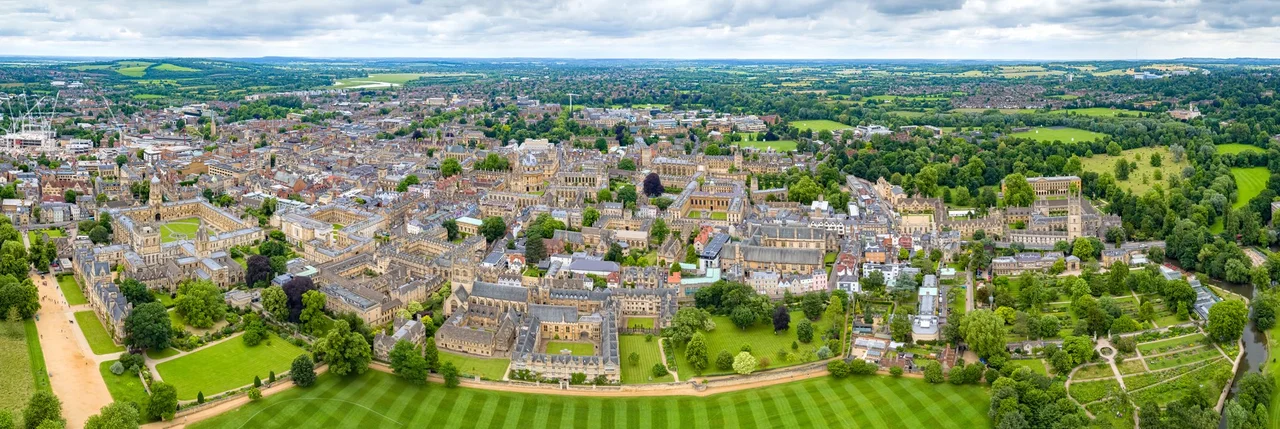
Oxford does not have a campus. It has a city, with 43 separate institutions threaded through it - 36 chartered colleges, four permanent private halls owned by religious orders, and three societies controlled by the university. Every student belongs to one of them. The colleges have their own libraries, their own dining halls, their own gardens, their own governing fellows. Tutors teach in college; lectures happen in faculty buildings. The result is a kind of academic federation that no one would design from scratch today, but that has produced an extraordinary continuity. After a riot between scholars and townsfolk in 1209, some of the masters fled to a market town called Cambridge and founded a university there. The two have shared the English-speaking academic establishment ever since - so completely that they are commonly referred to as a single entity, Oxbridge. From the 13th century to the 1820s, no other university was allowed to exist in England. Even London had to wait.
The Invisible College and the Royal Society
By the mid-17th century Oxford had become one of the centers of the scientific revolution. A group of experimental scientists meeting at Wadham College in the 1650s - among them Christopher Wren, then an undergraduate, along with Robert Boyle and Robert Hooke - gathered under the guidance of John Wilkins, the warden, for what they sometimes called the Invisible College. Their meetings became the seed of the Royal Society, formally chartered in 1660 after the Restoration of Charles II. Wren went on to design St Paul's Cathedral. Boyle wrote the law that bears his name. Hooke discovered cells under a microscope and invented the word for them. The university itself had been a Royalist stronghold during the Civil War - Charles I made Oxford his capital after he was driven from London - and the colleges donated their silver to fund his war effort. Merton was the lone Parliamentarian dissenter, for reasons more bureaucratic than political.
Women Above a Baker's Shop
The University of Oxford waited a long time to admit women. The Association for the Education of Women formed in 1878 and immediately split over religion - Edward Stuart Talbot wanted an Anglican college, T. H. Green wanted a non-denominational one. Both got what they wanted. Lady Margaret Hall opened in 1878, Anglican. Somerville opened in 1879, non-denominational. Twenty-one women - twelve at Somerville, nine at Lady Margaret Hall - took the first classes in rooms above an Oxford baker's shop. St Hugh's followed in 1886, St Hilda's in 1893. The university began awarding degrees to women in 1920. In 1927 the dons imposed a quota limiting female students to a quarter of male students; the rule lasted until 1957. Brasenose, Jesus, Wadham, Hertford, and St Catherine's were the first formerly all-male colleges to admit women, in 1974. The last men's college to surrender, Oriel, admitted women in 1985. The last women's college to admit men, St Hilda's, did so in 2008.
Eleven Million Books and a Dodo
The university's library system is the largest in the UK and second only to the British Library nationally - over 11 million volumes housed on roughly 120 miles of shelving. The Bodleian, founded by Sir Thomas Bodley in 1598 and opened in 1602, has been one of the United Kingdom's legal deposit libraries since 1610 and is entitled to a free copy of every book published in the country. Its collection grows by more than three miles of shelving every year. The Ashmolean Museum is the oldest museum in the UK and the oldest university museum in the world, founded in 1683 with the cabinet of curiosities collected by Elias Ashmole and the Tradescant family. It holds works by Michelangelo, Leonardo, Turner, and Picasso. The Pitt Rivers Museum holds half a million anthropological items in glass cases lit only by daylight. The University Museum of Natural History houses the most complete dodo remains in the world - the species went extinct on Mauritius around 1681, and the Oxford specimen is what Lewis Carroll likely saw when he wrote the dodo into Alice in Wonderland.
Tutorials, Sub Fusc, and a Dictionary
Oxford's central teaching method is the tutorial - one or two students sitting with a tutor for an hour each week, reading aloud a written essay and being argued with. The format has not significantly changed in five hundred years. The university's terms are short - Michaelmas, Hilary, Trinity, eight weeks each, numbered first to eighth and counted from Sunday. Students take exams in formal academic dress called sub fusc: dark suits, white shirts, white bow ties, mortarboards, and the gown appropriate to their rank as commoner or scholar. The Bachelor of Philosophy degree, abbreviated DPhil, was the first PhD program in Britain, established at Oxford in 1917 and first awarded in 1919 to Lakshman Sarup of Balliol College. Oxford University Press, the second-oldest university press in the world, publishes the Oxford English Dictionary - a project begun in 1857, completed for the first time in 1928, and continuously revised since then. The OED itself is one of the great Oxford institutions, a 600,000-word historical record of the English language built one quotation at a time over 170 years and counting.
From the Air
Located at 51.755N, 1.255W in central Oxford, England. The university occupies dozens of college and faculty buildings scattered through central Oxford and the Science Area to the north. The most prominent visual landmarks from the air are the dome of the Radcliffe Camera, the spires of the University Church of St Mary the Virgin and Christ Church Cathedral, Magdalen Tower (144 feet) at the eastern edge of the city, and Tom Tower at Christ Church. Best viewed from low altitude (1,500-3,000 feet AGL). Nearest airports: London Oxford Airport (EGTK, 6 nm north-northwest) and RAF Benson (EGUB, 12 nm south). London Heathrow (EGLL) lies 38 nm southeast. Oxford's compact cluster of stone college rooftops and spires is one of the most recognizable city centers in England from the air, with the open expanse of Christ Church Meadow forming a clear southern boundary.
Nearby Stories
- St George's Chapel, Windsor Castle 7 km away
- RAF Honeybourne 7.8 km away
- Sulgrave Manor 8.9 km away
- Cotswolds 9 km away
- Chesham 9.4 km away
- Avebury 11 km away
- Donnington Castle 12 km away
- Ampthill Park 14 km away