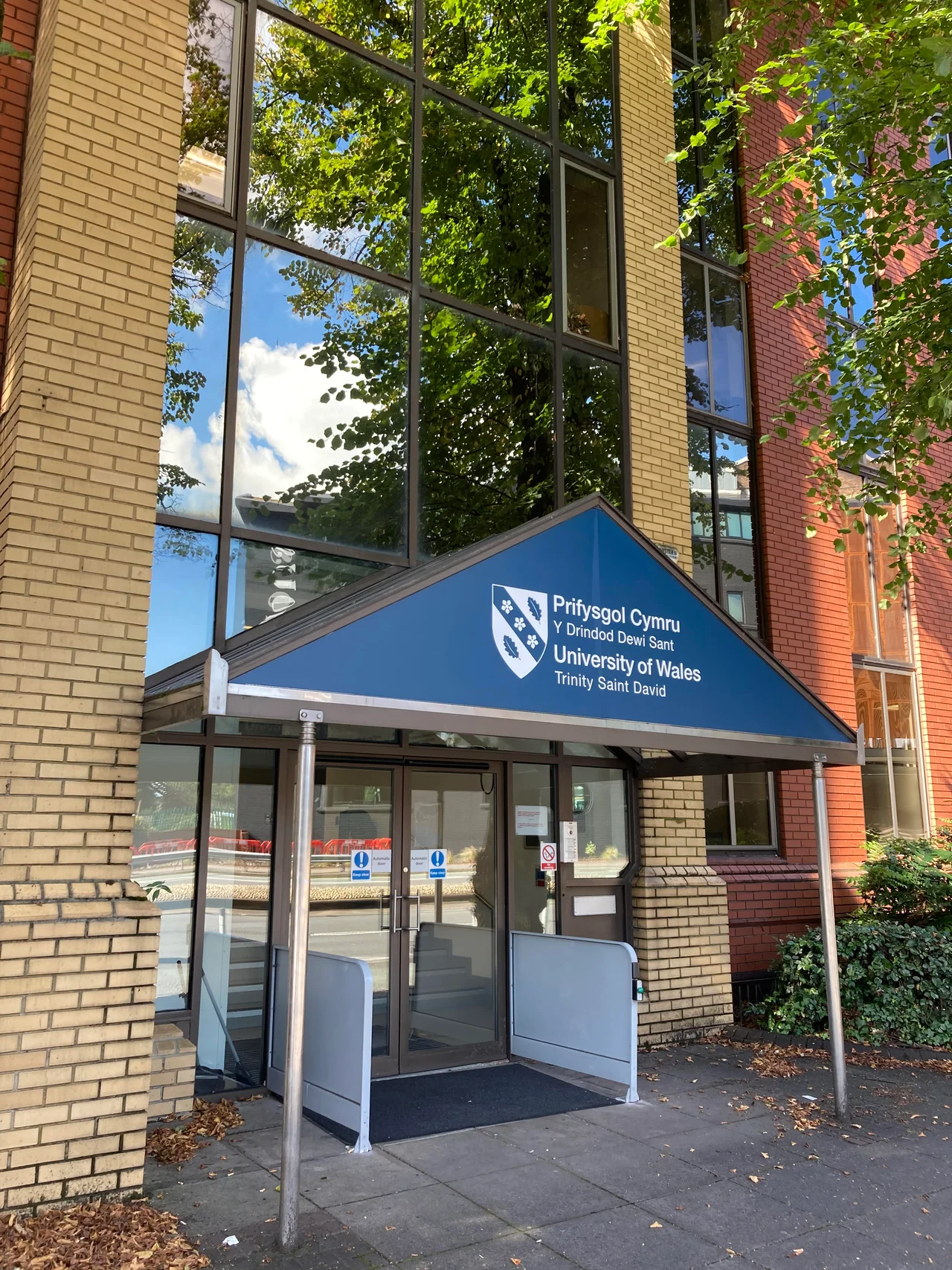

University of Wales Trinity Saint David
When you join two of the oldest higher-education institutions in Wales into a single university, what do you call it? The Welsh answer, settled in 2009 and formally adopted in July 2010, was to take Lampeter's original name - Saint David's College - and bolt it onto the name of Trinity College Carmarthen, producing the University of Wales Trinity Saint David. The new university used Lampeter's 1828 royal charter, the oldest such charter in Wales and one of the oldest in England and Wales after Oxford, Cambridge, and Durham. Over the next fifteen years it absorbed Swansea Metropolitan University, the University of Wales itself, two further-education colleges, and learning centres in London, Birmingham, and a Malaysian campus partnered with the University of Malaya. By 2025 it had also closed the Lampeter site that had given it half its name.
The 1822 Compromise
Bishop Thomas Burgess of St Davids founded Saint David's College at Lampeter in 1822 because he believed Wales needed somewhere to train Welsh-speaking Anglican clergy without sending them to Oxford or Cambridge. The college received its royal charter from George IV in 1828. Charles Robert Cockerell designed the buildings around a quadrangle in Tudor Gothic, modelled loosely on the older Oxford colleges. Lampeter spent the next 180 years being unmistakably itself: a tiny university in a remote market town in mid-Wales, strong in theology, classics, religious studies, history, and Welsh. It also had what may be the oldest rugby football team in Wales, started by vice-principal Rowland Williams around 1850. The Founders' Library held printed books from the 1470s, manuscripts from the 13th century, and the kind of small, irreplaceable special collection that universities the world over try to acquire. Lampeter merged into Trinity Saint David in 2010 after a critical Quality Assurance Agency report had thrown its independence into question. Teaching ended at the Lampeter campus in July 2025, and humanities courses moved to Carmarthen.
Carmarthen as the New Centre
The Carmarthen campus is now the academic heart of the federation. Trinity College, founded in 1848 as an Anglican teacher training college, contributed education, performing arts, sport science, theology, and the buildings to teach them in - the 1848 Old Building with its chapel, the Cwad coffee shop in the old library, the Halliwell Centre, the Carwyn James Building for the Faculty of Education and Training. Two of the university's three faculties are based here. The Norah Isaac Building, named for the dramatist and Welsh-language pioneer who founded the first Welsh-medium primary school at Aberystwyth in 1939, houses social justice and creative writing. The Raymond Garlick Library opened in 1995 with 110,000 volumes and the kind of poetry collection that makes a small university library worth visiting in itself.
Swansea, Cardiff, and the Coast
On 1 August 2013 the university absorbed Swansea Metropolitan University, whose roots reached back to 1897 as Swansea Technical College. The Swansea campuses now hold the Faculty of Architecture, Computing and Engineering, the Institute of Education, and the Swansea College of Art. A £350-million SA1 Swansea Waterfront campus opened in 2018 on reclaimed dock land at the eastern edge of the city, replacing the older Townhill and Mount Pleasant sites. In Cardiff, the Wales International Academy of Voice opened in 2011, joined in 2015 by Canolfan Berffomio Cymru, the Wales Centre for Performance. The two are now grouped as the Wales Academy of Voice and Dramatic Arts. Coleg Sir Gar, the further-education college with five campuses across Carmarthenshire, joined the federation in 2012. Coleg Ceredigion at Cardigan and Aberystwyth followed in 2016. The result is a 'dual-sector' institution that runs both higher and further education, an unusual structure even by Welsh standards.
London, Birmingham, Malaysia
A London campus opened in 2012, first in Islington, then moved in 2013 to Winchester House on Cranmer Road in Lambeth, where it teaches business, management, and cloud computing. Birmingham followed in 2018, originally as a learning centre in the Sparkhill district, later expanded to Quay Place and elevated to full campus status. In 2013 the university joined the University of Malaya to create a joint private institution in Kuala Lumpur called University of Malaya-Wales. King Charles III has been patron of UWTSD since 2011, when he was Prince of Wales, and his foundation's School of Traditional Arts is one of the university's many validation partners. A 2020 strategic alliance with the University of South Wales formalised a joint working relationship without erasing either institution's independence.
The Sophia Centre and Other Quirks
Among the more unusual things the university hosts is the Sophia Centre for the Study of Cosmology in Culture, an academic centre devoted to how humans have used the sky - astrology, astronomy, religious cosmology - to make meaning of their lives. There is the Confucius Institute at Lampeter, opened in 2007, and the Academy of Sinology in its Faculty of Humanities and Performing Arts. The Carmarthen campus shares its eastern edge with Canolfan S4C Yr Egin, the new headquarters of the Welsh-language television channel, whose move from Cardiff to Carmarthen was made possible because UWTSD owned the land. The university paid - sometimes controversially - for the privilege of having S4C as a neighbour. In the 2014 Research Excellence Framework the university entered six units of assessment, with 26 per cent of research in Modern Languages and Linguistics judged world-leading.
What the Federation Holds
The alumni list spans the curious range of a multi-component institution. Barry John and Dewi Bebb, the Welsh rugby internationals, both studied at Trinity. Huw Edwards, who became one of the BBC's principal news anchors, took a doctorate in history at Lampeter. Stuart Burrows, the international tenor, came through Trinity. Peter Paphides, the music journalist, studied philosophy at Lampeter. John Hefin, who created Pobol y Cwm in 1974, was a Trinity student. The campus at Lampeter has stopped teaching, but the new humanities home in Carmarthen will continue to award degrees under a charter granted by King George IV in 1828. Few universities can credibly claim to be both nearly two centuries old and recognisably modern. UWTSD is in a small group that genuinely can.
From the Air
UWTSD's Carmarthen campus sits at roughly 51.86°N, 4.33°W on the western outskirts of the town, on College Road and Job's Well Road. The 1848 Old Building of the former Trinity College is the most visible landmark from the air - a stone quadrangle in Tudor revival style, with the university chapel attached to its south range. Canolfan S4C Yr Egin, the Welsh-language television broadcaster's headquarters, sits on the same campus to the east. Nearest civil airfields are Pembrey (EGFP) about 14 nm south on Carmarthen Bay, Swansea (EGFH) about 25 nm southeast where the university's largest campus sits at SA1 Swansea Waterfront, and Haverfordwest (EGFE) about 25 nm to the west. The Lampeter site lies about 25 nm to the north, in Ceredigion, near the Teifi valley.
Nearby Stories
- New Quay 2.5 km away
- RNAD Trecwn 2.9 km away
- Neath Abbey 3.5 km away
- Castlemartin Training Area 6.7 km away
- Strata Florida Abbey 7.9 km away
- Burry Port Lifeboat Station 10 km away
- Cantre'r Gwaelod 15 km away
- Waterfall Country 29 km away