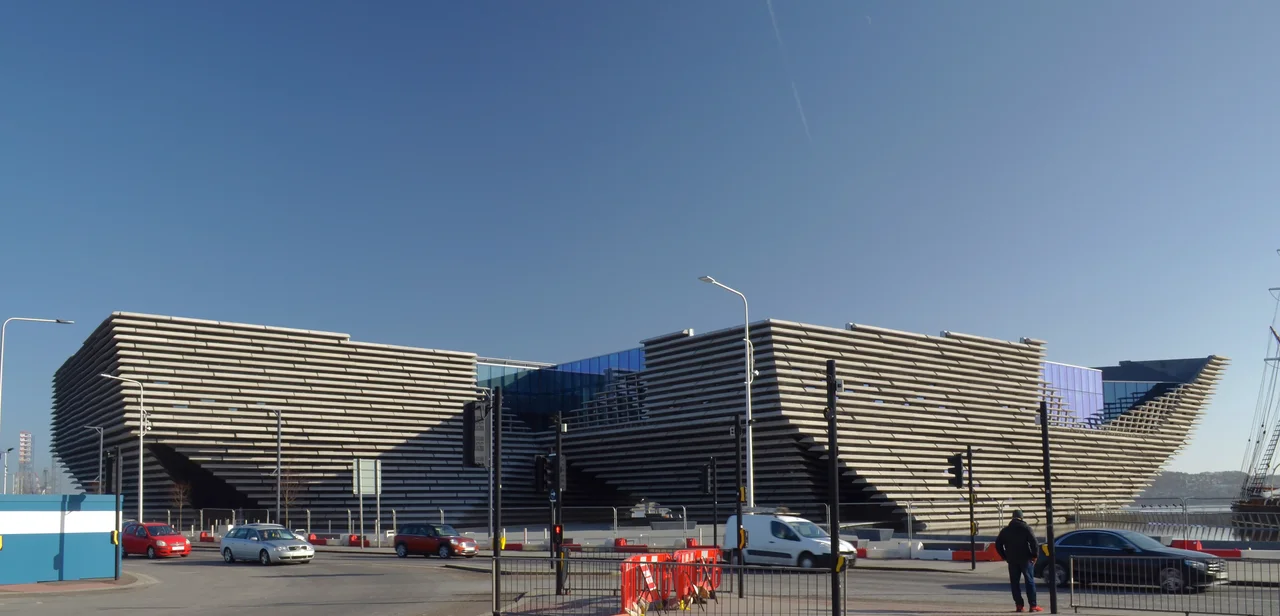

V&A Dundee
Kengo Kuma wanted a living room for the city. What he designed, perched at the edge of the Tay where the old Olympia Leisure Centre once stood, is something stranger: a building whose 780 tonnes of pre-cast grey concrete slabs are layered horizontally like the cliff edges of eastern Scotland, broken open in the middle by a great arched void that lets the river breathe through. Opened on 15 September 2018, V&A Dundee is the first Victoria and Albert museum outside London, the first design museum in Scotland, and Kuma's first building anywhere in the United Kingdom. The opening weekend drew a 3D Festival with Primal Scream and a not-yet-globally-famous Lewis Capaldi; 27,201 people came through the doors in the first week, 100,000 in the first three weeks. Whether it earns the £80.1 million it cost remains an argument the city is still having with itself.
An Idea That Started in a Pitch
The plan was born in 2007, in a conversation at the University of Dundee. Georgina Follett, then Dean of Duncan of Jordanstone College of Art and Design, suggested a V&A outpost in Dundee to the university's Principal, Sir Alan Langlands. Joan Concannon, the university's director of external relations, made a 20-minute pitch to Sir Mark Jones, then director of the V&A in London, framing the museum as an anchor for waterfront regeneration. Dundee had spent decades watching its jute mills empty and its docks fall silent. A design competition opened in 2010. Kuma won, then had to build it. BAM Construction started on site in April 2014. Engineers sank a cofferdam to let the outer wing cantilever over the Tay. The original 2017 opening slipped to 2018. The building was finished, broadly, on time for that schedule, and the city had a new front door.
Rescued Rooms and Rolling Galleries
The headline permanent piece is not by Kuma. Charles Rennie Mackintosh's Oak Room, completed in 1908 as a tearoom for Catherine Cranston on Glasgow's Ingram Street, sits inside the Scottish Design Galleries as a 13.5-metre-long double-height interior reassembled from over 700 original parts. Glasgow City Council had stored those pieces for more than fifty years; the £1.3 million restoration took sixteen months. Around it, the Scottish Design Galleries hold roughly 300 objects ranging from video game design to fashion, from healthcare to architecture, drawn from V&A collections and partners worldwide. Temporary shows have moved through quickly: Hello, Robot in 2019, Mary Quant pencilled in for April 2020 before COVID-19 closed the doors, then Tartan in 2023. In 2020 the museum re-labelled several historical exhibits to acknowledge their ties to Scottish involvement in colonialism and slavery, work the V&A continues alongside other Scottish institutions.
Boring or Brilliant
The reviews have never settled. Time magazine in 2019 named V&A Dundee one of the world's greatest places. The Scottish Design Award for Best Leisure/Culture Project followed the same year. Then came a counter-current: architects calling the building "silly" and "boring," describing the cavernous interior as too much circulation and too little exhibition space, criticising its accessibility for older visitors. As of October 2025, the museum sits 17th of 141 things to do in Dundee on TripAdvisor, with a middling 3.4-star rating. And yet, by its fifth anniversary in September 2023, the museum had welcomed 1.7 million visitors and generated, by its own accounting, £304 million for the Scottish economy and £109 million for Dundee specifically. In January 2024 it announced it would stage only one major exhibition a year as a cost-cutting measure. The arched void still frames the Tay. The cliff still sits there, contested, complicated, and exactly the conversation the city's waterfront was meant to start.
From the Air
V&A Dundee: 56.457°N, 2.967°W, on the north bank of the Firth of Tay just east of the Tay Rail Bridge and west of the Tay Road Bridge. From the air, the building reads as a sharply angled wedge with a deep central arch cutting through it, a striking dark form against the riverfront. Best viewed at 1,500–4,000 ft AGL. Nearest airport is Dundee (EGPN), 1.5 nm west; Edinburgh (EGPH) 30 nm south. The bridges flanking the museum make excellent navigation references along the Tay corridor.
Nearby Stories
- Battle of Dunkeld 7.2 km away
- Balgonie Castle 9.8 km away
- Bell Rock Lighthouse 10 km away
- Inverbervie 13 km away
- Battle of Dollar 14 km away
- Battle of Mons Graupius 16 km away
- HMS Pathfinder (1904) 23 km away