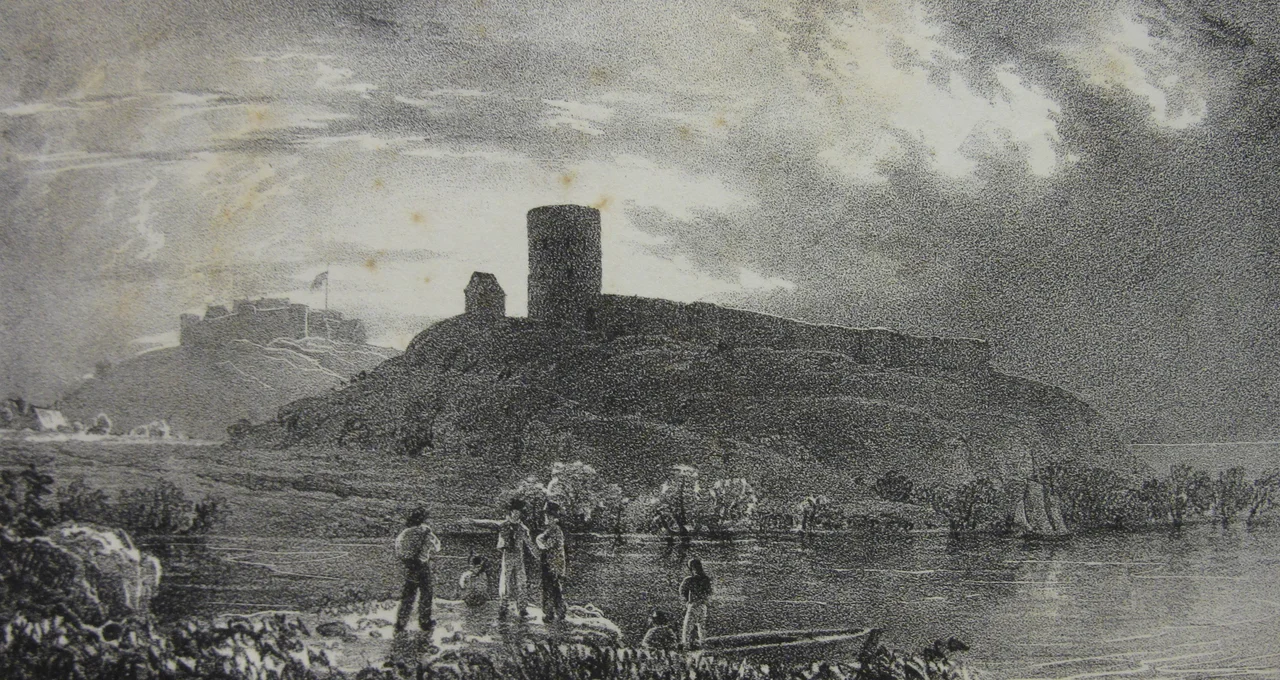

Vale Castle
The graves of Russian soldiers lie just inside the walls of Vale Castle on the northeast corner of Guernsey. They died in 1799 of disease, not battle, six thousand Tsarist troops quartered at nearby Delancey during the wars against revolutionary France and never quite acclimated to a Channel Islands winter. Around their bones run earthworks built in 600 BC by Iron Age hill people, curtain walls thrown up in the eleventh century by monks who had just driven off pirates, and concrete machine gun pits poured by the Wehrmacht in the 1940s. Few places stack three thousand years of military anxiety this neatly into a single hilltop.
Iron Age Bones
Long before there was a castle, the hill above what is now St Sampson's Harbour had a double ditch and bank, a fortified Iron Age site from somewhere between 500 and 600 BC. Archaeologists have found pottery from that period under both the medieval outer bank and beneath the fourteenth-century military buildings inside the walls. The hilltop made obvious sense as a refuge. To the south and east lay the sea; to the west, a tidal channel called the Braye du Valle once cut the entire northern part of Guernsey off from the rest of the island at high water. The Iron Age fort here is unique in Guernsey for its double bank, a sign that the people who built it took the threat from the sea seriously enough to dig twice.
Pirates and Monks
In 1061 pirates landed and pillaged Guernsey. The islanders complained to Duke William of Normandy, the same man who five years later would conquer England. William sent a knight, Sampson D'Anneville, who drove the pirates off with help from the local monastery. As thanks, D'Anneville and the monks divided half the island between them. The monastery's portion, Le Fief St Michel, included the hill above the harbor, and the monks built a castle on it as a refuge for the local population the next time pirates came. They called it the Castle of Saint Michael. During the English Channel naval campaign of 1338-1339, the French captured the castle and put its defenders to death. They held the island until the Battle of Sluys in 1340 crippled the French navy. In 1372 the Welsh claimant Owain Lawgoch led a French free company against Guernsey, killing four hundred islanders in the militia. The poem written about that fight, La Descente des Aragousais, called the castle the Chateau de l'Archange.
Russians, Cannons, and a Long Cold War
After the medieval centuries the castle settled into a long late life as a coastal artillery position. The American Revolutionary War, by making France a British enemy again, prompted new barracks and ramparts. The French Revolution brought one 24-pounder and two 9-pounder cannons to the walls and six thousand Russian troops to Delancey alongside as part of the European coalition against Napoleon. Disease did what the French had not, and the Russian graves at Vale Castle date from that winter. By the nineteenth century the castle was a backdrop more than a defense. Francis Grose engraved it in 1786. Joseph Mallord William Turner sketched it. Victor Hugo wrote it into Toilers of the Sea in 1866. The whole site was listed as a Protected Monument on 26 March 1938, just in time for a war that would treat it as functioning fortress again.
The Most Recent Layer
The Germans arrived in June 1940 and stayed five years. They saw the castle the way every previous occupier had, as the obvious hill from which to defend the eastern coast, and they fortified it. Tobruk pits, machine gun positions, a personnel shelter, a searchlight passage, a field gun emplacement: the bunkers are still there, threaded through the medieval curtain walls. Today the castle is open to the public without charge except on event days. The Vale Earth Fair, a music and arts festival, has been held here for more than forty years, the bass lines bouncing off the same walls that once echoed with cannon. You can walk through the German trenches, look down on Bordeaux Harbour, and stand a meter from where Russian soldiers were buried two centuries ago. The hill keeps adding layers. The view it watches has not really changed.
From the Air
Vale Castle sits at 49.4851 N, 2.5091 W on the northeast corner of Guernsey, overlooking St Sampson's Harbour to the south and Bordeaux Harbour to the east. From altitude the castle appears as an irregular curtain wall with six rounded towers on a low coastal hill, between two small harbors. Best viewed from 1,000 to 2,500 feet to see the castle in the context of the broader Vale parish and the former Braye du Valle channel, now drained and farmed. Nearest airport: Guernsey (EGJB), about 4 nautical miles southwest. The east coast of Guernsey is well-marked by St Sampson's harbor lights and Bordeaux's small marina. Watch for crossing channel ferry traffic between Guernsey and Herm.
Nearby Stories
- Pallot Steam, Motor & General Museum 29 km away
- HMS Affray 29 km away
- Operation Donnerkeil 29 km away
- German Submarine U-672 35 km away
- Action of 18 June 1793 60 km away
- Mont Saint-Michel: The Abbey That Becomes an Island Twice a Day 78 km away
- Basilica of Sainte-Therese, Lisieux 209 km away
- 1941 Santander Fire 642 km away