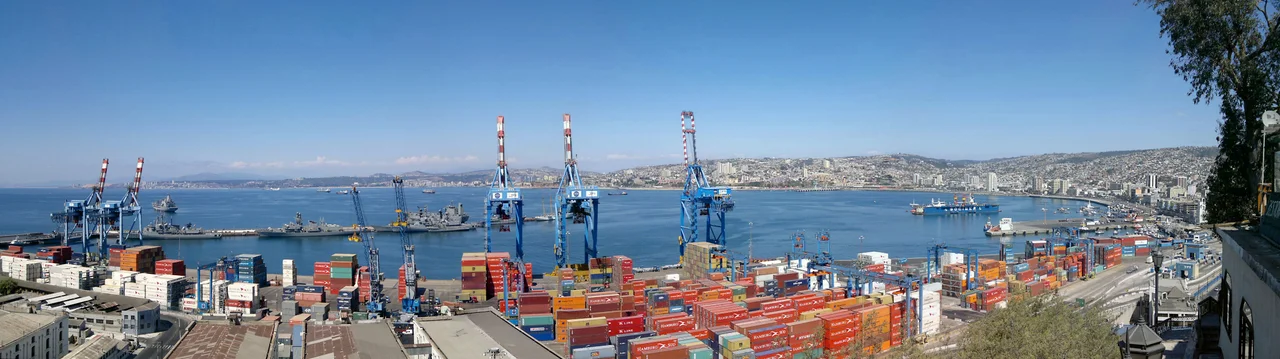

Valparaíso
Sailors had a nickname for it before the railroads and the cables and the UNESCO plaque: Little San Francisco. They meant the hills, the way the city seems to spill down forty-odd of them straight into the harbor, houses clinging to slopes too steep for streets. They meant the polyglot crowds, the British clubs and German schools and Italian newspapers all jostling along the waterfront. Valparaíso was the first great port a ship reached after rounding Cape Horn, and for the better part of a century the whole Pacific seemed to pass through its docks. Then the Panama Canal opened, the ships stopped coming, and the Jewel of the Pacific had to learn how to be something other than rich.
The Stairway City
There is almost no flat ground in Valparaíso. The narrow shelf along the water holds the banks, the customs houses, the naval headquarters that have stood here since 1817. Everything else goes up. To solve the problem of getting people from the plan to the cerros, the city built funiculars, the steeply inclined carriages locals call ascensores. The first climbed Cerro Concepción in 1883. By the 1930s roughly thirty of them threaded the hillsides, and sixteen survive today, creaking up gradients that would defeat any bus. In 1996 the World Monuments Fund named them among the hundred most endangered treasures on Earth. Ride one and you understand the whole city in two minutes: the harbor falling away beneath you, the corrugated-iron houses painted every color a hardware store ever stocked, the laundry strung between balconies that lean out over nothing.
Where the Ships Came First
Juan de Saavedra sailed into the bay in 1536 and named it after his home village in Spain, Valparaíso de Arriba. For three centuries it stayed a hamlet of a few houses and a church, occasionally sacked by English privateers. Francis Drake raided it in 1578. Everything changed with independence. As Chile opened to the world, ships rounding the continent needed a place to reprovision, and Valparaíso obliged. It supplied the California gold rush. It drew immigrants from Britain, Germany, France, Italy, and Switzerland, who settled the hills of Cerro Alegre and Cerro Concepción and built in the styles of home. They left behind a string of firsts: Latin America's oldest stock exchange, South America's first volunteer fire brigade, Chile's first public library, and El Mercurio de Valparaíso, founded in 1827 and still the oldest continuously published Spanish-language newspaper in the world.
After the Canal
When the Panama Canal opened in 1914, captains no longer needed the long, dangerous passage past the Strait of Magellan. Traffic drained away. Wealthy families abandoned their hillside mansions, and the twentieth century became a slow retreat. The earthquakes did not help; the 1906 quake alone killed thousands. Yet decline left something behind that prosperity might have erased. Nobody had the money to tear down the old quarters and start over, so the labyrinth of alleys and the painted houses simply stayed. Beginning around 2000, artists and students and small-time entrepreneurs began moving into the cheap, beautiful, crumbling hills. Murals climbed the walls. In 2003 UNESCO declared the historic quarter a World Heritage Site, recognizing exactly the improvised, unplanned cityscape that earlier eras had considered a problem.
The Fire and the Festival
Living on these slopes has always carried risk. In early February 2024, a wildfire swept out of the hills above the city and through its dense neighborhoods with terrible speed. The official toll reached 136 dead, the deadliest fire in Chilean history and the worst disaster to strike the country since the 2010 earthquake and tsunami. Whole hillsides of homes vanished in an afternoon, and the city is still grieving and rebuilding. Yet Valparaíso endures the way it always has. Each March the neighboring resort of Viña del Mar hosts the song festival that draws performers and crowds from across the Spanish- and English-speaking worlds, filling the whole metro area. And every New Year's Eve, the people climb to the miradores and watch fireworks burst over the bay where the ships once anchored, ten million tons of cargo and a city's whole strange history riding on the water below.
From the Air
Valparaíso sits at 33.05°S, 71.62°W on Chile's central Pacific coast, about 120 km northwest of Santiago. From the air the city reads as a dense amphitheater of hills wrapped around a working harbor, with the gridded plan along the waterfront giving way abruptly to the tangle of the cerros. A viewing altitude of 3,000 to 5,000 feet shows both the port and the hillside neighborhoods; higher passes reveal the conurbation with Viña del Mar just to the north. The nearest airfields are the regional strip at Viña del Mar / Concón (SCVM) a short hop north and Santiago's Arturo Merino Benítez International (SCEL) inland to the east. The coast here enjoys a mild Mediterranean climate, but morning fog off the cold Humboldt Current is common most of the year and can hide the hills until midday.
Nearby Stories
- Battle of Papudo 24 km away
- Casa de Isla Negra 28 km away
- Battle of Chacabuco 31 km away
- Battle of Maipú 38 km away
- Aconcagua 94 km away
- Constitución, Chile 237 km away
- Santa Olga 278 km away
- 1687 Peru Earthquake 1982 km away