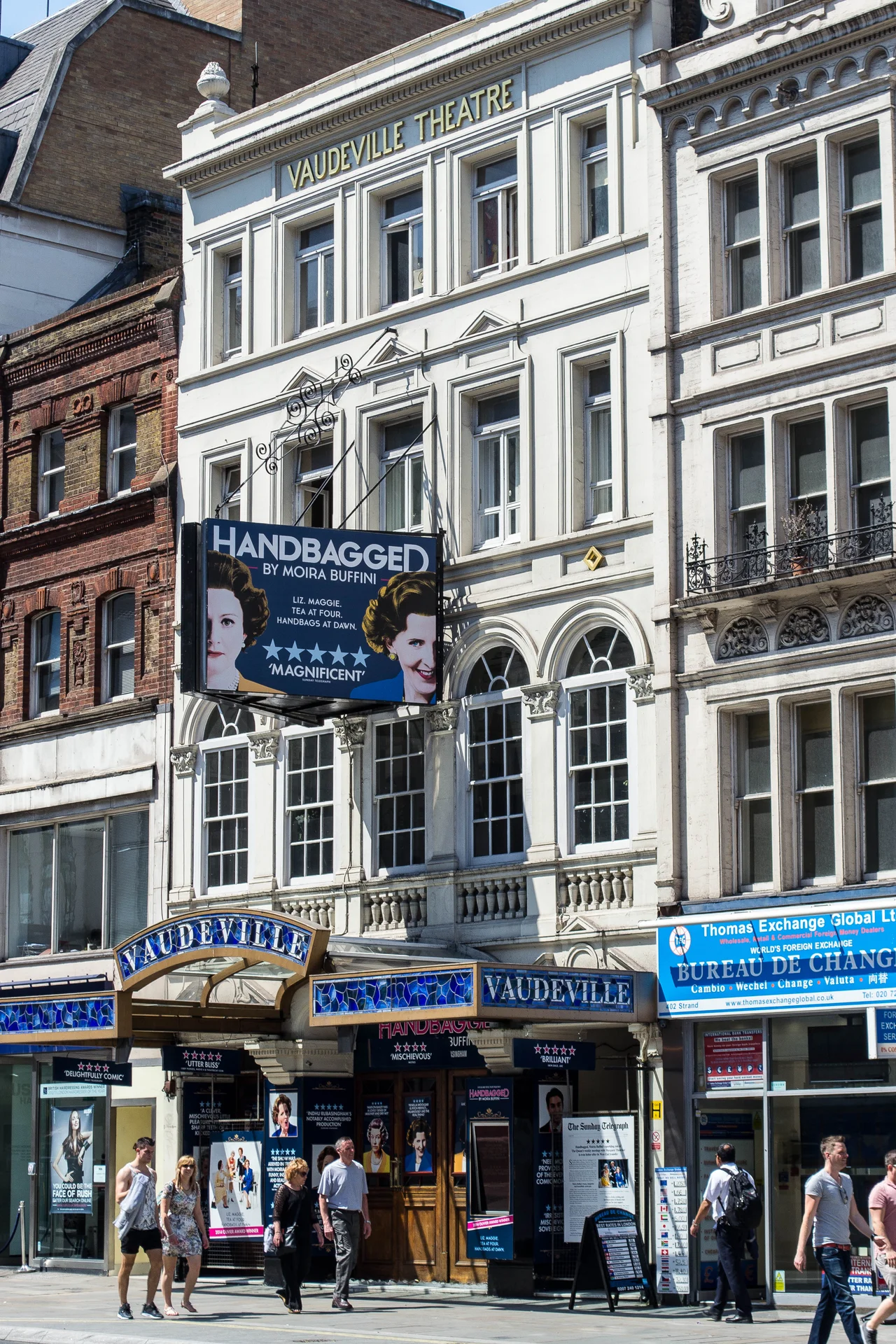

Vaudeville Theatre
Imagine being a London bus conductor in 1875, calling out stops on the route along the Strand. You reach the Vaudeville Theatre and you do not say "Vaudeville Theatre." You say "Our Boys!" - because the comedy by H. J. Byron that opened at the Vaudeville earlier that year was the first theatrical production in world history to pass 500 consecutive performances, then went on to break 1,000. Everyone knew where Our Boys was playing. Nobody needed reminding the building was called the Vaudeville. That kind of run-away success was so rare in the 1870s that the conductors made the building synonymous with the show. The Vaudeville is small - it seats 690 today - and has always punched above its weight. The current resident production, Six the Musical, sits in the same tradition: short, sharp, sold out, the kind of show that defines a building.
Robertson's Billiard Hall
The land at 404 Strand belonged to William Wybrow Robertson, who had tried to make money running a billiard hall on the site and failed. In 1869 he hired the prolific theatre architect C. J. Phipps - Phipps designed dozens of British theatres in his career - to build a playhouse instead. The decoration was Romanesque in style, executed by George Gordon. It opened on 16 April 1870 with Andrew Halliday's comedy For Love or Money and a burlesque, Don Carlos or the Infante in Arms. Robertson did not run it himself; he leased it to three actors, Thomas Thorne, David James, and H. J. Montague. The original building sat behind two houses on the Strand and was entered through a maze of small corridors. The auditorium was a horseshoe with a pit and three galleries, seating 1,046. The site was cramped front and back. One innovation made it notable: concealed footlights designed to extinguish automatically if the protecting glass broke - in an age of gaslight, this was a safety advance theatres badly needed.
Henry Irving and Our Boys
Henry Irving, who would become the most famous English actor of the Victorian era, had his first conspicuous success at the Vaudeville in 1870. He played Digby Grant in James Albery's Two Roses, and the production ran for 300 nights - an enormous run for the period. Five years later, in 1875, H. J. Byron's comedy Our Boys opened and refused to close. It ran for over 1,000 consecutive performances, the first show in the world ever to do so. This was such a phenomenon that London life adjusted around it - hence the bus conductors. In 1882 Thomas Thorne became the sole lessee. In 1889 he demolished the two houses in front and built a new foyer block in Adamesque style behind a Portland-stone facade on the Strand. The four-storey frontage you see today dates from then, as does the preserved foyer. The theatre reopened on 13 January 1891 with Jerome K. Jerome's comedy Woodbarrow Farm.
Quality Street and the Edwardian Hits
From 1900 to 1925 the Vaudeville ran successive long-running hits. Quality Street, a comedy by J. M. Barrie (the same Barrie who wrote Peter Pan), opened in 1902 and ran 459 performances - notable because it had failed in New York the previous year, lasting only 64 performances, and London's success made it one of the first plays to triumph more in Britain than in America. In 1904 the actor-manager Seymour Hicks and his collaborator Cosmo Hamilton wrote The Catch of the Season, a musical comedy based on Cinderella, which ran 621 performances. Zena Dare created the role of Angela when Hicks's wife Ellaline Terriss had to withdraw due to pregnancy. The Belle of Mayfair followed in 1906 (431 performances), composed by Leslie Stuart. The Girl in the Train arrived in 1910 - an English adaptation of Leo Fall's Viennese operetta Die geschiedene Frau. During and after the First World War the theatre stuck mostly to musical revues - Cheep (1917), Just Fancy (1920), Rats (1923). Audiences wanted light entertainment, and the Vaudeville knew its audience.
The 1926 Reconstruction
On 7 November 1925 the Vaudeville closed for a complete interior reconstruction designed by Robert Atkinson. The horseshoe auditorium was replaced with a rectangular one. The capacity dropped to just over 700. A new dressing-room block with an ornate boardroom extended the building back to Maiden Lane. The theatre reopened on 23 February 1926 with a revue by Archie de Bear called R.S.V.P. - the final rehearsal was broadcast live by the BBC, an early experiment in radio theatre. After the Second World War, William Douglas Home's play The Chiltern Hundreds ran 651 performances. The long-running musical Salad Days, composed by Julian Slade, premiered at the Bristol Old Vic in 1954 but transferred to the Vaudeville and broke the record for the longest theatrical run in history to that point. Arnold Wesker's Chips with Everything opened here in 1959. Early stage mechanisms survive backstage from the 19th-century building - rare thunder drums (cannonballs rolled in wooden boxes to simulate thunder) and lightning sheets (metal sheets shaken for the lightning sound), the kind of pre-electrical sound effects that have been removed from most British theatres.
Stomp, Six, and Survival
A Greater London Council redevelopment plan in 1968 nearly demolished the Vaudeville along with several neighbouring theatres - the Adelphi, Garrick, Lyceum, and Duchess. The Save London Theatres Campaign, backed by the actors' union Equity and the Musicians' Union, stopped the demolition. From 2002 to 2007 the dance company Stomp lived in residence. Since 2005 the theatre has been managed by Nimax Theatres. Recent runs have included David Suchet in The Importance of Being Earnest in 2015, Patricia Routledge transferring from Chichester in 1999, and Kit Harington and Johnny Flynn in True West in late 2018. Six - the pop musical that imagines the six wives of Henry VIII as a girl group, written by Toby Marlow and Lucy Moss when they were Cambridge undergraduates - opened at the Vaudeville on 29 September 2021 and is currently booking through January 2027. The Vaudeville is Grade II listed. The foyer and the Portland-stone Strand facade are both protected. The building sits between Charing Cross and Embankment tube stations, on the slice of the Strand that has been London's theatre district for four centuries. The bus conductors no longer call the stops by the name of the show. But the bus still stops there. The lights are still on.
From the Air
Vaudeville Theatre at 51.5103°N, 0.1225°W sits on the Strand in the City of Westminster, between Southampton Street and Bedford Street. Best viewed at low altitude. Trafalgar Square lies west, Covent Garden north, the Thames south. Nearest tube stations are Charing Cross and Embankment.
Nearby Stories
- Stevenage 5.7 km away
- Malling Abbey 5.7 km away
- 1952 Farnborough Airshow Crash 7.7 km away
- Ingatestone Hall 8.2 km away
- Hellfire Caves 9.1 km away
- The Carrington Event: The Solar Storm That Could Happen Again 9.8 km away
- Bletchley Park 16 km away
- Castle Hedingham 23 km away