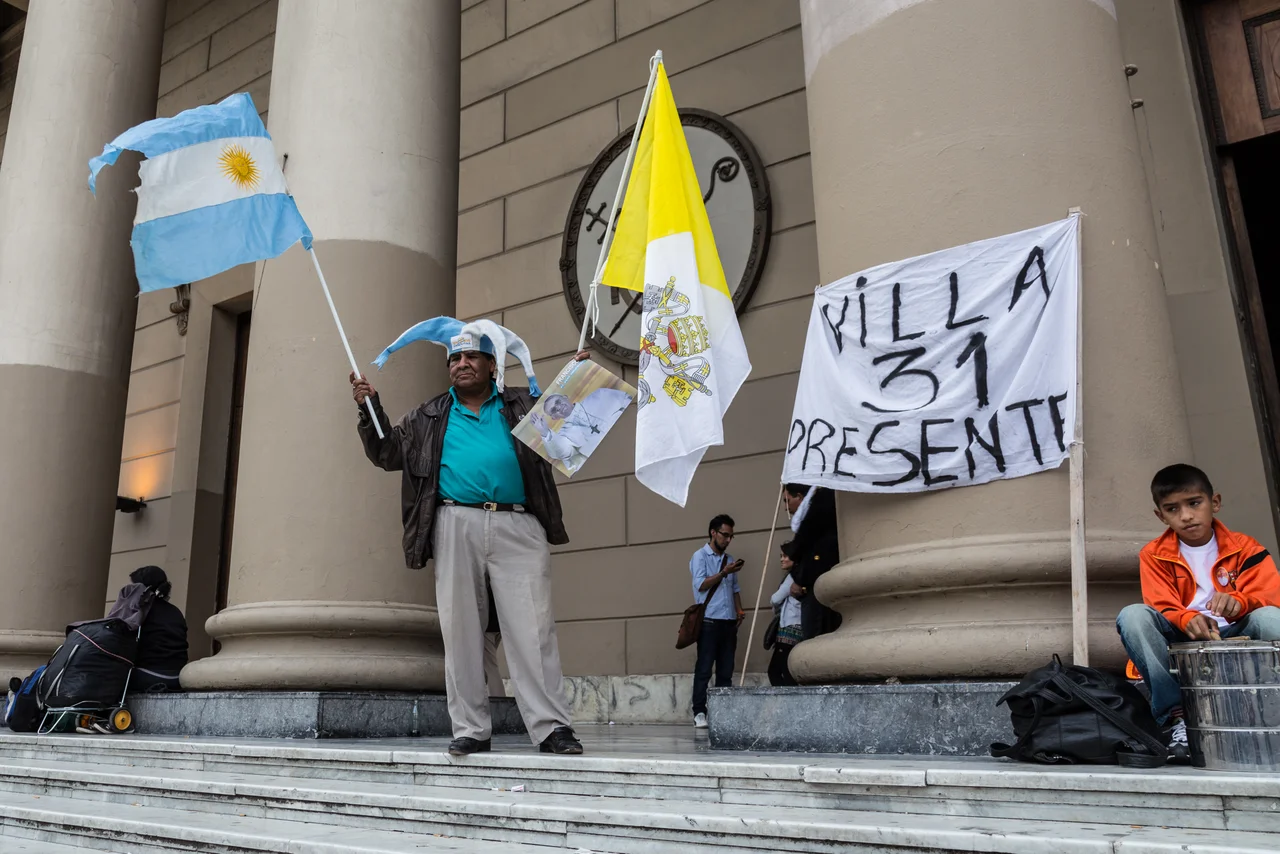

Villa 31
From the highway that arcs above it, the contrast is impossible to miss: on one side, the glass towers and manicured parks of one of South America's wealthiest districts; on the other, a dense warren of self-built homes climbing over one another in brick and concrete. This is Villa 31, and the families who live here are not a backdrop to the city's prosperity. They are its workers, its vendors, its bus drivers and builders, a community of tens of thousands that grew in the very heart of Buenos Aires because the heart of the city was where the work was.
Refuge by the Port
The first families arrived in 1932, in the long shadow of the Great Depression. The land near the Port of Buenos Aires was government-owned and undeveloped, and the government, eyeing future plans for offices and universities, had left it empty. People moved in because the port meant jobs and the railway meant the rest of the country was close. They came from Argentina's poorer northern provinces, and they came from across the borders too, from Bolivia, Paraguay, Peru. That mix of origins became the neighborhood's defining trait. Early shelters were patched together from zinc and cardboard; even decades later, some residents still made homes in disused railway wagons parked near the tracks.
The Names They Chose
A place fights for dignity partly through what it calls itself. In the lean years, residents named their neighborhood Villa Esperanza, Hope Village, and Villa Desocupación, the village of the jobless, holding both their circumstances and their stubbornness in the same breath. Authorities tried to remove them more than once. Every eviction failed, and the settlement kept expanding, a small city taking shape inside a larger one. Each surge of growth tracked the country's recurring economic crises, and each push to demolish it tracked the ambitions of governments and, during the dictatorship, of generals who wanted the poor swept out of sight.
The Priest of Villa 31
No one is more bound to this neighborhood than Father Carlos Mugica. Born in 1930 into a comfortable Buenos Aires family, he gave up that comfort to become the villa's first resident priest, founding the parish of Cristo Obrero, Christ the Worker, and throwing himself into the fight against the slum's eradication. He paid for it with his life. On May 11, 1974, gunmen from the right-wing death squad known as the Triple A shot him after he had finished saying mass. He was forty-three. In 1999 his body was moved from an elite cemetery to the Cristo Obrero parish in the villa, returned to the people among whom he had done his greatest work. Many now call the neighborhood Barrio Padre Mugica in his memory. The tradition of priests standing with the villa's residents outlasted him: years later, the Archbishop of Buenos Aires, Jorge Mario Bergoglio, the future Pope Francis, celebrated mass at the parish in solidarity with the slum priests who carried on Mugica's work.
A Neighborhood, Officially
For most of its life, Villa 31 existed in a legal limbo, a community everyone knew and no map fully acknowledged. That began to change when the city government formally recognized its legality and launched an ambitious integration plan, financed in part by the World Bank and the Inter-American Development Bank. The roughly 320-million-dollar effort aimed to bring in electricity, water and sewage, to give residents a path to actually owning their homes, and even to extend the Buenos Aires Underground into the neighborhood. The plan drew its skeptics. Some warned of gentrification, of a community improved until its own people could no longer afford to stay. Nearly a third of residents feared they would not be rehoused. As the integration advanced, the outside world arrived in small, telling ways: a McDonald's opened in the neighborhood and hired residents to staff it, and during the 2018 Summer Youth Olympics, Buenos Aires placed some sports and training facilities here. The villa has long since entered the country's imagination too, inspiring the hit telenovela La 1-5/18 and the novel La Villa by the celebrated writer Cesar Aira. The work continues, and so does the central question the villa has always posed to the city around it: who does Buenos Aires belong to?
From the Air
Villa 31 sits at 34.584°S, 58.378°W, immediately northwest of the Retiro railway and bus terminals in central Buenos Aires, hard against the Río de la Plata waterfront and the elevated Illia highway. From the air it reads as a dense, tightly packed cluster of low rooftops pressed between the rail yards and the upscale towers of Recoleta and Puerto Madero. Best identified by its sharp contrast with the open green space and high-rises that surround it. Aeroparque Jorge Newbery (SABE) lies about 2.5 km north along the coast; Ezeiza International (SAEZ) is roughly 30 km to the southwest.
Nearby Stories
- Ezeiza Massacre 1.9 km away
- Luján, Buenos Aires 5.1 km away
- Curutchet House 13 km away
- Colonia del Sacramento 17 km away
- Martín García Island 28 km away
- Atucha Nuclear Power Plant 37 km away
- Lobos 43 km away
- Cry of Asencio 87 km away