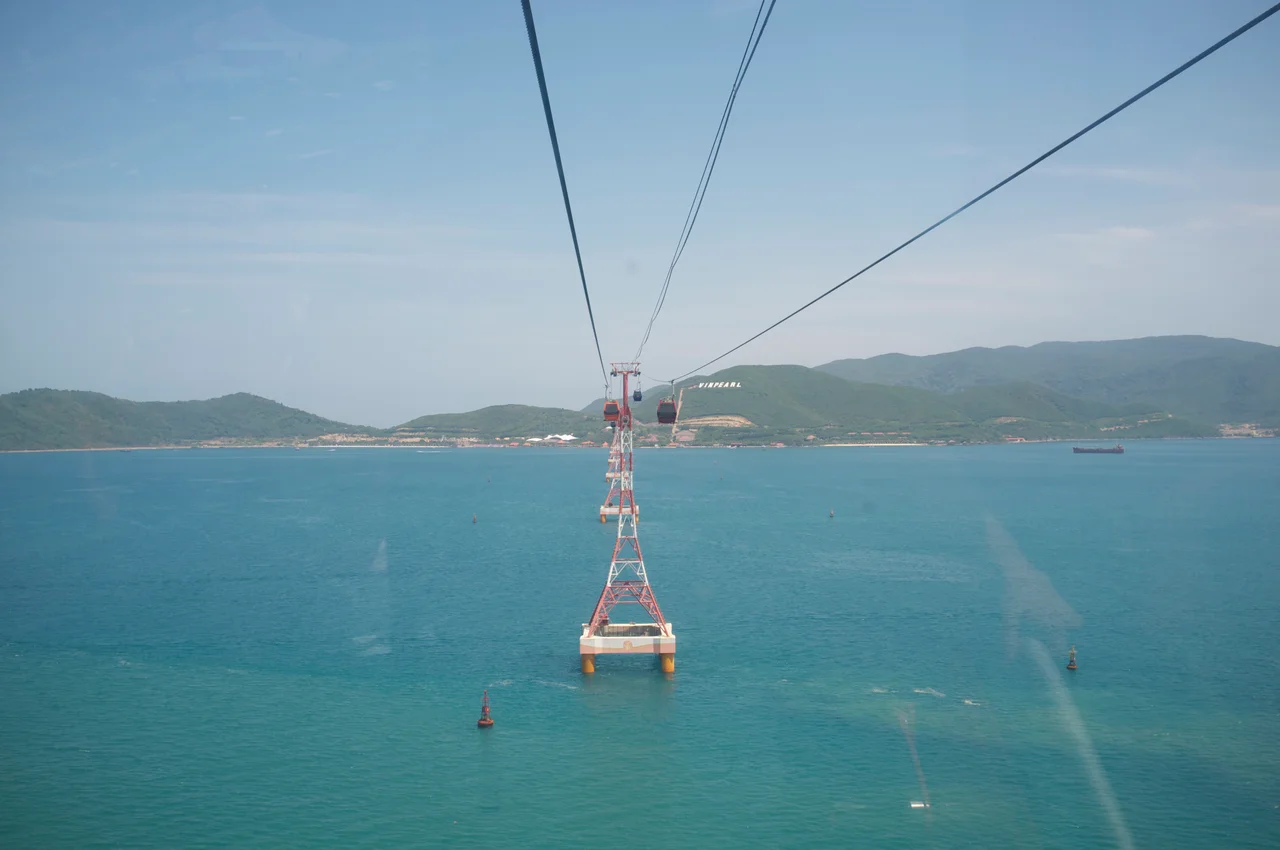

Vinpearl Cable Car
Seven towers stand in the sea between the Nha Trang shoreline and Hon Tre Island. They rise out of open water — no pier connecting them to land, no causeway running beneath them — each one sunk into the seabed on four steel pipe piles drilled as deep as 94 metres into the bedrock. The tallest reaches 115 metres above the waterline, with another 40 metres of its structure hidden below the surface. This is not the kind of engineering you can hide.
Built in Twelve Months
The Vinpearl Cable Car spans 3,320 metres from the Nha Trang terminal to Hon Tre Island, making it one of the longest over-water cable car runs in the world when it opened. French company POMA designed and supplied the gondola lift system. The foundations and towers were built by two Vietnamese construction companies — Kim Do Thanh built the pile foundations, Nam Dong Duong erected the towers — with consulting services from KhanhHoa Public Works Consultant Company. The entire project, from groundbreaking to operating gondolas, was completed in twelve months. The 52-millimetre stainless steel main cable stretched across the bay, carrying gondola cabins on a one-way journey of approximately fifteen minutes, depending on wind conditions. Total construction cost came to 240 billion Vietnamese dong.
Engineering in Open Water
The challenge of building in the South China Sea is not just the water — it is everything the water does. Typhoons track regularly through this part of Vietnam. The seabed is soft sediment over bedrock that can lie 74 to 94 metres down. The average depth of the bay in the crossing zone runs around 25 metres. Each of the seven towers is supported by four steel pipe piles, each pipe 2,500 millimetres in diameter and filled with reinforced concrete, anchored to bedrock far below. The structure was engineered to withstand earthquakes up to magnitude 7 on the Richter scale. Looking at the towers from a passing boat, their Eiffel-type lattice silhouettes rising from the water are incongruous and somehow elegant — a piece of infrastructure that is also, unavoidably, a spectacle.
The Crossing
The gondola ride from Nha Trang to Hon Tre Island passes through a panorama of the bay. Below the cabin, the South China Sea runs in shades of turquoise and deep blue. Behind, the city's crescent waterfront curves away. Ahead, Hon Tre grows from a green smudge to an island with a beach, a resort complex, and the forested interior that gives it a different character from the urban shore. The fifteen-minute crossing is long enough to appreciate the scale of what it crosses: 3.3 kilometres of open water, served by seven towers that hold a cable connecting two worlds — the mainland city and an island that, without this span, would require a boat and a different kind of patience. The cable and gondolas have at times been removed for maintenance or operational reasons; visitors should confirm current service status before planning a crossing.
Looking Back at the Shore
From the midpoint of the crossing — the highest point of the gondola's arc — Nha Trang appears as a long line of white buildings along a beach that stretches for several kilometres. The mountains behind the city close the view to the west, their forested ridges running parallel to the coast. On a clear day the views extend north and south along the coastline of Khánh Hòa Province, one of central Vietnam's most striking stretches of sea and mountain. The cable car has become one of the most recognizable images of Nha Trang, those seven towers rising from the bay in a row as regular as a musical phrase. They are visible from the beach, from the hotels, from the road along the waterfront — a constant reminder that the island offshore is connected, however improbably, to the city by a cable stretched through open air.
From the Air
The Vinpearl Cable Car runs from approximately 12.201°N, 109.214°E at the Nha Trang shore terminal to Hon Tre Island to the east-southeast. The seven offshore towers form a clearly visible line across the bay when viewed from above at 1,000 feet AGL or higher. Approaching from the north along the coast, the towers appear as a row of lattice structures standing in open water south of the city center. Cam Ranh International Airport (VVCR) is approximately 30 km to the south. Nha Trang Air Base (VVNT) lies about 4 km north-northwest of the cable car's shore terminal. The towers present a potential low-level hazard: the tallest reaches 115 metres above mean sea level. Pilots operating VFR below 1,500 feet in the bay area should be aware of the cable car alignment.
Nearby Stories
- Cam Ranh 5.1 km away
- Linh Phước Temple 15 km away
- Đà Lạt Plateau 25 km away
- Chư Yang Sin National Park 49 km away
- Vũng Rô Bay 52 km away
- South-East Asian Theatre of World War II 220 km away
- Kashmir Princess 361 km away
- Battle of the Paracel Islands 494 km away