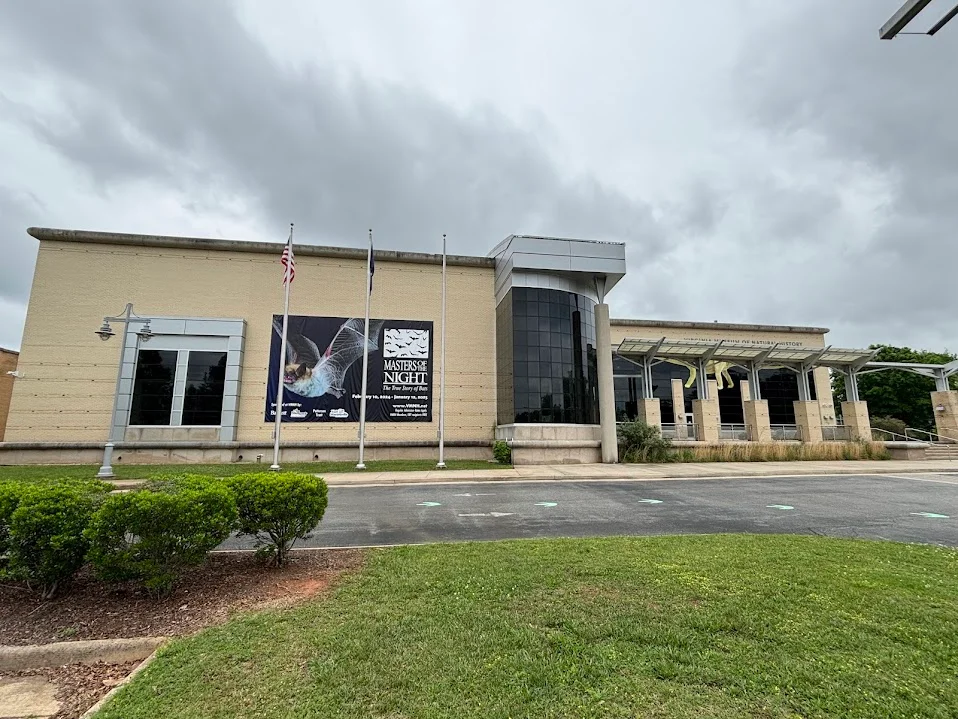

Virginia Museum of Natural History
The stromatolite is more than five feet across and weighs more than two tons - a fossilized cabbage of ancient blue-green bacteria, preserved for hundreds of millions of years and now mounted in a museum gallery in a small Virginia city most travelers cannot point to on a map. Visitors walk past it on their way to the Allosaurus skeleton overhead and miss what they have just seen. The stromatolite head is the largest complete specimen of its kind ever found in Virginia, possibly one of the largest complete heads in the world. It is also one of those objects that explains why the Virginia Museum of Natural History exists - and why the choice to put it in Martinsville rather than Richmond or Charlottesville turns out, on reflection, to make perfect sense. The museum is the official natural history museum of the Commonwealth of Virginia. It opened to the public in 1985, became a state agency in 1988, has been accredited by the American Alliance of Museums since 1994, and holds more than 22 million catalogued items - including the stromatolite, the Allosaurus, a 14-million-year-old baleen whale, and a Pteranodon hanging in the same hall.
The Boaz Foundation
In 1984 Dr. Noel T. Boaz and Dr. Dorothy Dechant Boaz - paleoanthropologists by training - founded what they called the Boaz Foundation as a private institution. On June 2, 1985, they opened the doors to the public under a new name: the Virginia Museum of Natural History. The location was Martinsville, a small Southside city better known for sweatshirts than for natural history. The choice made the museum unusual from the start: most state natural history museums are placed in capital cities or major university towns. Three years later, in 1988, the Virginia General Assembly - with Speaker A.L. Philpott, himself from Henry County, leading the push - made the museum an agency of the Commonwealth. It moved out of a former school building in 2007 into the current 100,000-square-foot facility. The American Alliance of Museums accredited the museum in 1994 and re-accredited it in 2010, a distinction held by fewer than five percent of American museums.
The Hall of Ancient Life
The first thing visitors see beyond the ticket booth is the Harvest Foundation Hall of Ancient Life - a soaring space lit by skylights and dominated by mounted skeletons. An Allosaurus, the late Jurassic predator that hunted the western interior of North America around 150 million years ago, stands in front of you. Above your head hangs the skeleton of a 14-million-year-old baleen whale - a fossil from the Calvert Cliffs of Chesapeake Bay, the great Miocene marine deposit that runs along Virginia's coastline. A Pteranodon, the toothless pterosaur with a wingspan up to 23 feet, rounds out the assembly. The stromatolite mentioned at the start sits at floor level. Six rotating column cases display smaller fossils from current research. The lab windows along one wall let you watch museum scientists at work on specimens being prepared for the collections. The hall is a working introduction to deep time.
Uncovering Virginia
The most distinctive gallery in the museum is called Uncovering Virginia, and it does something most natural history museums do not attempt. The exhibit recreates six actual research sites in the Commonwealth where VMNH scientists have worked - from a 700-million-year-old Precambrian outcrop to a 300-year-old colonial archaeological dig. At each station you see what the site looks like today, examine actual or reproduction fossils and artifacts using the tools the scientists used, and watch a short animation that brings the place back to its original time and ecology. The effect is to make Virginia itself the subject: not a museum about dinosaurs that happens to be in Virginia, but a museum about how scientists read this particular landscape across vast spans of time. The galleries surrounding it - How Nature Works, the Hahn Hall of Biodiversity, the Fossil Overlook, the Discovery Reef for young children - extend the theme outward from Virginia into the world.
Twenty-Two Million Items
Behind the public galleries, the museum's research collections hold more than 22 million catalogued items. The departments include Invertebrate Paleontology, Vertebrate Paleontology, Recent Invertebrates, Archaeology, Mammalogy, Marine Science, and Earth Science. The number is staggering for a state museum operating in a small city; most state collections that large live in much larger metropolitan institutions. The Hahn Hall of Biodiversity, opened in 2010, features the African mammal collections donated by Dr. Thomas Marshall Hahn Jr., President Emeritus of Virginia Tech. Researchers from around the world draw on the collections by appointment. The reach of the museum thus extends far beyond the visitors who walk through. A specimen catalogued in Martinsville may be referenced in a paper written in Beijing or Stuttgart, a quiet kind of influence that the building itself does not advertise.
Smithsonian Affiliate in a Small Town
The Virginia Museum of Natural History is affiliated with the Smithsonian Institution - one of the perks of being a state museum at this caliber, and a relationship that pulls traveling exhibits and research collaborations to a city that would not otherwise see them. The museum runs a deep education program: school groups, after-school programs through the Martinsville-Henry County After 3 Program, Adventure Camps in the summer, sleepovers, scout badges, and teacher-training programs in science and STEM education. The choice to put a major state museum in Martinsville rather than a larger city has paid off in ways that the founders may not have fully imagined: students who grow up in Henry County have a working natural history museum within driving distance, with actual research scientists and an Allosaurus and a stromatolite that is older than nearly anything else in the building. That access matters. A small city with a great museum is doing something a large city with a great museum cannot match: democratizing the wonder.
From the Air
The Virginia Museum of Natural History sits at 36.687 north, 79.863 west, just east of downtown Martinsville. Blue Ridge Airport (KMTV) is about nine miles away for general aviation. Larger airports: Roanoke (KROA) about 51 miles north, Piedmont Triad International (KGSO) about 48 miles south. The museum building itself is recognizable from the air as a low modern structure set among trees east of downtown Martinsville, near the Smith River.
Nearby Stories
- Ferrum College 4.1 km away
- Wreck of the Old 97 8 km away
- Pulaski County, Virginia 24 km away
- Chang and Eng Bunker 24 km away
- Chinqua Penn Plantation 25 km away
- Battle of Shallow Ford 34 km away
- Pyle's Massacre 37 km away
- Red Hill Patrick Henry National Memorial 51 km away